

TL;DR
To follow up on a cold email, send your first follow-up two to three business days after no reply, then space three to five more touches across two to three weeks. Keep each message under 75 words, add new value every time, and end with one clear, low-friction ask.
- Send 3 to 5 follow-ups (4 to 6 total touches). Most replies come after the first email, not from it.
- Wait 2 to 3 business days before the first follow-up, then widen the gap with each send.
- Change the angle every time: a reminder, then value, then proof, then a polite breakup.
- Follow-ups only work if they reach the inbox, so warm up your domain before you scale.
You sent a sharp, personalized cold email to a perfect-fit prospect. Then nothing. No reply, no rejection, just silence. Most senders read that silence as a polite no and move on to the next name on the list. That single habit quietly wastes more pipeline than any bad subject line ever will.
The numbers are blunt. Backlinko analyzed 12 million outreach emails and found that 91.5% of them are ignored. A first email rarely lands at the right moment. Your prospect is in a meeting, buried under 200 unread messages, or simply not ready to think about it. The reply you wanted is usually sitting one or two follow-ups away.
In this guide, you’ll learn when to send a cold email follow-up, how many to send, and the cadence that keeps you in front of a prospect without annoying them.
You’ll get a full follow-up sequence, five copy-paste templates for the no-response situation, and a fix for the one problem that quietly kills most follow-ups: deliverability.
Table of Contents
Why Do Cold Email Follow-Ups Matter So Much?
Cold email follow-ups matter because the first email almost never gets the reply. A single follow-up can lift responses by roughly two-thirds, and sending several messages to the same contact can double your total replies. Persistence, not the perfect opening line, drives most cold outreach results.
A cold email follow-up is a short, polite message sent to a prospect who did not reply to your initial outreach, written to resurface your offer and prompt a response. It is the engine of outbound sales, and the data backs that up:
- 91.5% of outreach emails are ignored, so a single send is a coin flip you usually lose (Backlinko, 12 million emails).
- Sending just one extra follow-up lifts replies by 65.8% (Backlinko).
- Emailing the same contact multiple times leads to 2x more responses overall (Backlinko).
- A 2026 analysis of more than 53 million cold emails found that around 40% or more of all replies come from follow-ups, not the first email.
The reason is simple. Inboxes are noisy, attention is short, and timing is luck. A follow-up gives a busy prospect a second and third chance to notice you, which is why outbound is a game of sequences, not single sends.
When Should You Send a Cold Email Follow-Up?
Send your first cold email follow-up two to three business days after the original, not the next morning and not a week later. That window gives a busy prospect time to surface your email naturally while your message is still recent. After the first follow-up, widen the gap between each send.
A reliable spacing pattern looks like this:
- First follow-up: 2 to 3 business days after the initial email.
- Second follow-up: 4 to 5 days after that.
- Later touches: roughly weekly, so the thread stays warm but never crowds the inbox.
Two timing details matter more than people expect. Send during the prospect’s local business hours, since a mid-morning send on a Tuesday through Thursday tends to land better than a Friday afternoon. And do not let the gap stretch past a week or so, because the context of your first email fades, and the follow-up reads as a fresh, cold pitch instead of a reminder.
How Many Times Should You Follow Up on a Cold Email?
Follow up three to five times after your first cold email, for a total of four to six touches. Backlinko found that sending three or more messages produces the best overall response rate, but replies fall and spam complaints climb once you push much further. Stop the moment you get a clear no or run out of value to add.
Match the number of touches to the prospect:
- High-value, well-researched prospects: use the full 5 to 6 touch sequence. The deal is worth the effort.
- Broad or lightly qualified lists: 3 to 4 touches is plenty before you move on.
- Anyone who replies, even a soft no: stop the automated sequence and switch to a human reply.
There is a hard ceiling. Past five or six touches, you are not persistent, you are a nuisance, and recipients start marking you as spam. That damages your sender reputation and quietly hurts every future campaign, so discipline protects more than just one prospect.
What Does a Good Cold Email Follow-Up Sequence Look Like?
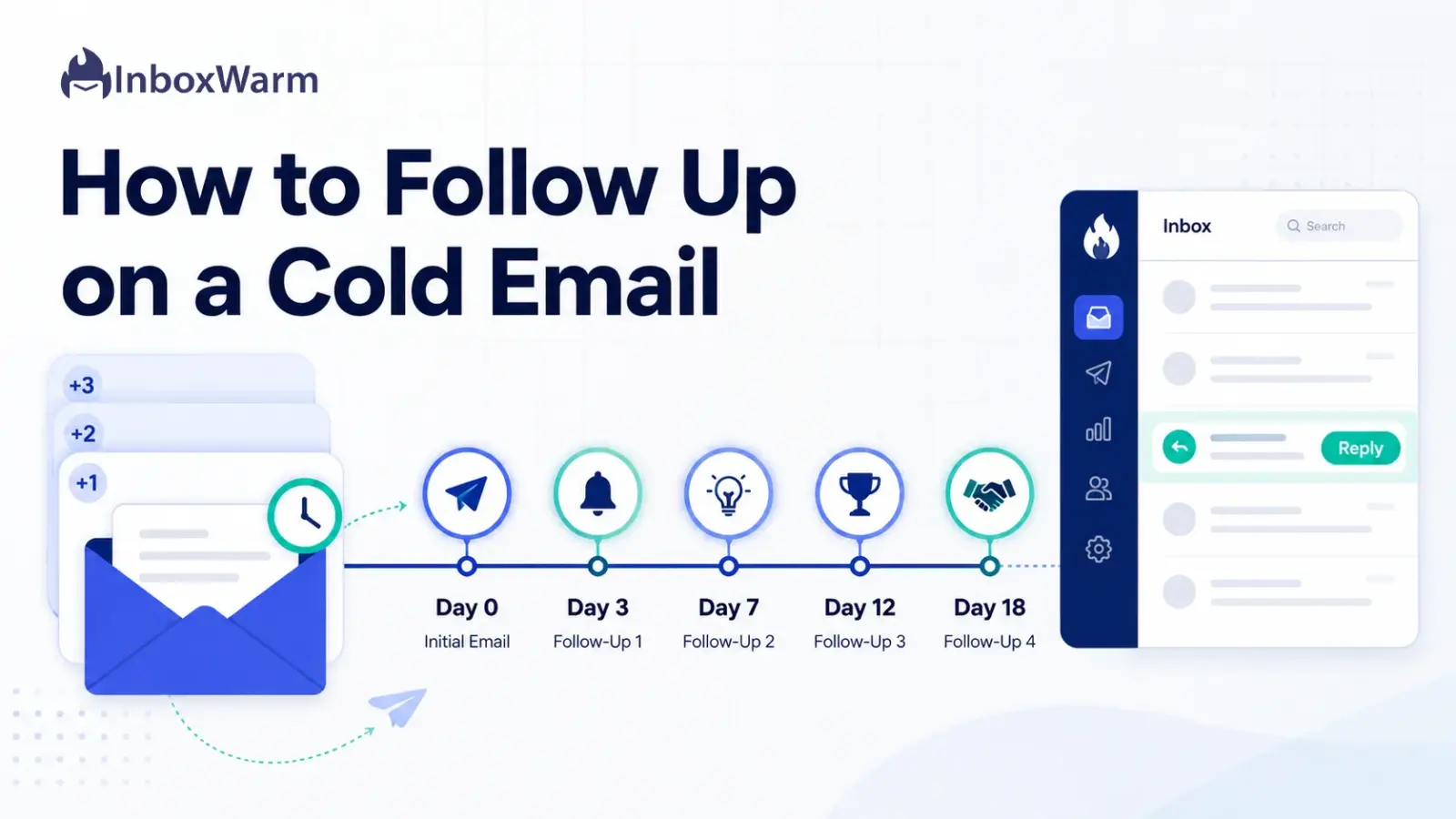
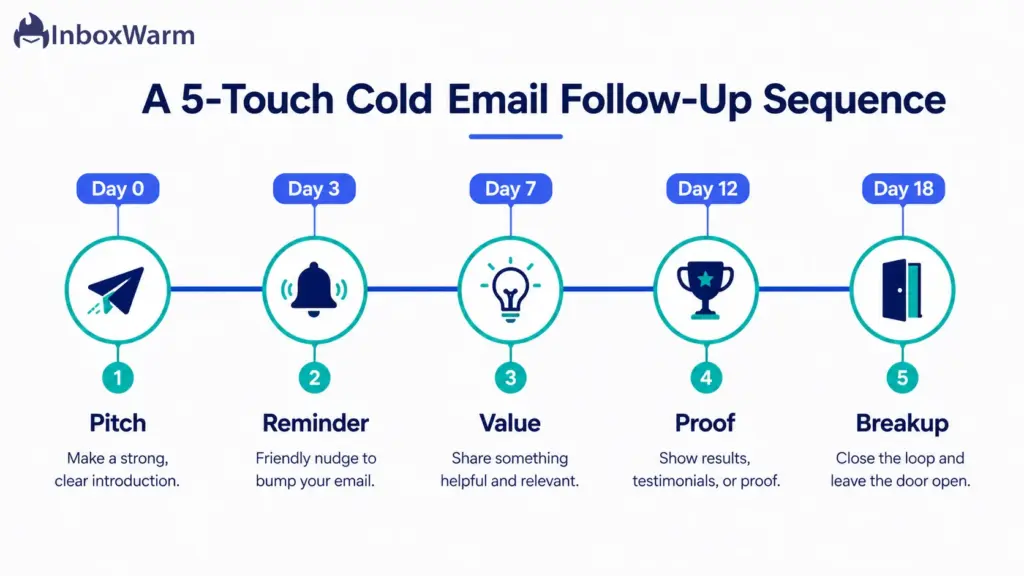
A good cold email follow-up sequence spaces four to six touches over two to three weeks, with each message adding a new reason to reply. A typical cadence runs the initial email on day 0, then follow-ups on day 3, day 7, day 12, and a final breakup around day 18. Here is the full sequence at a glance:
| Touch | When | Goal | What to include |
|---|---|---|---|
| Email 1 | Day 0 | Initial outreach | Your core pitch and one clear, specific ask. |
| Follow-up 1 | Day 3 | Gentle reminder | Bump the thread and restate the value in one line. |
| Follow-up 2 | Day 7 | New value | Share a resource, stat, or insight tied to their role. |
| Follow-up 3 | Day 12 | Social proof | A short, relevant result from a similar company. |
| Follow-up 4 | Day 18 | Breakup | Give an easy out and a final reason to reply. |
Treat this as a starting template, not a fixed rule. Shorten it for low-value lists, extend the gaps for enterprise deals with long buying cycles, and always let reply signals override the schedule. If a prospect opens your email five times but never replies, that is a nudge to call or change channels, not to send the same line again.
How Do You Follow Up Without Spamming Prospects?
To follow up without being pushy, add value instead of asking again. Keep each message under 75 words, reference your original email in one line, give the reader something useful, and make a single low-friction ask. Personalization is the difference between a follow-up and a nag, and Backlinko found that personalized subject lines lift responses by 30.5%.
Do this:
- Lead with something useful, like a relevant stat, a quick idea, or a resource they can use.
- Keep it short and skimmable, with one paragraph and one ask.
- Personalize with their role, company, or a recent trigger event (warm up your domain first so personalized messages still land).
- Give an easy way to say no, which paradoxically earns more replies.
Avoid this:
- “Just bumping this to the top of your inbox” with no new value attached.
- Guilt trips like “This is my third email, and I still haven’t heard back.”
- Daily sends, giant attachments, or five links crammed into one message.
Cold Email Follow-Up Templates That Get Replies
The best cold email follow-up templates are short, value-led, and built for a prospect who never replied. Use a different angle for each touch: a reminder, a value add, social proof, a new contact, and a breakup. Adapt the five follow-up email examples below to your offer, and swap anything in brackets for real detail.
Follow-Up #1: The Gentle Reminder (Day 3)
Your first follow-up should be the lightest. Reply in the same thread, keep it warm, and restate the value in a single line.
Subject: Re: [original subject]
Hi [First name],
Floating this back to the top of your inbox in case it slipped past. I know things move fast at [Company].
Quick recap: we help [their role] [specific outcome] without [common pain].
Worth a 15-minute look next week?
[Your name]
Follow-Up #2: The Value Add (Day 7)
Now you earn attention instead of asking for it. Share one genuinely useful thing tied to their role or industry.
Subject: A quick idea for [Company]
Hi [First name],
No worries if now isn’t the moment. In case it’s useful, here’s something working for similar [their industry] teams: [one-line insight or resource].
If [outcome] is on your radar this quarter, I’m happy to share how we’d approach it for [Company].
[Your name]
Follow-Up #3: The Social Proof (Day 12)
Specific, measurable proof from a comparable company does the persuading for you. Keep it to one result and one ask.
Subject: How [Similar company] hit [result]
Hi [First name],
[Similar company] had the same [problem] you’re likely seeing. After [what you did], they [specific measurable result] in [timeframe].
I think [Company] could see something similar. Open to a quick call to map it out?
[Your name]
Follow-Up #4: The New Contact or Angle (Day 15, optional)
If your main contact stays silent, try a fresh angle or a second person at the company. Backlinko found that emailing more than one contact at the same organization lifts response rates by 93%.
Subject: Re: [original subject] – wrong person?
Hi [First name],
I may have caught you at a busy time, or this may not be your area. If [outcome] sits with someone else on your team, could you point me their way?
Either way, I’ll keep it brief from here.
[Your name]
Follow-Up #5: The Breakup Email (Day 18)
The breakup email is your most reliable reply-getter. It removes pressure, signals you will stop, and often surfaces the people who meant to respond.
Subject: Closing the loop
Hi [First name],
I don’t want to clutter your inbox, so this is my last note. If [outcome] isn’t a priority right now, no problem at all.
If it is, just reply ‘open’ and I’ll send a few times.
Thanks for reading this far.
[Your name]
Two rules tie these together. Rotate the angle so no two messages feel the same, and stop the entire sequence the second a prospect replies. A live human conversation always beats the next scheduled template.
Why Do Your Follow-Ups Land in Spam (And How to Fix It)?
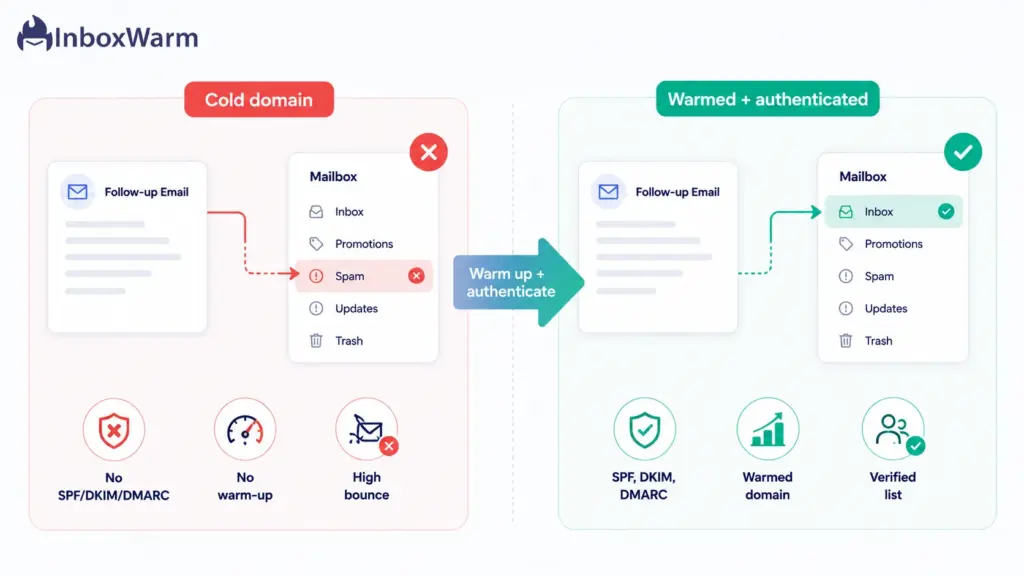
Follow-ups often fail because they never reach the inbox, not because the copy is weak. Repeated sends from a cold domain raise spam-filter suspicion fast, and a flawless sequence is worthless in the spam folder. Authenticating and warming your domain before you scale is what keeps your sequence visible.
Follow-up campaigns are uniquely risky for deliverability. You are sending several similar messages, from a domain with little sending history, to people who have not engaged yet. Mailbox providers read that pattern as a warning sign.
Here is how to stay in the inbox:
- Authenticate your domain. Set up SPF, DKIM, and DMARC so providers can verify you are who you claim to be.
- Warm up the domain first. Build sender reputation gradually before high-volume outreach, whether you send from Gmail or Outlook.
- Keep spam complaints low. Google’s bulk sender guidelines say to keep your reported spam rate under 0.3% and ideally below 0.1%.
- Verify your list. Bad addresses cause bounces, and high bounce rates drag down sender reputation for everyone in the campaign.
- Vary your copy. Slightly different wording between touches, with few links and no spam-trigger words, looks far more human to filters.
This is the gap most outbound teams miss. InboxWarm.ai is an AI-powered email warm-up tool that improves inbox placement and sender reputation, so the follow-up sequence you just built actually reaches a human. If you want the deeper playbook, our work on cold email deliverability and how to stop emails going to spam goes step by step.
Conclusion
Cold outreach is won in the follow-up, not the first send. A single email is a coin flip you usually lose, while a disciplined sequence of four to six touches is where most replies actually come from. The opener gets you noticed once; the follow-ups get you the meeting.
The mechanics are straightforward. Wait two to three business days for the first follow-up, widen the gap with each send, and change the angle every time so no message feels like a repeat. Use the templates as starting points, personalize them, and stop the sequence the instant a prospect replies or gives a clear no.
None of it matters if your messages never arrive. Before you scale how you follow up on a cold email, get email authentication in place and warm up your domain so every well-timed, well-written follow-up lands where your prospect will actually see it.
Frequently Asked Questions
How long should you wait before following up on a cold email?
Wait two to three business days before your first follow-up. That gives a busy prospect time to see your email naturally while it is still recent in their inbox. After the first follow-up, widen the gap to four to five days, then move to roughly weekly for later touches.
What should you write in a follow-up email after no response?
Reference your first email in one line, then add something new and useful, such as a relevant insight, a resource, or a short proof point. Keep the whole message under 75 words and finish with a single, low-friction ask. Avoid simply repeating your original pitch, because a fresh angle is what earns the reply.
How do you follow up on a cold email without being pushy?
Lead with value rather than another request, and keep each message short and personalized. Give the prospect an easy way to decline, which often increases replies instead of reducing them. The goal is to be helpful and persistent, not to guilt-trip someone into responding.
How often should you follow up on a prospect?
Space your touches so the prospect never feels crowded: the first follow-up after two to three days, then progressively wider gaps of several days to a week. A common cadence is day 0, day 3, day 7, day 12, and a final note around day 18. Adjust the spacing to the deal size and how the prospect is engaging.
Do follow-up emails actually increase replies?
Yes, and the effect is large. Backlinko found that sending one additional follow-up can lift replies by 65.8%, and emailing the same contact multiple times can double total responses. Modern benchmark reports also show that a substantial share of all replies arrive from follow-ups rather than the first email.
Should you follow up in the same email thread or start a new one?
Reply in the original thread for your first one or two follow-ups, so the prospect has the full context in one place. For later touches, a fresh subject line can re-spark attention if the thread has gone stale. Test both, and let your reply data decide which works for your audience.
Why do my cold email follow-ups go to spam?
Repeated, similar messages from a domain with little sending history are a classic spam signal. The usual fixes are authenticating with SPF, DKIM, and DMARC, warming up the domain to build sender reputation, verifying your list to cut bounces, and keeping spam complaints under Google's 0.3% threshold. Sort deliverability out before you scale, not after.
Your follow-up sequence is only as good as your inbox placement.
InboxWarm.ai warms up your domain and builds sender reputation automatically, so your follow-ups land where prospects actually read them. Start free for 10 days, no credit card required.