
TL;DR
- A needs-validation cold email tests whether an offer is relevant before treating a possible need as confirmed.
- Use one verified company detail, explain your capability, and ask one focused question that allows a negative answer.
- Five first-email templates cover a priority check, current process, stated goal, specific assumption, and a scoped use case.
- Separate interest in a resource from confirmation of a need, a project, or a purchasing decision.
- After a reply, ask about the actual workflow and clarify the prospect’s own words instead of inserting a diagnosis.
- Respect “already covered,” “not a priority,” refusals, and opt-outs. Silence is not proof of need.
A cold email for validating a prospect’s needs checks whether your offer fits something the recipient actually wants to address. It begins with relevant context, explains the capability you provide, and asks a question the prospect can answer honestly—including that the current approach works well.
The first email is a commercial introduction, not a disguised research interview. Its purpose is to test relevance and earn an appropriate next step. The templates below help you explore a possible need without turning a company fact into an invented pain point.
Table of Contents
How Can a Cold Email Check Whether Your Offer Is Relevant?
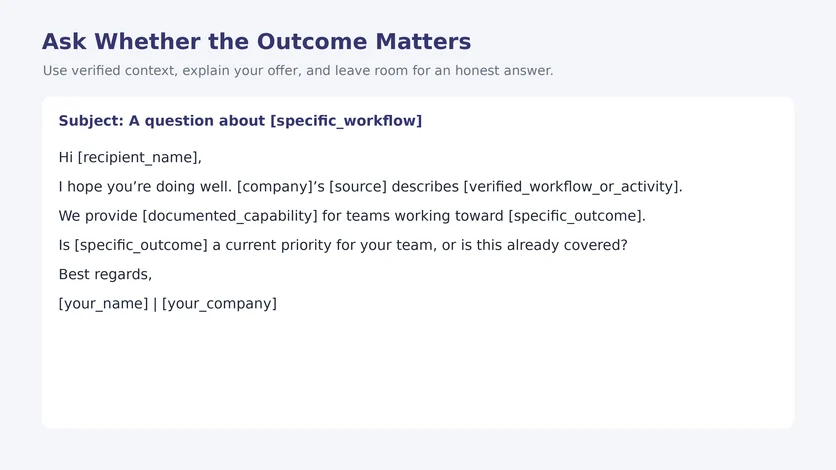
Use this main template when you have verified a connection to the prospect’s work but do not know whether the desired outcome matters to them now. Ask about that one outcome instead of presenting a list of problems they have not confirmed.
Replace the outcome with a clear business result connected to your capability, such as making handoff information easier to review. Avoid vague claims like “unlocking growth.” A brief relevance check can open the conversation; it does not, on its own, establish why the outcome matters or whether a purchase is needed.
What Are You Trying to Validate?
Before writing, identify the uncertainty that changes whether you should continue. A good first email does not need to collect the prospect’s entire process, budget, authority, and timeline at once.
| Question to Resolve | What Would Help You Learn | What It Would Not Prove |
|---|---|---|
| Does this task belong to the prospect’s work? | A description of the relevant workflow or a correction about ownership. | A need for a new product. |
| Is the outcome important now? | The prospect’s statement about a priority or goal. | An approved project or budget. |
| Does the condition you suspect actually occur? | A real example from the prospect’s experience. | That your proposed solution is the right one. |
| Is the existing approach sufficient? | An account of what works and what, if anything, needs to change. | A commitment to replace the current approach. |
| Would a specific next step help? | Agreement to review an example or discuss a defined topic. | Buying intent or permission for an unrelated sales sequence. |
In B2B lead generation, company fit makes a prospect worth researching. Needs validation adds what the recipient says about their situation. Keep those two sources of evidence separate.
Turn Your Assumption Into a Question
A public detail can explain why you contacted the business. It rarely tells you the full condition of the internal process. Write down the observed fact, the possible connection, and what remains unknown before choosing your question.
| What You Observed | Assumption to Avoid | Question to Explore |
|---|---|---|
| The company serves several customer segments. | “Your onboarding must be inconsistent.” | “How does onboarding differ across those customer groups?” |
| A role includes responsibility for reporting. | “Reporting is taking too much time.” | “How is that reporting work handled today?” |
| An announcement names an expansion plan. | “You urgently need another sales tool.” | “Which part of the planned work is a current priority?” |
| A source names an existing platform. | “The platform leaves a gap you need to fix.” | “Is the current approach meeting your needs for this task?” |
GOV.UK’s interview guidance recommends neutral questions, simple follow-ups, and real examples. That is useful guidance for learning once a conversation begins; it is not evidence that any particular cold-email wording will increase replies.
Ask the smallest useful question for the stage. A short first email may use a focused relevance check. After the person engages, an open question can reveal more context than repeatedly asking for agreement with your hypothesis.
What Could You Ask Instead of Assuming a Pain Point?
Choose one of these four alternatives according to the uncertainty you need to resolve. Together with the main version, they provide five first-email options. Do not send every version to the same person.
1. Ask About the Current Process
Use it when: The task is relevant, but the company’s current method is unknown. Explain your commercial context before asking about the work.
What the answer can establish: A description of the current process. It does not automatically mean the process is difficult, inefficient, or due for replacement.
2. Check a Publicly Stated Goal
Use it when: The company has named a relevant goal, but you do not know which part of the work matters to the recipient’s team.
What the answer can establish: Whether the team is involved and how it describes its current focus. A company-level announcement does not prove that every function owns the same goal.
3. Test One Specific Assumption
Use it when: You have a reasonable connection between the observed activity and a possible condition, but the condition itself is unverified.
What the answer can establish: Whether the condition occurs in their situation. Keep it specific and plausible; do not use the template to introduce an alarming or unsupported diagnosis.
4. Check the Use Case Before Offering a Demo
Use it when: Your capability is relevant to the broad workflow, but you need to confirm the scope before choosing an example.
What the answer can establish: Whether the use case belongs in the conversation. A match still does not confirm a problem, dissatisfaction, or interest in a demo.
How Do You Avoid Questions That Push the Prospect Toward “Yes”?
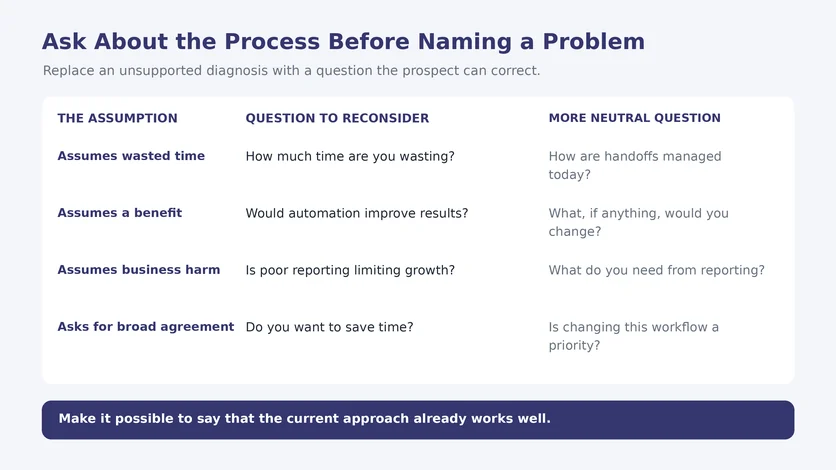
Read the question as if the prospect’s current process is already meeting their needs. They should be able to say so without correcting a false claim or accepting your framing first.
| Question to Avoid | Why It Leads the Answer | More Neutral Alternative |
|---|---|---|
| “How much time are you wasting on manual handoffs?” | It assumes the work is wasteful. | “How are handoffs managed today?” |
| “Wouldn’t automating this improve your results?” | It asks for agreement with your proposed benefit. | “What, if anything, would you change about this step?” |
| “Is poor reporting holding back your growth?” | It inserts both a diagnosis and a business impact. | “What does your team need from the reporting process?” |
| “Do you want to save time and reduce costs?” | It is too broad to establish a specific need. | “Is changing this particular workflow a priority now?” |
Nielsen Norman Group’s guidance on leading questions explains how wording can influence feedback. Apply the principle by removing unsupported conclusions and clarifying what the person actually says. Do not treat a more neutral question as a guarantee of honest, complete, or representative feedback.
Avoid an interrogation. One relevant question is enough for the opening email. Save detailed process and commercial questions for a conversation the recipient has agreed to continue.
A Worked Example: From a Possible Need to a Confirmed Detail
Fictional illustration: MapleStudio, the recipient Aisha, the sender Sam, and the product BriefTrack are invented. The email and reply below demonstrate interpretation; they are not customer evidence or measured outreach results.
Assume MapleStudio’s current services page describes both one-off projects and ongoing retainers. BriefTrack supports structured handoff notes, but Sam does not know whether MapleStudio needs to change its process.
Illustrative prospect reply: “We have a process already. The issue is occasionally missing the client’s agreed exclusions when a new project moves to delivery.”
| Evidence From the Reply | Accurate Interpretation |
|---|---|
| The team already has a process. | Do not describe the company as having no handoff process. |
| Agreed exclusions are sometimes missing. | A specific information issue has been described. |
| The reply does not explain frequency or impact. | Those details remain unknown. |
| The reply does not mention buying software. | A purchase or replacement project is not confirmed. |
A suitable next reply could be: “Thanks for explaining. When that happens, how does the delivery team get the missing exclusions?” That follows the prospect’s example rather than replacing it with a broader claim about lost revenue.
If the capability fits what you learn, ask whether a sample handoff note covering agreed exclusions would be useful. Explain the relevant capability and limitations honestly before proposing a larger next step.
What Should You Do After the Prospect Replies?
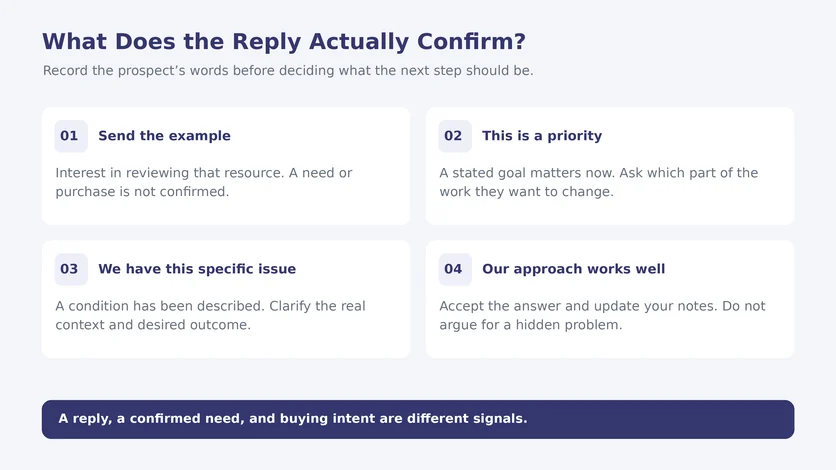
Match the next question to the reply. Do not move straight to a full pitch simply because the person has answered the email.
| Reply | Useful Next Action | Avoid Concluding |
|---|---|---|
| “We already handle this.” | Acknowledge that and update the account record. | They have a hidden need you must persuade them to admit. |
| “Yes, this is a priority.” | Ask which part of the work they want to change. | A budget or purchase has been approved. |
| “We have this specific issue.” | Clarify a real example, the current response, and the desired outcome. | Your product is automatically the right solution. |
| “Send the example.” | Send the promised resource with accurate scope. | The person has confirmed a problem or agreed to a demo. |
| “That belongs to another team.” | Record the routing accurately and assess a suitable next contact. | The new contact has endorsed the offer. |
| No reply | Review delivery, message relevance, and contact fit separately. | The hypothesis is either confirmed or disproved. |
Use the prospect’s words in your notes. If you summarize them, distinguish what they stated from your interpretation. A need becomes clearer through concrete context; it is not validated by labeling the account “interested.”
Subject Lines for a Genuine Relevance Check
Keep the subject connected to the task or question. It should not imply that you have already diagnosed a problem or that the person requested your advice.
- A question about [specific_workflow]
- How is [specific_task] handled?
- [stated_goal] at [company]
- A fit check for [specific_use_case]
- [specific_workflow]: already covered?
Use a clear sender identity and explain the commercial reason for writing. Do not present a sales introduction as independent research, an internal audit, or a requested consultation.
Two Follow-Ups That Leave Room for “Not Relevant”
Follow up only when the context remains relevant and the recipient has not declined or opted out. These are options, not a required cadence; choose a reasonable gap for your audience and situation.
Follow-Up 1: Narrow the Question
Follow-Up 2: Close the Sequence
Use “Re:” only in the actual email thread. If a reply says the topic is not a priority, accept that information. A later question should come from genuine new context or an invitation to continue, rather than a need to complete the sequence.
Does Your Email Allow the Prospect to Correct You?
Use this final check to make the question useful for learning as well as clear to the reader. The draft should explain why you are writing while leaving unconfirmed needs open.
- Context: Is the company-specific opening supported by a source you checked?
- Purpose: Is the commercial offer clear rather than disguised as research?
- Question: Are you asking about one task, outcome, or use case?
- Neutrality: Can the prospect say the current approach works well?
- Interpretation: Will you record the actual reply separately from assumptions about buying interest?
- Campaign: Have you reviewed sender details, contact suitability, refusals, opt-outs, relevant requirements, and provider policies?
Check the sending configuration separately from the need hypothesis. No question, template, or response category guarantees an accurate diagnosis, qualified opportunity, or inbox placement.
Frequently Asked Questions
What Does It Mean to Validate a Prospect’s Needs?
It means checking whether a possible need is real for that prospect, using their account of the situation rather than your assumptions. A first email can test relevance; understanding the workflow, desired outcome, and importance usually takes a conversation.
What Is a Good First Question in a Needs-Validation Cold Email?
Ask about one relevant priority or task, and make it possible to answer that no change is needed. For example, ask whether a specific outcome is a current priority. Once the person engages, use an open question to understand their actual process.
Should I Ask About Budget in the First Email?
Budget may matter later, but it does not replace understanding whether the offer fits a real need. For these templates, the first email focuses on relevance. Ask further commercial questions when the conversation and agreed next step make them appropriate.
Does a Positive Reply Confirm a Need?
Not necessarily. A request for an example confirms interest in reviewing that example. A statement about a desired outcome or current difficulty provides different evidence. Record what the prospect actually said rather than treating every reply as a qualified opportunity.
How Do I Avoid Leading Questions?
Remove unverified claims from the question and allow answers that challenge your idea. Ask how the work happens today instead of asking why the current process is failing. In follow-up conversations, invite a real example and clarify the prospect’s wording.
Can I Validate Needs Without Claiming a Pain Point?
Yes. You can ask about the current process, a stated goal, or the relevance of a capability without diagnosing a problem. The current approach may already meet the team’s needs; that is useful information for deciding whether to continue.
What If the Prospect Says the Current Approach Works Well?
Accept the answer and update the account record. Do not argue that they must have a hidden problem. Ask another question only when the response invites it or leaves a specific point genuinely unclear.
What If the Prospect Does Not Reply?
Silence does not establish that a need exists or that it does not. The message may have been missed, been unsuitable, or reached the wrong person. Review delivery and account fit separately, and do not continue after a refusal or opt-out.
A Clear Question Deserves a Prepared Sending Setup
Give the prospect a relevant reason to respond, then check your sending domain for configuration issues that could affect delivery. Prepare the message and the domain before you test your outreach.