


TL;DR
- Read the source request for the exact question, expert requirements, deadline, and submission instructions.
- Lead with a short, attributable quote that answers the question and gives the reporter a concrete detail they can use.
- Include the expert’s name, title, affiliation, and one relevant qualification. Disclose any connection that could influence their answer.
- Link to the original source for factual claims, approve the wording with the expert if you represent them, and confirm availability for a quick fact check.
A journalist asks how small agencies keep client approvals moving. You have a useful answer, but it’s buried below a company introduction and an offer to arrange a call. Give the reporter the comment they asked for while they still have time to use it.
To pitch an expert quote to a journalist, reply through the requested channel by the deadline. Answer the reporter’s specific question in one or two quotable sentences, identify who said it and why they know the topic, and provide a source for any fact that needs checking.
Table of Contents
What Is an Expert Quote Pitch?
An expert quote pitch is a short response that gives a journalist a named source’s comment on a specific reporting question. It can offer a firsthand observation, explain why something happens, or show readers what to do next.
A source request typically tells you what the reporter needs, such as a written comment, a brief interview, or someone who meets a particular qualification. Cision’s guidance on media pitching emphasizes relevance and timing. When the request gives you both, use them to judge whether you can help.
Before you write the email, check whether your expert fits the request closely enough to answer it.
How Do You Decide Whether to Respond to a Journalist’s Request?
Respond when you have the right expertise, a specific answer, and time to meet the reporter’s instructions. Check these details before drafting:
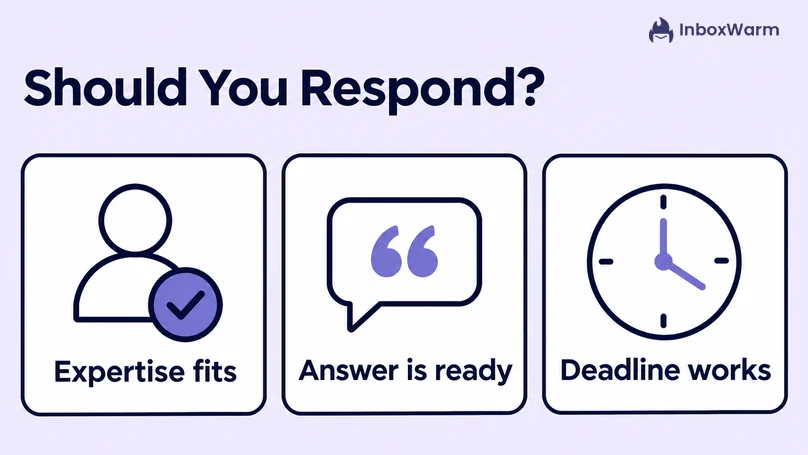
- The requested source. Check subject, role, industry, geography, or other eligibility details. A reporter asking for agency owners may need a different perspective from a vendor that serves agencies.
- The question and format. Identify the exact prompt, requested length, and whether the journalist wants written commentary or interview availability.
- The deadline and channel. Check the time zone and use the email address, form, or platform provided. For example, Qwoted’s code of conduct restricts off-platform outreach and prohibits AI-generated pitches on its platform. Follow the channel’s own rules and write from genuine expert input.
- Evidence and permissions. Check whether the source can speak on the record and whether any examples or findings can be shared publicly.
Once the request is a fit, draft the quote first. It will tell you which credentials and supporting details the email needs.
What Should You Include in an Expert Quote Pitch Email?
Give the reporter a clear answer, a verifiable source, and a way to ask a follow-up question. A short email can do all three.
- Identify the request. Keep the original subject if you’re replying. For a new email, name the topic so the reporter can recognize their request.
- Answer the question up front. Add one or two sentences with a concrete observation, example, or practical action. Follow the requested word count if the journalist gives one.
- Include attribution. Give the expert’s full name, title, and organization. Add one line explaining how they know this particular subject. Say whether you represent them.
- Provide evidence and disclose relevant ties. For a statistic or factual claim, link to the original source and specify the relevant section, population, or timeframe where needed. Disclose a financial or professional interest that affects the topic.
- Confirm availability. Say when the source can clarify a point or speak briefly. Use a time zone when a deadline is close.
The Society of Professional Journalists’ Code of Ethics emphasizes verification and original sourcing. Make that work easier by offering a public bio or the original research when it helps the journalist verify your answer. Describe what the evidence establishes, especially when it comes from your company’s own data.
Those details help verify the response. The wording of the quote determines whether it can stand on its own in the story.
How Do You Write a Quote a Journalist Can Use?
Put one useful idea in plain language. Start with the answer, add a specific detail or useful condition, and check that the meaning stays clear if the sentence is quoted on its own.
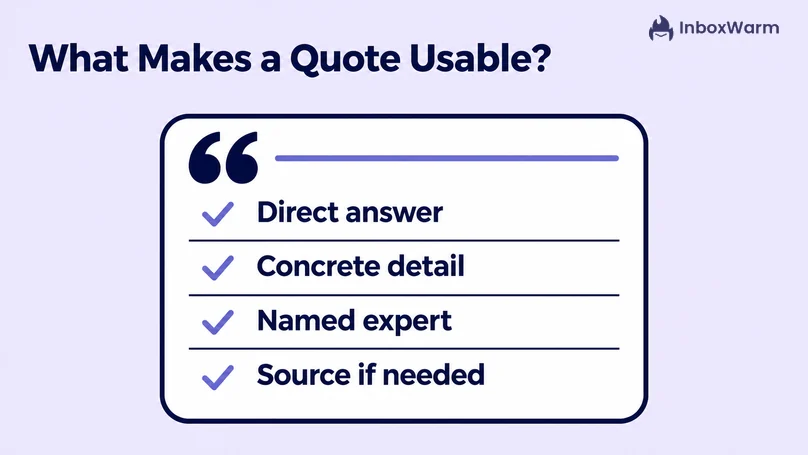
Broad comment: “Clear communication is essential when teams share responsibility for approvals.”
More useful comment: “Name one decision-maker for each approval. If three people can comment but only one can sign off, label that person in the brief and tell the team whose reply makes the decision final.”
The second version answers what to do and shows what the instruction looks like in practice. When your answer depends on firsthand experience, say what you observed and in what context. When you cite a measurement, use its original source. Reuters’ journalism standards explain why accurate attribution and representative quotes matter.
With the quote ready, choose an email format based on who is sending it and how much time the reporter has.
Which Expert Quote Pitch Email Template Should You Use?
Use the first template to pitch your own expertise, the second to send a spokesperson’s approved quote, and the third when a reporter’s verified deadline is close. Replace each placeholder with information you can stand behind.
How Do You Pitch Your Own Expertise?
Use this when the request matches work you do directly and you can provide a clear comment on the record.
Subject: Expert comment on [Specific Topic]
Hi [Recipient’s Name],
I’m responding to your request about [Exact Question or Story Topic]. Here’s an on-the-record comment you can attribute to me:
“[Answer the question in one sentence. Add a concrete example or condition in a second sentence if it helps.]”
I’m [Full Name], [Title] at [Organization]. I [one relevant responsibility or firsthand qualification]. [Public bio or primary source URL if useful.]
I’m available [Time Window and Time Zone] if you’d like a quick clarification.
Thanks,
[Your Name]
How Do You Pitch a Spokesperson’s Quote?
Use this when you represent someone with relevant expertise and they have approved the exact wording and attribution.
Subject: [Topic] comment from [Expert Name], [Relevant Role]
Hi [Recipient’s Name],
I represent [Expert Name], [Title] at [Organization], who [specific work relevant to the request]. In response to your question about [Topic], they shared this on-the-record comment:
“[Expert’s approved quote that answers the question directly.]”
[Expert bio or original source URL.] [Relevant affiliation or interest if it affects the story.]
[Expert Name] can answer questions by [Time and Time Zone]. I can connect you directly if useful.
Best,
[Your Name], [Role or Agency]
How Do You Reply When the Journalist Is on a Tight Deadline?
Use the original thread when available and put the approved answer first. Keep the contact details and timing easy to spot.
Subject: Re: [Original Request Subject]
Hi [Recipient’s Name],
For your [Topic] deadline, here’s an on-the-record response to [Question]:
“[One or two verified sentences that answer the question.]”
Attribution: [Full Name], [Title], [Organization]. [Relevant qualification or source URL.]
I can confirm details by [Time and Time Zone] at [Contact Method].
Thanks,
[Your Name]
Here’s how the first template reads when the expert has a specific answer and a credential the reporter can check.
What Does a Filled-In Expert Quote Pitch Look Like?
This fictional example shows how an agency operator could answer a question about client approvals. The names and biography link are illustrative.
Subject: Expert comment on avoiding delays in agency approvals
Hi Alina,
In response to your question about how small agencies can avoid delays in client approvals, here’s an on-the-record comment:
“At kickoff, name the one person whose approval moves the work forward. If others need to weigh in, ask that person to consolidate their comments before the proofing deadline so the team gets one set of instructions.”
I’m Nina Rahman, operations lead at Cedar Studio, where I run creative handoffs and client sign-off for our agency projects. My public bio is at cedarstudio.example/team/nina-rahman.
I’m available until 3 p.m. Eastern today if you’d like me to explain how we record approvals in the project brief.
Thanks,
Nina Rahman
The quote is usable on its own, and the credential explains why this source can speak about the process. Since the comment describes a workflow, it can stand without a numerical claim. If you add a percentage or benchmark, supply the underlying source before sending.
When Should You Follow Up After Sending an Expert Quote?
Follow the instructions in the request. A brief reply in the same thread can help if you need to correct a detail or can quickly supply something the reporter still needs. Send it while the information is useful, and respect any request to skip follow-ups.
Cision’s follow-up guidance discusses how timing and a journalist’s preferences affect whether a follow-up is helpful. If you’re adding context, use the same principle as following up after sending requested information: give the recipient a specific reason to reopen the thread. If an article later names your company without a link, that calls for a separate unlinked brand mention request when an editorial link would help readers.
Frequently Asked Questions
Use these answers to decide what to send when a journalist’s request is brief or leaves an editorial detail open.
How Long Should an Expert Quote Pitch Be?
Follow the word limit in the request. If none is specified, start with one or two sentences of commentary, a short credential, and an offer to clarify.
Should You Attach a Bio or Headshot?
Include a short credential in the message and a public bio link if it helps verify expertise. Send a headshot or attachment if the journalist requests it and you have permission to share it.
Can You Ask for a Backlink in the Pitch?
Provide a relevant source or biography link for verification. Keep the comment available on its own merits and leave attribution format and linking to the publication.
Can You Pitch a Quote if the Deadline Has Passed?
Skip the submission unless the journalist confirms they’re still accepting responses. An open request or a new opportunity is a better use of your time.
Will the Journalist See Your Pitch Before the Deadline?
Your quote is ready, but a pitch that lands in spam can miss the reporting window. Use InboxWarm to warm up your sending inbox before your next round of media outreach.
