

TL;DR
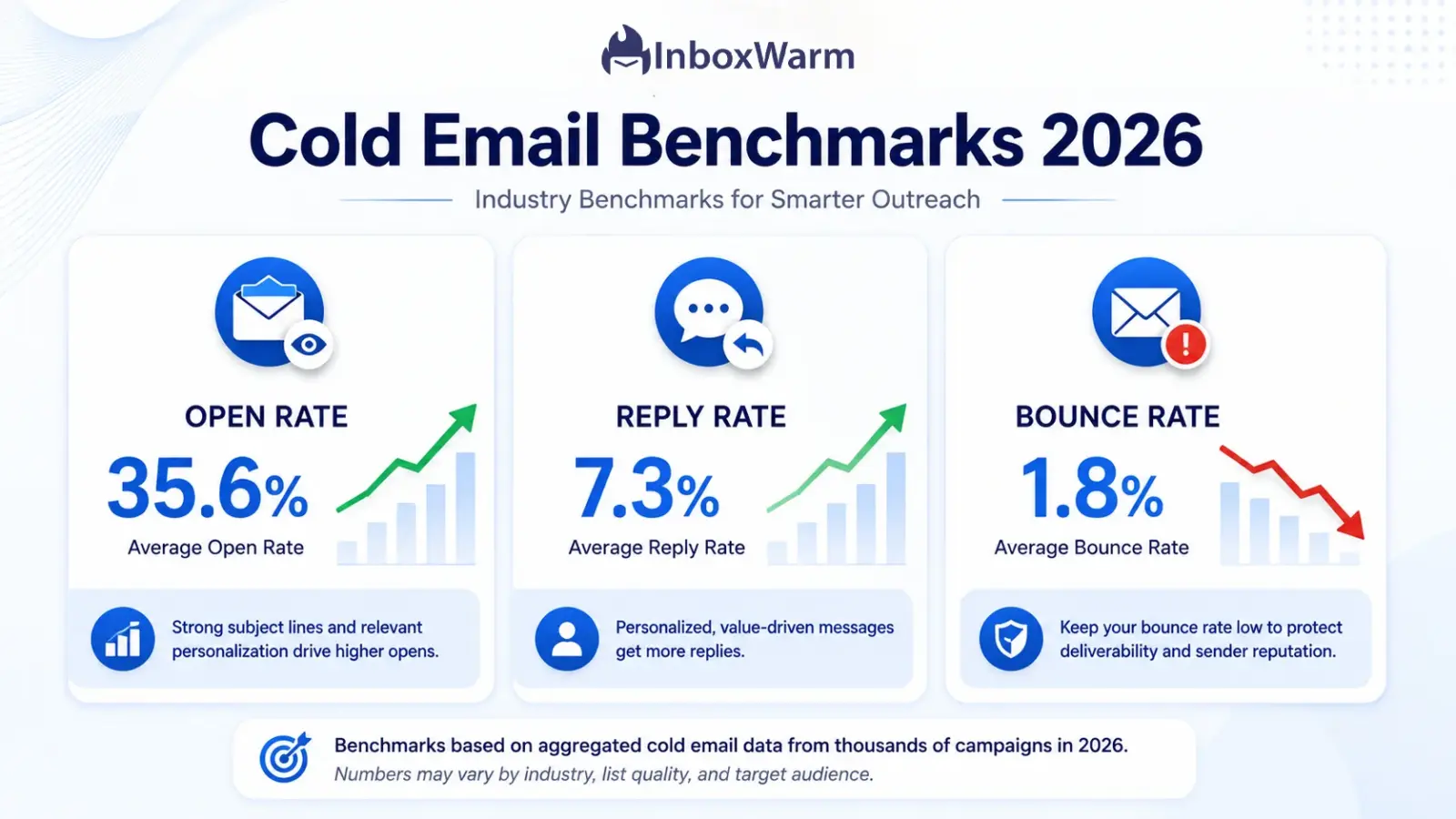
- The average cold email open rate in 2026 sits around 27.7 to 44 percent, though Apple Mail Privacy Protection inflates this figure significantly.
- The average reply rate in 2026 is roughly 3.43 percent, with top performers exceeding 10 percent and elite senders hitting 15 percent or higher.
- Average bounce rate across all senders is about 5.1 percent, but a healthy, well-maintained list should stay under 2 percent.
- Bounce rate is the single biggest differentiator between top and bottom-performing campaigns, more than copy or subject lines.
- Verified email lists generate roughly twice the reply rate of unverified lists and far outperform purchased lists.
- Domain warm-up and authentication remain the highest-leverage fix for improving every metric on this page.
Cold email benchmarks shifted again in 2026, and the gap between average and elite senders keeps widening. The current average open rate lands between 27.7 and 44 percent depending on how Apple Mail Privacy Protection is accounted for; the average reply rate sits at 3.43 percent, and the average bounce rate is 5.1 percent across all senders.
This article breaks down each metric individually, explains why open rate has become an unreliable signal, and shows what separates top quartile campaigns from the rest.
These figures are compiled from multiple 2026 industry benchmark reports, including Instantly’s Cold Email Benchmark Report, Woodpecker’s cold email statistics, and Cleverly’s cold email benchmarks by industry. Where reports disagree, this article uses the median range rather than the most favorable number, since list quality, ESP, and deliverability infrastructure vary widely across senders.
Table of Contents
What Is a Good Cold Email Open Rate in 2026?
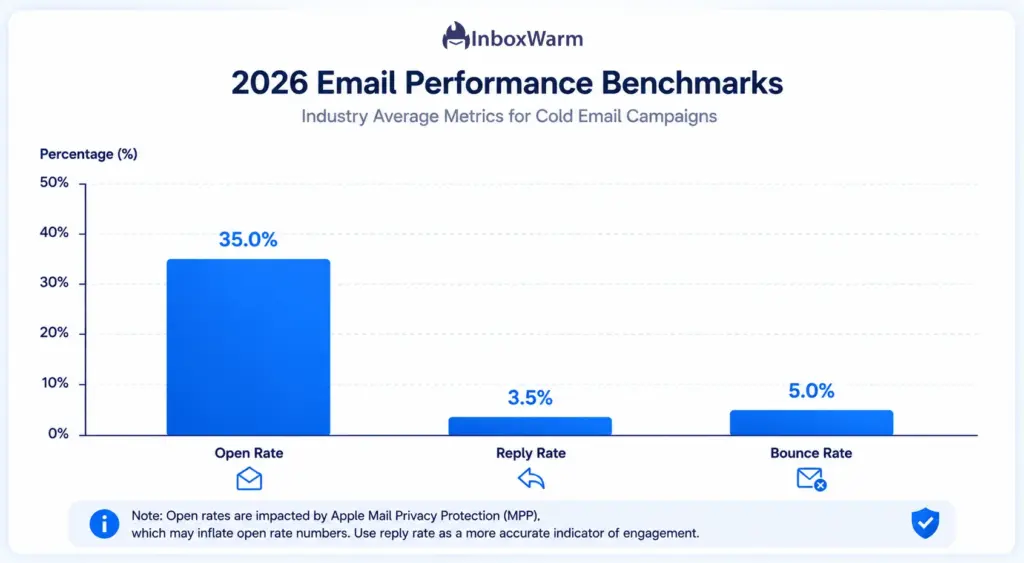
A good cold email open rate in 2026 falls between 35 and 60 percent, with anything above 45 percent generally considered strong according to Cleverly’s industry benchmark data. The blended average across all senders sits around 27.7 percent, though this number has dropped from roughly 36 percent in 2023 as inbox providers tightened filtering.
| Performance Tier | Open Rate Range |
|---|---|
| Below average | Under 25% |
| Average | 27.7% to 35% |
| Good | 35% to 45% |
| Excellent | 45% to 65%+ |
Why Open Rate Is Becoming an Unreliable Metric
Apple Mail Privacy Protection automatically preloads tracking pixels on a large share of inboxes, which artificially inflates reported open rates regardless of whether a human actually read the email. Industry estimates suggest a reported 27 percent open rate may reflect closer to 18 percent of real opens once Apple Mail traffic is excluded. Reply rate and inbox placement are now considered far more trustworthy engagement signals than open rate alone.
What Is a Good Cold Email Reply Rate in 2026?
The average cold email reply rate in 2026 is 3.43 percent, according to Instantly’s 2026 benchmark report, down from roughly 5 percent in 2025 and 8.5 percent in 2019. A good reply rate for most B2B campaigns falls between 5 and 10 percent, while elite senders in the top 10 percent regularly hit 15 percent or higher through micro-segmentation and personalization.
| Performance Tier | Reply Rate Range |
|---|---|
| Below average | Under 1% |
| Average | 3% to 5% |
| Good | 5% to 10% |
| Elite | 10% to 15%+ |
Why Reply Rate Drops as List Size Grows
Campaigns sending to fewer than 50 to 200 recipients consistently post reply rates two to three times higher than campaigns sending to 500 or more, based on data from Saleshandy’s analysis of 53 million cold emails. Smaller, tightly segmented sends allow for sharper personalization, which is consistently the strongest lever for reply rate across every benchmark report referenced in this article.
How Much Do Follow-Ups Contribute to Total Replies?
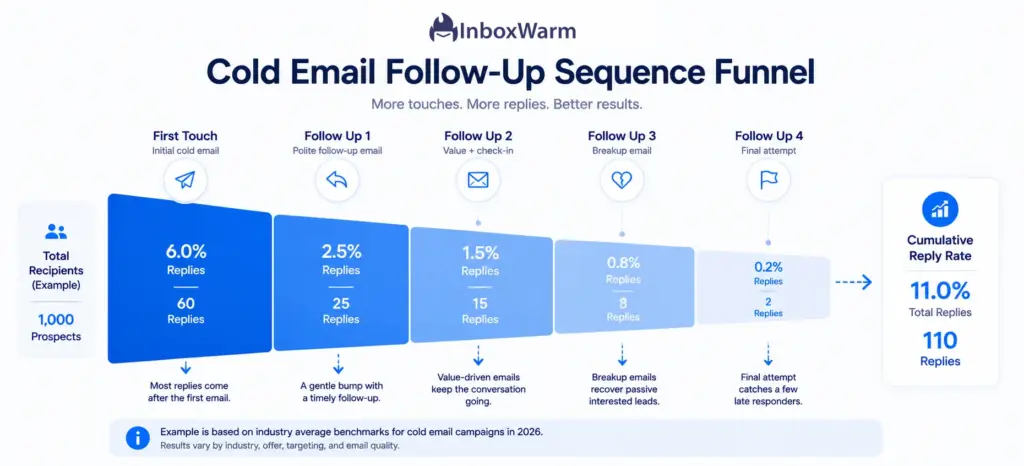
First touch emails generate roughly 58 percent of all replies in a sequence, while the remaining follow-up emails contribute the other 42 percent. Sequences with four to seven touches and a 3-7-7-day cadence tend to outperform shorter sequences, since many recipients do not engage until the second or third message reaches their inbox.
What Is a Good Cold Email Bounce Rate in 2026?
A good cold email bounce rate in 2026 is under 2 percent, with best-in-class senders staying below 1.5 percent. The blended average across all senders is 5.1 percent, which is significantly skewed upward by senders using unverified or purchased lists.
Cleanlist’s 2026 cold email data found that purchased lists bounce at an average of 18.5 percent, a rate that can permanently damage a sending domain’s reputation within weeks.
| List Type | Typical Bounce Rate |
|---|---|
| Purchased list | 18.5% |
| Unverified list | 5% to 8% |
| Verified, maintained list | Under 2% |
| Best in class, verified and warmed | Under 1.5% |
Why Bounce Rate Damages Reputation Exponentially, Not Linearly
Crossing from 1.8 to 2.3 percent bounce rate is not treated as a small increase by inbox providers. Gmail and Outlook weigh bounce rate as a primary reputation signal, and once a domain crosses the 2 percent threshold, the damage compounds rather than scaling proportionally. A domain with a 2.3 percent bounce rate can see disproportionately worse inbox placement than one sitting at 1.8 percent, even though the numeric gap is small.
This is the same threshold covered in our guide on How Many Cold Emails Can You Send Per Day Without Getting Blacklisted, where sending volume and bounce rate combine to determine real blacklist risk.
What About Spam Complaint Rate?
Spam complaint rate is the strictest threshold on this page. Google and Yahoo’s bulk sender requirements, in force since February 2024, cap spam complaints at 0.3 percent, while Google Postmaster Tools data suggests Gmail’s internal comfort threshold is closer to 0.1 percent. Crossing either ceiling risks throttling or blocking delivery regardless of how strong the rest of the campaign performs.
What Separates Top-Performing Cold Email Campaigns From Average Ones?
Across every 2026 benchmark report referenced in this article, the same four factors consistently separate elite senders from average ones.
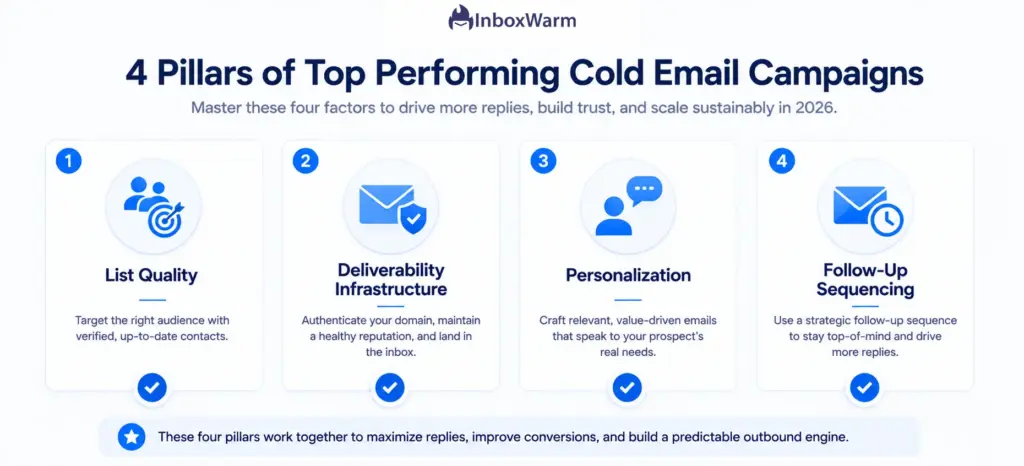
- List quality: Verified lists generate roughly twice the reply rate of unverified lists and significantly lower bounce rates, protecting domain reputation on every future send.
- Deliverability infrastructure: Proper SPF, DKIM, and DMARC setup, combined with a warmed sending domain, consistently outperforms unauthenticated, cold sending. See our guide on How to Set Up SPF, DKIM, and DMARC Correctly for the full setup.
- Personalization depth: Emails using industry-specific pain points and recent triggers achieve reply rates roughly double those using only basic personalization, like a first name.
- Sequence length and follow-ups: Four to seven touches with varied timing intervals consistently outperform single-touch outreach, since nearly half of all replies come from follow-up messages.
Does Industry Affect These Benchmarks?
Significantly. Legal services campaigns report reply rates up to 10 percent, while SaaS and software campaigns often post open rates above 47 percent but reply rates under 2 percent, since buyers in saturated categories like SaaS receive far more cold outreach and have grown selective. Benchmarking against your specific vertical produces a far more useful target than comparing against a blended global average.
Want to know where your domain currently stands against these benchmarks?
Frequently Asked Questions
2. What Counts As A Bad Cold Email Reply Rate?
A reply rate below 1 percent generally signals a deliverability or targeting problem rather than a copy problem. Since the average sits around 3.43 percent in 2026, anything well under 1 percent is worth auditing for bounce rate, authentication, and list quality issues first.
3. How Often Do These Benchmarks Change?
Benchmarks shift gradually but consistently year over year as inbox providers update spam filtering and bulk sender rules. Reply rates specifically have declined from 8.5 percent in 2019 to 3.43 percent in 2026, largely due to inbox saturation and tighter rules following the Google and Yahoo bulk sender requirements introduced in 2024.
4. Should I Prioritize Open Rate Or Reply Rate When Optimizing Campaigns?
Reply rate. It is a far more reliable signal of genuine engagement since it cannot be artificially inflated by tracking pixel preloading, the way open rate can. Open rate is useful only as a secondary, directional metric.
5. Does warm-up actually improve these benchmarks?
Yes. Warmed domains consistently show higher inbox placement rates, which directly improves both open and reply rates since the email has to reach the inbox before either metric can register. For background on the mechanics, see What Email Warm Up Is and How Does It Work.
What bounce rate should trigger an immediate campaign pause?
Most benchmark reports recommend pausing and re-verifying your list once bounce rate crosses 2 percent since reputation damage compounds rather than scales linearly past that threshold.
Bottom Line
The 2026 cold email benchmarks tell a clear story: open rate is losing reliability as a metric, reply rate continues to decline industry-wide as inboxes get more crowded, and bounce rate remains the single highest leverage for protecting domain reputation. Senders hitting elite numbers are not sending more; they are sending cleaner, smaller, better authenticated campaigns and tracking the right metrics instead of vanity ones.
Continue exploring these related guides: