

TL;DR
- Invite people who can answer a specific reader question from firsthand experience.
- Put the question in the first email. Give an approximate word count, a deadline with a time zone, and a way to reply.
- Explain where the roundup will appear and how you’ll credit contributors.
- Follow up once before the deadline if there’s still time for a thoughtful answer.
- Check names, titles, and facts before publishing. Confirm edits that could change what a contributor meant.
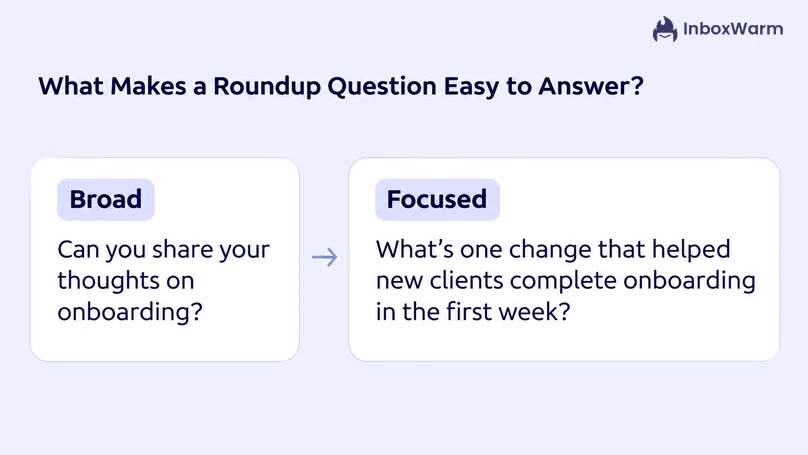
A busy expert should be able to read your invitation and decide whether they have something useful to say. “Can you share your thoughts on onboarding?” leaves them to guess what you need. “What’s one change that helped new clients complete onboarding in the first week?” gives them a question they can answer from experience.
To invite an expert to a roundup, explain who the article is for, ask one focused question, and say how to reply. Include the answer length, deadline, publication name, and attribution details so they can make a decision without another email.
Table of Contents
What Is an Expert Roundup Email?
An expert roundup email asks a specialist or practitioner to contribute a short answer alongside other perspectives on a shared question. The sender is putting the article together and gives each person enough context to submit a quote.
For example, a roundup for small agency owners might ask project leads which kickoff change helped clients finish onboarding in week one. The answers can give readers a few approaches to compare. If you’re the expert offering a quote for someone else’s article, an expert quote pitch starts with the insight you can contribute.
How Do You Choose Experts and Write a Question They Can Answer?
Start with one reader problem. Then look for contributors who have handled it in different settings and can explain what happened.
- Define the decision readers need to make. For an agency onboarding roundup, the question could be what to change when clients miss their first onboarding task.
- Find a reason to invite each person. Look for a published talk, case study, or article that shows relevant experience. Write down the specific detail you can mention in the invitation.
- Ask one question with a clear boundary. “What’s one change that helped new clients complete onboarding in the first week?” gives contributors room to describe their approach without turning the reply into an essay.
- Ask for a detail that makes the answer useful. Invite contributors to name the action they took and what they observed. Ask for a public source if they include a figure that needs verification.
A narrower question also makes the replies easier to edit together. You can compare how agencies handled the same problem and explain the circumstances in which each answer applies.
What Should an Expert Roundup Invitation Email Include?
Give contributors everything they need to decide and reply. For a short written quote, a 60–100 word target is a practical starting point. Adjust it to the length and format of your article.
- A specific subject line. Try “Expert roundup invitation: Client onboarding in week one.”
- The audience and publication. Name the site or newsletter and explain who will read it.
- Why you chose them. Refer to a detail from their work that relates to the question.
- One question and clear instructions. Give the approximate length, deadline with a time zone, and response method. If email replies work, say so.
- Attribution and publication terms. Say which details you plan to publish alongside their quote, whether you may shorten it for clarity, and whether inclusion depends on editorial selection.
An invitation through a mutual contact can use the same question and instructions. If you haven’t been introduced yet, ask the contact for a warm introduction and give them a short note they can forward.
Which Expert Roundup Outreach Email Template Should You Use?
Choose the template that matches how you know the contributor and where you are in the process. Keep the question, deadline, and credit details consistent across the invitation and follow-up.
1. How Do You Send a First-Time Expert Roundup Invitation?
Use this when you can point to work the expert has done on the topic.
Subject: Expert roundup invitation: [Specific Topic]
Hi [Name],
I’m putting together a roundup for [Publication] to help [Audience] [Reader Goal]. Your [Article, Talk, or Project] showed how you [Specific Detail], and I’d value your perspective on one question.
[One Focused Question]
If you’re interested, could you reply with [Word Count] words by [Date, Time, and Time Zone]? If we include your quote, we’ll credit you as [Name, Role, and Company or Profile]. Let me know if you’d prefer different attribution.
Thanks,
[Your Name]
2. How Do You Invite an Expert After a Mutual Introduction?
Use this once the mutual contact has made the introduction. Thank them briefly and give the expert enough context to decide on their own.
Subject: Re: [Introduction Subject]
Thanks for introducing us, [Mutual Contact]. Hi [Name],
I’m gathering short answers for a [Publication] roundup on [Topic] for [Audience]. I’d like to include the perspective of someone who’s worked on [Relevant Situation].
[One Focused Question]
If you’d like to contribute, [Word Count] words by [Date, Time, and Time Zone] would be plenty. You can reply here or email me directly. We’ll use your preferred name, role, and affiliation if we publish your answer.
Thanks,
[Your Name]
3. How Do You Follow Up Before the Roundup Deadline?
Reply in the original thread once, with enough time for the expert to contribute. Restate the question so they can answer without rereading the invitation.
Subject: Re: [Original Invitation Subject]
Hi [Name],
I’m collecting answers for [Roundup Topic] until [Date, Time, and Time Zone]. The question is [One Focused Question]
If you have time to contribute, [Word Count] words by email are enough. Feel free to pass if the timing is tight.
Thanks,
[Your Name]
What Does a Filled-In Expert Roundup Invitation Look Like?
This fictional example invites an agency operations lead to share one onboarding change. The people, publication, and talk are illustrative.
Subject: Quick quote for an agency onboarding roundup
Hi Leena,
I’m writing a roundup for the Studio Field Notes blog on how small agencies help clients get through their first week. In your Agency Ops Lab talk, you showed how you gave clients one checklist owner instead of routing every question to the whole team.
What’s one change that helped new clients complete onboarding in the first week, and how did you know it helped?
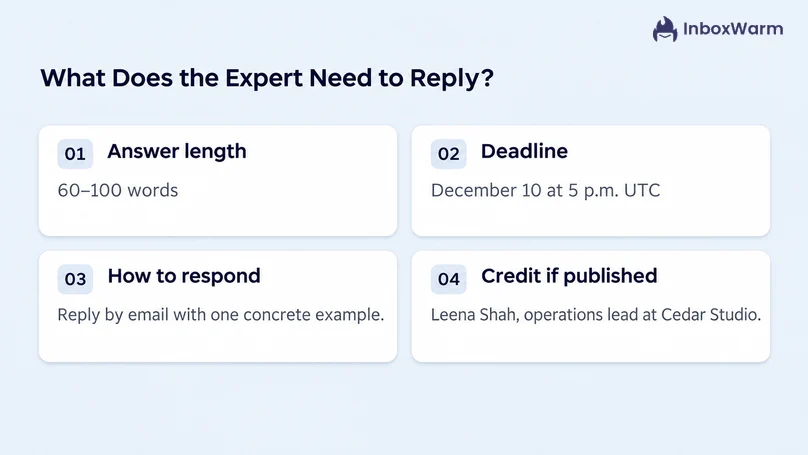
If you’re interested, could you reply with 60–100 words by December 10 at 5 p.m. UTC? One concrete example would be plenty. If we use your quote, we’ll credit you as Leena Shah, operations lead at Cedar Studio. Please let me know if you prefer a different title or attribution.
Thanks,
Nina
Leena can answer from a project she knows and choose an observation she can stand behind. The deadline and credit line also give her enough information to decide whether she wants to participate.
What Should You Do After Experts Reply?
Acknowledge each contribution and record what the expert agreed to share. This makes it easier to keep the published quote accurate and send the right update later.
- Confirm attribution. Check the spelling of their name and their preferred title, affiliation, and profile link if used.
- Check the quote in context. Verify factual claims where possible. If you need to shorten an answer in a way that could change its meaning, confirm the revised wording with the contributor.
- Explain where answers differ. If two experts recommend different approaches, show the reader what circumstances informed each answer.
- Send the published URL. Thank contributors and link to the piece so they can find their quote. If you later pitch the finished article to a newsletter editor, lead with the takeaway that fits its readers.
Frequently Asked Questions
These answers cover timing, attribution, and what to do when you receive fewer responses than expected.
How Much Time Should You Give Experts to Reply?
How Many Experts Should You Invite?
Should You Offer a Backlink for an Expert Quote?
Can You Use a Quote From an Expert’s Previous Article?
Will Experts See Your Invitation Before the Deadline?
You’ve made the question easy to answer. If the invitation lands in spam, the expert may miss your deadline altogether. Start warming up your sending inbox with InboxWarm before you send your next round of invitations.
