

- Lead with one finding that gives the journalist’s readers a reason to care. Put the report name and company introduction lower in the email.
- State who or what you studied, how many observations the result covers, and when the data was collected.
- Share the original report and methodology. Disclose who funded the study and any limitation that could change how the result is interpreted.
- Tailor the angle to the reporter’s beat. Follow up only when you have a useful new detail, such as a labeled chart or a relevant breakdown.
You spent weeks collecting data. Now you have one email to explain what the finding means and give a journalist enough information to check it. Start with the result that fits their readers, then show exactly where it came from.
To pitch original research to journalists, put one accurate finding and its relevance in the first two lines. Follow with the sample, collection dates, a link to the report and methodology, and an offer to answer questions. Use the templates below for a new report, a beat-specific finding, or a follow-up with supporting data.
Table of Contents
What Is an Original Research Pitch?
An original research pitch is an email that proposes a story based on data you collected or analysis you conducted. You might pitch a survey, an analysis of public records, or a study of a defined dataset. When you use existing public data, credit the source and explain what your analysis adds.
If a reporter has already asked for commentary, an expert quote pitch answers their specific question. A research pitch starts with a finding and gives them enough information to decide whether it could become a story.
Start with a result the data can support, then look for a reporter whose audience would find it useful.
How Do You Choose a Research Finding a Journalist Can Use?
Choose a finding that answers a question the journalist’s readers already have or helps them understand a new development. Read the reporter’s recent coverage, then describe the connection in one sentence.
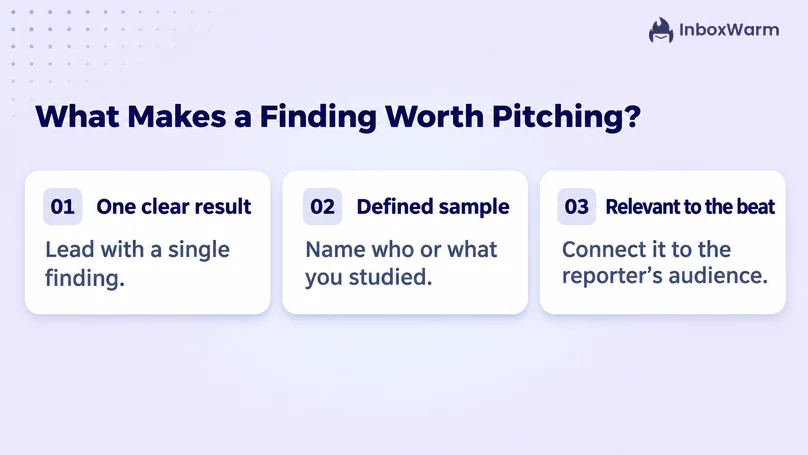
- Choose one result. Focus on a clear pattern, a difference between groups, or a measurable change. Use a trend claim only if the periods and methods are comparable.
- Name the group precisely. If you surveyed your customers, describe the result as applying to the customers who responded. Use the count behind the percentage, especially when the finding is for a subgroup.
- Explain why it matters to that beat. A local reporter may need a city-level result. A trade reporter may care more about the implications for a particular role or industry.
- Check the interpretation. If your analysis shows a relationship, describe the relationship. A claim about what caused it needs evidence that supports that conclusion.
Once the finding is clear, gather the details the reporter will need to verify it without a long email exchange.
What Should an Original Research Pitch Email Include?
Structure the email around the finding, its relevance, and the evidence behind it. Keep the first message short enough to scan and put the full details in the linked methodology.
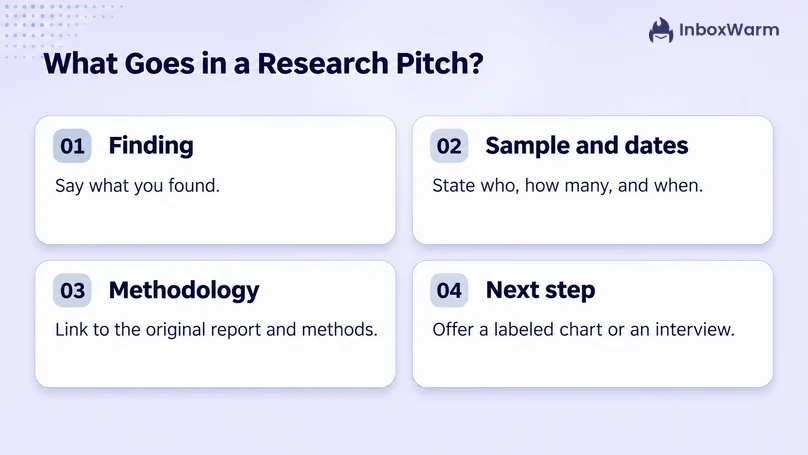
- A subject line with the finding or beat. Name the topic and the group it concerns. Use a number only if the wording still makes the result accurate.
- The result and why readers should care. Give the finding up front. Name one decision, question, or development it helps explain.
- The scope of the research. Include the sample size or number of observations, who or what was included, and the collection dates. If the finding refers to a subgroup, state that subgroup’s base.
- Direct access to the evidence. Link to the original report and methodology or to the exact table where the result appears. Identify the organization that conducted or funded the research.
- An easy next step. Offer an interview, a chart with labels and a source, or answers about the method. Say what you can share and when.
The American Association for Public Opinion Research’s disclosure standards are a useful reference for survey research. They cover details such as recruitment, collection dates, sample size, and question wording. For an analysis of records, explain the data source, definitions, exclusions, and what the dataset misses.
When the evidence is ready to share, choose the template that fits the kind of story you’re offering.
Which Original Research Pitch Email Template Should You Use?
Use the first template for a new report, the second for a finding tailored to a journalist’s beat, and the third for a follow-up that gives them something useful to work with.
How Do You Pitch a New Research Report?
Use this when a report is ready to share and one finding describes a clear reader problem or decision.
Subject: New research on [Specific Finding or Audience]
Hi [Recipient’s Name],
In our [Sample or Dataset], [Finding With Number and Group]. That may be useful for your readers who are [Specific Decision or Issue].
[Organization] [Conducted or Funded] the research. We analyzed [Sample Size and Population] from [Collection Dates]. [One Limitation That Matters.] The full report is at [Report URL], and the methodology is at [Methods URL].
Would a labeled chart or a short conversation with the researcher help?
Thanks,
[Your Name], [Role and Organization]
How Do You Pitch a Finding Specific to a Journalist’s Beat?
Use this when the relevant result is for a geography, industry, or group your research can describe accurately. Give the subgroup count.
Subject: [Local or Industry Finding] for your [Beat] coverage
Hi [Recipient’s Name],
Your coverage of [Specific Topic] raised a question about [Reader Question]. Among [Number of Observations in Subgroup] in our [Study or Dataset], [Finding].
The analysis covers [Dates] and defines [Important Term] as [Short Definition]. [Study Sponsor or Relevant Relationship.] Here are the [Table or Report URL] and the [Methodology URL].
I can share the breakdown for [Relevant Group] or answer questions about how we calculated it.
Best,
[Your Name]
How Do You Follow Up With a Chart or Additional Finding?
Use this when new material adds context that matters for the reporter’s story. Reply in the original thread so they can see the earlier research pitch.
Subject: Re: [Original Research Pitch Subject]
Hi [Recipient’s Name],
One detail that may help with your [Topic] coverage: [New Finding or Chart Takeaway]. It covers [Group, Base, and Dates]. The labeled chart is at [Chart URL], with the source table and notes at [URL].
If you’re working on this topic, I can clarify [Specific Method or Definition].
Thanks,
[Your Name]
The new-report template puts the finding first. See how the sample, dates, and method fit into a short email.
What Does a Filled-In Research Pitch Look Like?
This fictional example uses illustrative data and reserved .example addresses. It shows how to present a finding a trade reporter could verify in a real pitch.
Subject: 38 of 120 surveyed agency leads reported three or more approval rounds
Hi Aisha,
In a survey of 120 agency operations leads, 38 (32%) said that getting client approval took three or more review rounds on their most recent project. The finding could add context to your coverage of how small agencies plan delivery timelines.
Cedar Studio funded and ran the unweighted online survey from September 7 to 18, 2026. We recruited leads at agencies with 5 to 30 employees through our newsletter and a professional community. The result describes the people who replied.
The full report is at cedarstudio.example/research/agency-approvals. The question wording and response counts are at cedarstudio.example/research/agency-approvals/methodology.
Would a labeled chart of the response counts help?
Thanks,
Nina Rahman, Cedar Studio
The first line gives the count and denominator as well as the rounded percentage. The recruitment and funding disclosures help an editor decide how to frame the finding. The methodology link shows where the exact question and counts would be documented in a real study.
When Should You Follow Up on a Research Pitch?
Follow the reporter’s instructions and the story’s timing. A short reply can be useful if you can share a labeled chart, correct a detail, or give a relevant breakdown the original email lacked.
Cision’s media follow-up guidance discusses following up once and respecting the reporter’s preferences. If the journalist requested a chart or table, make the follow-up after sending requested information about what they can check in that material. If they decline or ask you to stop, close the thread.
Frequently Asked Questions
Use these answers to decide what to share when a reporter needs more context or early access.
Should You Attach the Report or Link to It?
Start with a direct link to the report and methodology unless the reporter asks for attachments. Check that the links work from a signed-out browser.
Can You Pitch a Small Sample?
Yes, if the finding is useful within its scope. Explain who was studied, how they were recruited, and what the sample can support. For small subgroups, give the count alongside any percentage.
How Do You Pitch Research Under Embargo?
Ask whether the reporter agrees to the embargo before sharing restricted findings. Give the date, time, and time zone and state when the report will be public. Follow the outlet’s policy.
Can You Ask the Journalist to Link to the Research?
Provide the original research URL so the journalist can verify the finding and cite it if they choose. Leave the final wording and linking decision to the publication.
Will the Reporter See Your Findings Before Their Deadline?
You checked the numbers and gave the journalist a clear story angle. If the pitch lands in spam, they may miss it while the finding is timely. Warm up your sending inbox with InboxWarm before your next research launch.
