
TL;DR
- Read the publication’s contributor guidelines and search its archive before emailing an editor.
- Pitch one original article idea. Include a working headline, a brief explanation of the angle, and what readers will learn or be able to do.
- Show why you can write it. Mention relevant experience or evidence and share one suitable writing sample, unless the editor requests a different format.
- Follow the submission process. Send one brief follow-up when guidelines allow it and you have something useful to add.
“I’d love to write about client onboarding” gives an editor a topic. “How to Run a Client Kickoff When the Decision-Maker Can’t Attend” gives them an article they can picture. A strong guest post pitch makes it easy for the editor to judge the fit before anyone writes a draft.
To pitch a guest post, read the publication’s guidelines and send one idea tailored to its readers. Include a working headline, a short explanation of what the article will cover, the experience or evidence you’ll draw on, and a relevant writing sample. Ask whether the editor would like an outline or draft.
Table of Contents
What Is a Guest Post Pitch?
A guest post pitch is a short proposal to write an original article for someone else’s publication. It explains what you want to write, who it will help, and why you can cover it well.
A pitch can work by email when the publication accepts email submissions. Some outlets prefer a form, an outline, or a complete draft. For example, Harvard Business Review’s contributor guidelines explain the role of demonstrated expertise, and its submission instructions point contributors to a dedicated form. Use the route your target publication specifies.
Once you know how the editor accepts submissions, check what the publication has already covered.
How Do You Find an Article Angle the Publication Hasn’t Covered?
Start with a specific problem its readers face. Search the archive for that problem and read the closest pieces. Look for a question those articles leave open, a group of readers they don’t address, or a practical example that would help someone apply the advice.
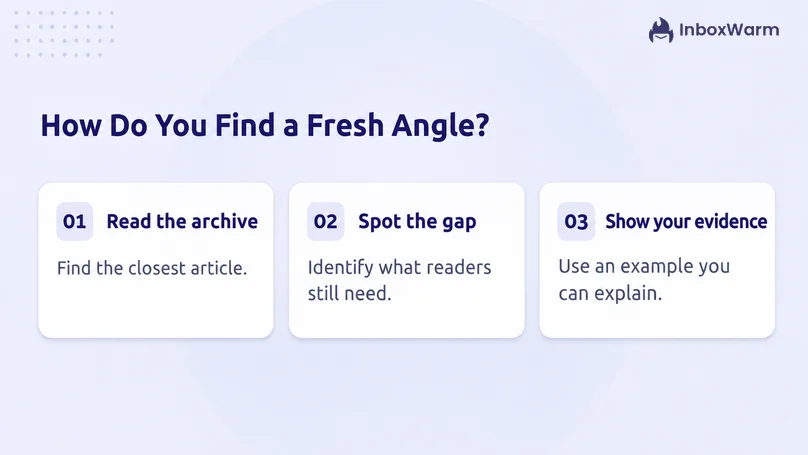
- Identify the reader. Note the audience and level of detail in recent posts. A short introduction for new freelancers and a detailed process for agency leads serve different needs.
- Check similar coverage. Use the site’s search or a query such as
site:publication.example client kickoff. Look for related terms as well as your planned headline. - Find a useful gap. Write down the closest article, what it handles well, and the decision or problem your article would help readers solve.
- Check what you can prove or show. Identify a process you know firsthand, a worked example you can share, or reliable sources that support the angle.
If the site has already covered the same question in depth, find a different angle or a better-fit publication. If you have an existing guide or tool that fills a gap in a curated list, use a resource outreach email to offer that asset directly.
Once you can state the gap in a sentence, use it to explain the idea in your email.
What Should a Guest Post Pitch Email Include?
Give the editor enough information to decide whether they want to see more. Follow any limits on length, links, attachments, or the number of ideas.
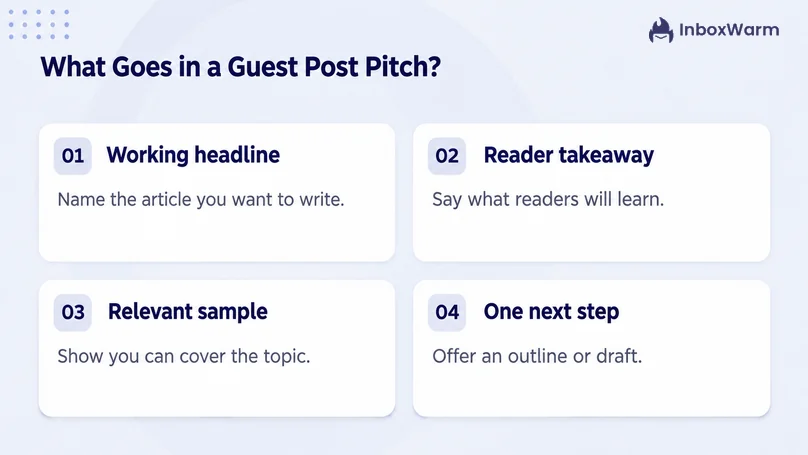
- A subject line with the idea. Try “Guest pitch: [Specific Working Headline]” when the publication doesn’t prescribe a format.
- A reason it fits. Mention the relevant section, reader problem, or article you read.
- A working headline and clear angle. Use a sentence or two to explain what the piece covers and what readers can take away.
- Relevant expertise and a sample. Name the experience, example, or sources you can draw on. Share one sample that shows similar subject knowledge or writing style.
- One next step. Ask whether the editor would like a short outline or a draft, depending on their process.
Disclose a relevant employer, client, or product affiliation if it could affect the piece. Leave links and anchor text for the editor. Google’s link spam policies identify paid links for ranking purposes and optimized links in guest posts among the examples of link spam. Keep the proposal centered on what the article contributes to the publication.
Use those details to choose the email that matches your reason for reaching out.
Which Guest Post Pitch Email Template Should You Use?
Use the first template for a new idea, the second when an existing article gives you a clear starting point, and the third when a brief follow-up adds something the editor can assess.
How Do You Send a First-Time Guest Post Pitch?
Use this when you’ve confirmed the publication accepts contributions and you have one idea that fits a specific section.
Subject: Guest pitch: [Working Headline]
Hi [Recipient’s Name],
I’d like to pitch “[Working Headline]” for [Publication or Section]. It would help [Specific Readers] [Solve a Specific Problem]. I’d show [Concrete Example or Step] so readers can [Apply the Takeaway].
I [Relevant Experience], and I’d draw on [Example, Method, or Sources]. Here’s a related writing sample: [URL].
Would a short outline be useful?
Thanks,
[Your Name]
How Do You Pitch an Article That Builds on Existing Coverage?
Use this when you can name the follow-on question the existing article raises and show what your piece will add.
Subject: Follow-on article idea for [Existing Topic]
Hi [Recipient’s Name],
In “[Existing Article Title],” you cover [Specific Point]. I’d like to pitch “[Working Headline],” a follow-on piece about [Related Question the Existing Article Leaves Open].
The article would walk readers through [Specific Steps or Example] and give them [Practical Takeaway]. I [Relevant Experience], and this sample shows how I’d approach the topic: [URL].
Would you be interested in an outline for [Section]?
Best,
[Your Name]
How Do You Follow Up on a Guest Post Pitch?
Use this when the submission window allows a follow-up and you can add a concrete example, source, or sharper takeaway.
Subject: Re: [Original Subject]
Hi [Recipient’s Name],
One detail to add to my pitch for “[Working Headline].” I can include [New Example or Source], which would help readers [Take a Specific Action].
If the idea fits [Publication or Section], I’d be happy to send a short outline.
Thanks,
[Your Name]
The second template is useful when you can show exactly how your angle extends a published article. Here’s what that looks like in practice.
What Does a Filled-In Guest Post Pitch Look Like?
This fictional example shows how someone who runs agency kickoffs could pitch a practical follow-on article. The people, publication, and sample URL are illustrative.
Subject: Guest pitch: How to Run a Client Kickoff When the Decision-Maker Can’t Attend
Hi Aisha,
Studio Field Notes’ client kickoff guide covers what to put on the agenda. I’d like to pitch a follow-on piece for your Agency Operations section called “How to Run a Client Kickoff When the Decision-Maker Can’t Attend.”
I’d show how to separate decisions the team can make live from approvals they need to confirm afterward. The article would include a short decision log with an owner and deadline for each open item.
I run creative handoffs and client approvals at Cedar Studio. Here’s a related writing sample on role assignment in project briefs: cedarstudio.example/notes/project-brief-roles.
Would you like a short outline?
Thanks,
Nina Rahman
The pitch names what the existing guide covers, puts the new scenario in the headline, and describes a takeaway an editor can evaluate. The sample is closely related to the proposed article, so it also shows how the writer explains the work.
When Should You Follow Up on a Guest Post Pitch?
Use the publication’s stated response window. If none is given, give the editor a reasonable review period and consider one short reply in the original thread when you can add a useful detail. Respect instructions that say only accepted pitches receive a reply.
If you plan to submit the idea elsewhere, check the publication’s exclusivity and simultaneous-submission policies first. Keep a record of where you sent it and when, so you can handle any overlap clearly.
Frequently Asked Questions
Use these answers when the contributor guidelines leave a question open.
Should You Send a Full Draft With a Guest Post Pitch?
Send a full draft when the publication requests one. If it accepts pitches, start with the headline, angle, and reader takeaway. Offer an outline or draft as the next step.
Can You Pitch Without a Published Writing Sample?
If the guidelines allow it, share a relevant piece from your own site or portfolio. Choose something that shows how you explain a similar problem to a similar reader.
How Many Guest Post Ideas Should You Send?
Start with one well-developed idea unless the editor asks for several. Give them a working headline and enough detail to judge the audience fit.
Can You Pitch the Same Article to Multiple Editors?
Check each publication’s rules on simultaneous submissions and exclusivity. If a publication requires exclusive consideration, submit elsewhere only after that window ends or you withdraw the pitch.
Will the Editor See Your Guest Post Pitch?
You read the archive and wrote an angle that fits. If the email lands in spam, the editor may never see it. Warm up your sending inbox with InboxWarm before your next round of outreach.