
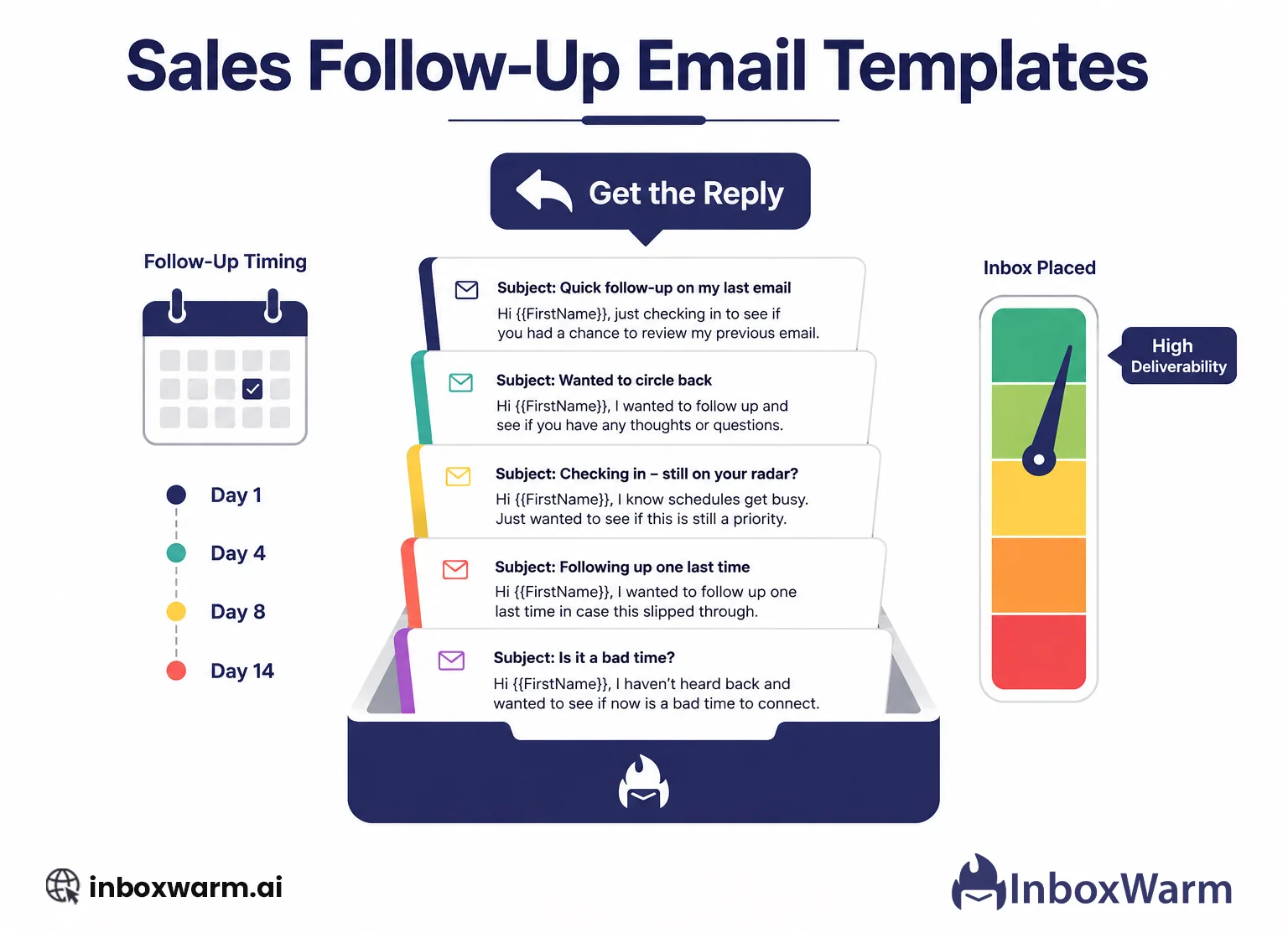

- Most sales deals require 5+ follow-ups, but most reps stop after 1–2 and lose pipeline as a result.
- This guide includes 20 real-world sales follow-up email templates designed for different stages of outreach, no-response follow-ups, post-call emails, value-add messages, check-ins, break-ups, and re-engagements.
- Each template comes with subject line options, deliverability risk level, and practical guidance on what actually increases reply rates (or causes emails to fail), including structure, timing, and formatting decisions.
- It also shows how small changes in message design and sequencing directly impact prospect engagement.
What separates this guide from a standard template list: every template includes a deliverability note. Most follow-up templates are written as if the only thing that matters is what the email says. In reality, how it is formatted, how many links it contains, and whether the sending domain is warmed up all determine whether the email reaches the inbox in the first place.
A template that cannot get delivered cannot get a reply. This guide covers both.
The templates are organized by situation: no response, post-call, value-add, break-up, and more.
Each template shows the subject line, two or three subject line alternatives, and the full body text.
Variables are shown in [brackets] rather than curly braces to reduce the risk of an unfilled merge tag sending as a literal placeholder.
Every template includes a deliverability rating: low risk, medium risk, or high risk, with specific notes.
Read the deliverability note before using any template on a warming domain.
Table of Contents
Why Do Most Sales Follow-Up Emails Fail to Get a Reply?
There are two categories of reasons a follow-up email fails. The first is copy: the email is not compelling enough to prompt a response. The second is deliverability: the email never reached the inbox. Most follow-up guides only address the first.
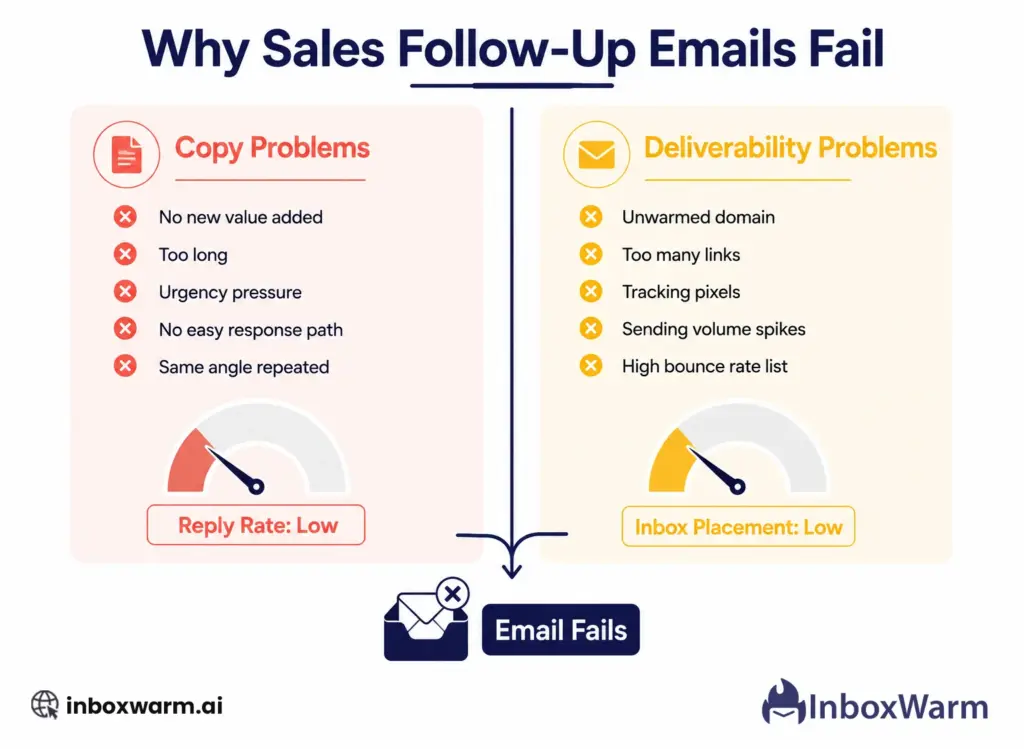
On the copy side, the most common problems are:
- Following up with ‘just checking in’ or ‘bumping this up’ with no new value added.
- Sending increasingly long follow-up emails when shorter ones perform better.
- Using urgency language that reads as pressure rather than genuine concern.
- Not giving the prospect an easy way to respond, either with a yes, a no, or a not right now.
- Recycling the exact same angle from the original email instead of approaching from a different direction.
Most failed outreach campaigns are not a result of weak messaging alone but poor execution of the cold email follow-up strategy, where timing, relevance, and sequence structure are misaligned.
On the deliverability side, the most common problems are:
- Sending from a domain that was never warmed up before the campaign started.
- Adding links, images, or HTML formatting that increase the email’s spam score.
- Including tracking pixels in follow-up emails being sent to corporate email gateways.
- Increasing follow-up volume too quickly, causing the domain’s sending pattern to look like a spam burst.
- Sending to a list with high bounce rates, which damages sender reputation between campaigns.
The templates below address both. Each one is built to be both worth replying to and safe to send.
What Makes a Sales Follow-Up Email Template Worth Using?
Before getting into the templates, here is the framework behind them. Every template in this guide was built to satisfy these four criteria:
| Criterion | What It Means in Practice |
|---|---|
| It adds something new | Every follow-up must give the prospect a reason to engage that was not in the previous email. A different angle, a useful resource, a relevant observation, or simply a graceful exit offer. 'Just following up' is not a reason. |
| It is easy to respond to | The best follow-up emails can be answered in one sentence or less. If the prospect has to compose a paragraph to reply, they will not. Make the ask specific and the response simple. |
| It is short enough to skim | Follow-ups should be shorter than the original email, not longer. A three-sentence follow-up gets read. A nine-sentence follow-up gets archived. |
| It is deliverability-safe | Plain text, minimal links, no tracking pixel on warming domains, no promotional language. A follow-up that looks like a personal email performs better on both spam filters and reply rates. |
What Are the Best Follow-Up Templates After No Response?
This section focuses on the early-stage sales follow-up sequence, where most cold email campaigns fail due to poor email sequence timing and lack of message variation.
- Plain text only. No links. Under 30 words in the body.
- Thread reply format: uses the same subject line with the original email, which is legitimate and maintains context.
- Safe to use on warming domains. No spam triggers.
- Contains one link: acceptable in a follow-up when the domain is warmed and inbox placement is stable.
- Do not use on a warm domain. The link adds to total link count across the sequence.
- Why it works: ‘No agenda beyond that’ is disarming. It frames the email as a genuine resource share, not a sales move. That framing makes the reply rate higher than a standard CTA.
- Only use this template when the resource is genuinely relevant. A poorly matched resource destroys credibility faster than no follow-up at all.
- Contains one link: acceptable in a follow-up when the domain is warmed and inbox placement is stable.
- Do not use on a warmed domain. The link adds to total link count across the sequence.
- Plain text. No links. Specific personalization based on a real trigger event.
- Trigger-event personalization is nearly impossible to achieve with a simple merge tag, which means spam filters score it as a personally composed email.
- Why it works: connecting a follow-up to a real event the prospect is experiencing (a hire, a launch, a funding announcement) gives them an immediate reason to read. It also demonstrates you are paying attention.
- Requires real research. Do not fake the trigger event. Prospects notice and it destroys trust.
What Are the Best Follow-Up Templates After a Sales Call?
- Plain text. No links. Numbered structure is fine in a post-call context because the email is clearly a personal summary.
- Why it works: reflecting back the prospect’s own words (not yours) shows you listened. Most sales follow-up emails recap what the seller wants the prospect to remember, not what the prospect actually said. This does the opposite.
- The ‘Does that match your notes?’ close is brilliant for two reasons: it invites a response, and it gives the prospect a chance to correct any misunderstanding before it becomes a deal obstacle.
- Contains one link. Acceptable in a post-call follow-up where the relationship is already warm.
- Do not send this from a warming domain. The link counts toward the domain’s total link density.
- Why it works: ‘As promised’ confirms the email is expected, not unsolicited. The specific call-out to a relevant section demonstrates you actually read the resource rather than just forwarding a link. That detail is what separates a thoughtful follow-up from an automated one.
- Plain text. No links. Under 40 words in the body.
- Why it works: it puts the agreed next steps in writing, which increases follow-through on both sides. The single question at the end requires a one-word response (yes or no), which reduces reply friction to almost nothing.
- The brevity is intentional. A long confirmation email looks like you are trying to re-pitch. This email looks like you are doing what you said you would do.
What Are the Best Follow-Up Templates for Checking In Without Being Pushy?
- Plain text. No links. No promotional language.
- Why it works: this template acknowledges a real truth, which is that most non-responses are about timing rather than disinterest. Giving the prospect explicit permission to ask you to go away actually increases reply rates, because it removes the pressure of having to come up with a polite rejection.
- The phrase ‘get out of your inbox’ is casual and human. It signals that you are not going to chase them endlessly, which paradoxically makes them more likely to stay engaged.
- Plain text. No links. Binary choice structure.
- Why it works: ‘A quick yes or no is all I need’ is one of the most reply-friendly phrases in cold outreach. It frames the ask as something the prospect can handle in 10 seconds. Most people prefer a clear binary choice over an open-ended ‘let me know your thoughts.’
- The second sentence names the specific problem rather than just the product or company. This keeps the focus on them, not on you.
- Plain text. No links. Direct acknowledgment of the outreach history.
- Why it works: it is transparent. Most prospects appreciate a sender who acknowledges reality (‘I have reached out a few times’) rather than pretending each email is the first contact. The binary offer at the end (‘if yes / if not’) is easy to act on and signals respect for their time.
- This template is particularly effective at re-engaging cold sequences because it resets the dynamic from ‘salesperson pursuing prospect’ to ‘two professionals being direct with each other.’
What Are the Best Value-Add Follow-Up Templates?
- Contains one link if including the case study URL. Consider the 2-sentence summary option if sending from a warming domain.
- Why it works: a case study from a company the prospect recognizes (or can relate to) is more persuasive than a product claim. It shifts the conversation from ‘trust us’ to ‘here is evidence.’ The specificity of matching the case study to a problem the prospect actually mentioned is what makes this feel like a follow-up rather than a drip campaign.
- Only use this template when the resource is genuinely relevant. A poorly matched resource destroys credibility faster than no follow-up at all.
- Plain text. No links. The insight itself is the value, not a link to content.
- Why it works: “Whether or not we end up working together” is a genuinely powerful phrase. It signals that you are not contingently helpful, which is the opposite of how most salespeople communicate. Prospects trust people who give value without conditions.
- This template only works if the insight in paragraph two is genuinely non-obvious and useful. If it is generic, it reads as a hollow attempt to seem helpful.
- Plain text. No links. Competitive intelligence framing.
- Why it works: people in sales and business development are acutely aware of what their competitors are doing. A follow-up that brings them genuinely useful competitive intelligence is impossible to ignore. This template works because it is about them, not you.
- Requires real research. The competitive update must be real and specific. A vague ‘your industry is changing’ observation has the opposite effect.
What Are the Best Break-Up Email Templates for Cold Outreach?
- Plain text. No links. Under 50 words. No urgency language.
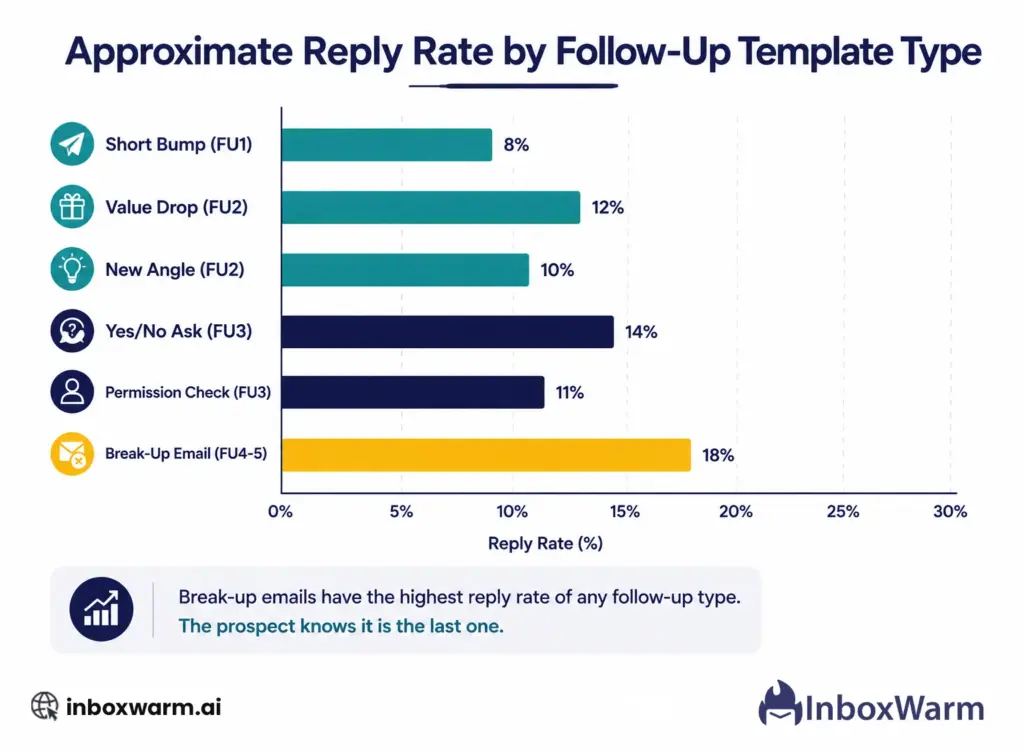
- Why it works: it is final without being dramatic. ‘I am going to assume the timing is off’ is charitable rather than accusatory, which means the prospect does not feel judged for not responding. Ending with an open invitation rather than a closed door keeps the relationship intact.
- Do not use ‘I am disappointed you did not respond’ or ‘I am surprised I have not heard back.’ Both create a guilt dynamic that damages trust.
- Plain text. No links. One specific claim followed by a binary offer.
- Why it works: the honesty framing (‘before I do, I wanted to be honest’) signals that what follows is a real statement of belief, not a sales script. The prospect reads it as a final, genuine pitch rather than another automated follow-up.
- The binary offer at the end (‘if I am wrong / if there is any chance I am right’) is psychologically compelling. It acknowledges uncertainty while making the upside case one more time.
- Plain text. No links. References the original conversation without re-sending the pitch.
- Why it works: reopening a closed sequence after months of silence does not feel like harassment because time has passed. The ‘things may have changed on your end’ framing is accurate, which most salespeople forget. Priorities shift. Budget cycles change. A prospect who was a hard no in March may be a genuine opportunity in September.
- This email should feel like running into an old acquaintance, not like picking up where a rejected pitch left off.
What Follow-Up Templates Work Best for Specific Industries?
- Plain text. No links. Specific reference to the proposal rather than a generic follow-up.
- Why it works: instead of ‘just checking in on the proposal,’ this email addresses a specific part of the proposal that the prospect is likely thinking about. It signals you understand the evaluation process they are going through and are proactively helping them think it through.
- Plain text. No links. Product-specific action referenced without a hard upsell.
- Why it works: it references a specific in-product action rather than asking a generic ‘how is the trial going?’ The aha moment reference signals you know your product’s value delivery path well enough to guide the user to it. That expertise builds confidence.
- Plain text. No links. The least salesy email in this entire guide.
- Why it works: asking to be redirected signals humility and respect for the recipient’s time. It also gives them an extremely low-effort response option: reply with a name and an email address. Many non-responses to cold email happen because the prospect does not know how to say no. This gives them a way to help without having to engage.
- Plain text. No links. The social proof is delivered as a statement, not as a link to a case study.
- Why it works: a before-and-after structure in two sentences is one of the most compelling sales communication formats that exists. The prospect maps their own situation onto the ‘before’ and imagines the ‘after.’ That visualization does the selling.
- Only use a customer name if you have permission to share it externally. If not, use ‘[B2B SaaS company similar to yours]’ or the industry name instead.
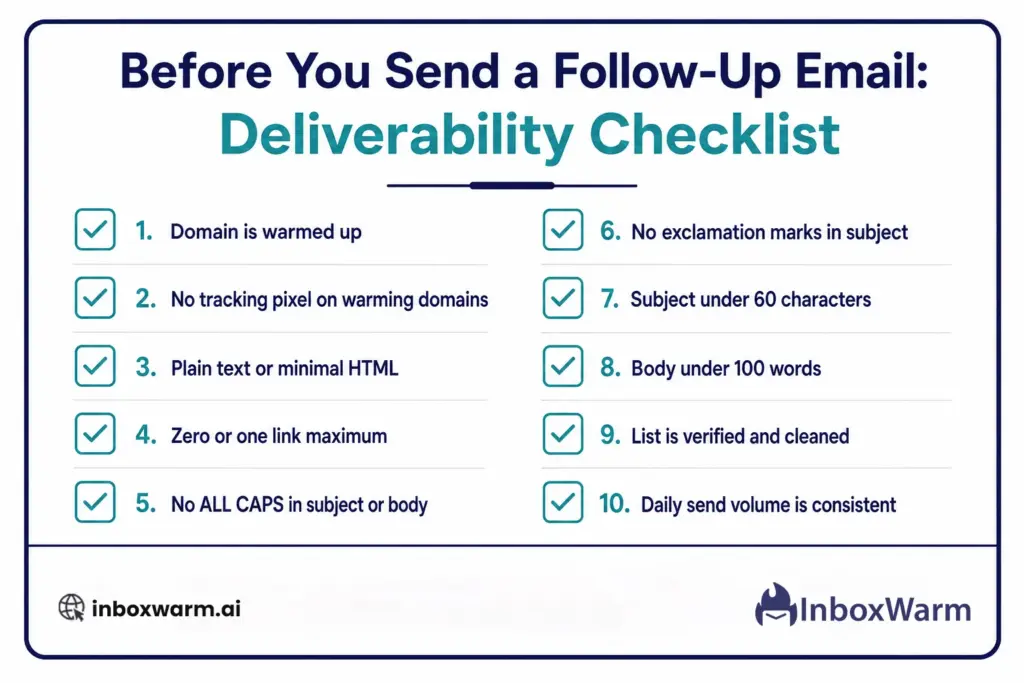
How Does Email Deliverability Affect Sales Follow-Up Performance?
Every follow-up email in your sequence faces the same infrastructure challenge as the original cold email: it has to reach the inbox before a human can read it. Follow-up emails are often more deliverability-vulnerable than the original, especially without email warm-up in place. All three of those patterns increase spam filter risk
| Deliverability Variable | How It Changes Across a Sequence |
|---|---|
| Sending volume | Should stay consistent day over day. Spiking volume on the days you send follow-ups creates an irregular pattern. |
| Link count | Should decrease or hold at zero as the sequence progresses. Adding links in follow-ups is the opposite of what deliverability requires. |
| Email length | Should decrease as the sequence progresses. Most sellers do the opposite. |
| Urgency language | Should be absent at all points in the sequence. 'Final reminder' and 'last chance' are spam trigger phrases regardless of where they appear. |
| Plain text vs HTML | Should be plain text throughout. Adding HTML formatting in later follow-ups increases risk without benefit. |
| Open tracking | Consider disabling on warming domains. The tracking pixel adds an HTML image tag to every email in the sequence, not just the first. |
| Domain reputation |
Keep your email warm-up running in the background while your follow-up sequence is active.
Each follow-up email in a sequence generates its own set of engagement signals: opens, replies, ignores, and occasionally spam complaints. Without warm-up maintaining a baseline of positive engagement, the negative signals from an outreach sequence accumulate without a counterbalance.
This is especially important for longer sequences (4 to 6 follow-ups) where the later emails are going to the least engaged portion of the list.
Templates Are Step Two. Deliverability Is Step One.
A follow-up sequence only works when your emails reach the inbox. InboxWarm.ai builds and maintains the sender reputation that gets your entire sequence delivered.
Frequently Asked Questions
What Is the Best Subject Line for a Sales Follow-Up Email?
The best subject lines for sales follow-ups are short, specific, and non-promotional. Question-format subject lines consistently outperform statement formats. 'Still relevant?' outperforms 'Following up on our conversation.' Personalized subject lines that reference something specific about the prospect's situation outperform generic ones. Subject lines with ALL CAPS words, exclamation marks, or the word "FREE" are spam filter triggers and should be avoided entirely in a cold outreach context.
How Long Should a Follow-Up Email Be?
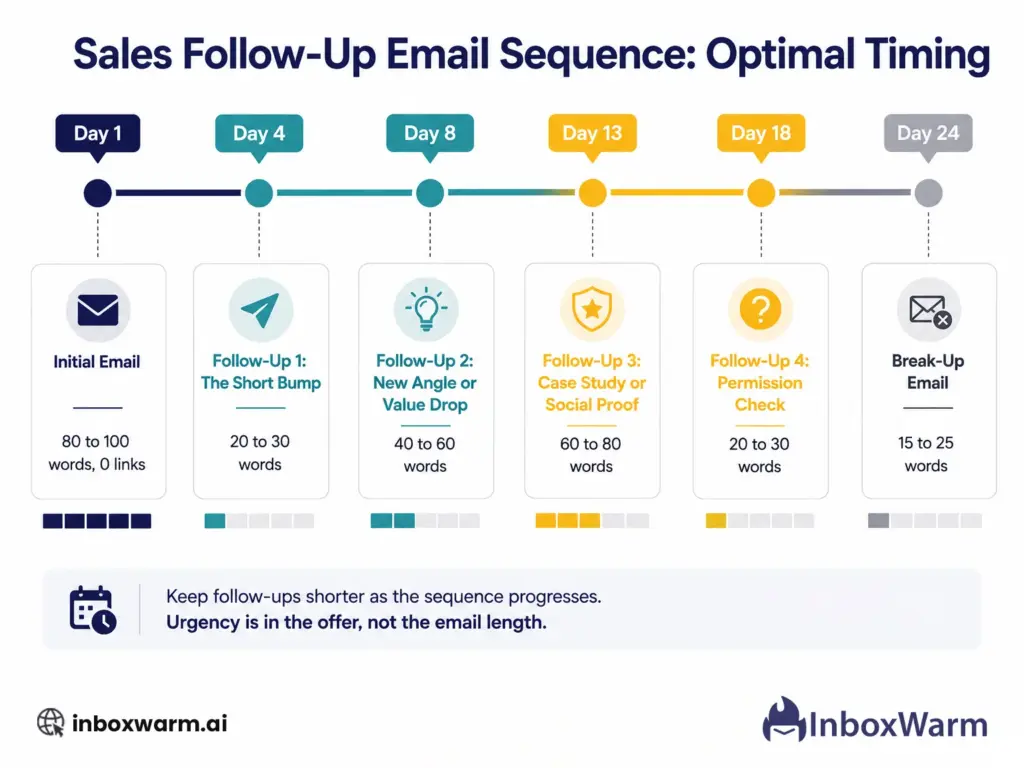
Follow-up emails should be shorter than the original cold email, not longer. A first cold email should be 80 to 100 words. A first follow-up should be 30 to 50 words. A break-up email should be 15 to 25 words. The progression is intentional: shorter emails are easier to respond to, easier to skim on mobile, and less likely to trigger spam filters based on keyword density.
How Soon Should You Send a Follow-Up Email?
The optimal spacing between a cold email and the first follow-up is three to five business days. Following up the next day signals impatience and can generate spam complaints from prospects who feel harassed. Waiting two weeks between follow-ups loses momentum. For a standard four-follow-up sequence: Day 1 (original), Day 4 to 5 (follow-up 1), Day 8 to 10 (follow-up 2), Day 14 to 16 (follow-up 3), Day 21 to 25 (break-up email).
Should Sales Follow-Up Emails Be Plain Text or HTML?
Plain text is better for both deliverability and reply rates in cold outreach. Plain text emails look like personal emails composed in a mail client. HTML emails look like marketing campaigns. Cold outreach is supposed to look like the first category. There are legitimate use cases for HTML in follow-ups, such as sharing a formatted case study or a structured recap of a meeting, but for the majority of cold outreach follow-ups, plain text wins on every relevant metric.
Why Are My Sales Follow-Up Emails Going to Spam?
The most common reasons sales follow-up emails land in spam are the following: the sending domain was not warmed up before the campaign; the follow-ups include links or HTML elements that increase the spam score, open tracking pixels are triggering corporate spam filters. Urgency language like 'final reminder' or 'last chance' is triggering keyword filters; the daily sending volume is inconsistent and spiking on follow-up send days; or the list includes old addresses generating hard bounces. Copy is almost never the primary reason. Infrastructure and deliverability are.
Conclusion
Sales follow-up emails are where most deals are won or lost. The first cold email starts the conversation, but the follow-ups decide the outcome.
The 20 templates in this guide cover every key stage of a cold outreach sequence, from early no-response follow-ups to value-add messages, post-call emails, break-ups, and long-term re-engagement. Each one is designed to improve replies while keeping deliverability in mind.
But results don’t depend on copy alone. Your sales follow-up sequence, cold email follow-up strategy, and email sequence timing all play a direct role in whether your emails actually reach the inbox and get responses.
Even strong messaging fails without proper setup. That’s why many SaaS outbound teams also use an email warm-up tool to maintain sender reputation and improve inbox placement across the entire sequence.
Start with the right template. Then make sure your timing and deliverability are working just as hard as your copy.