
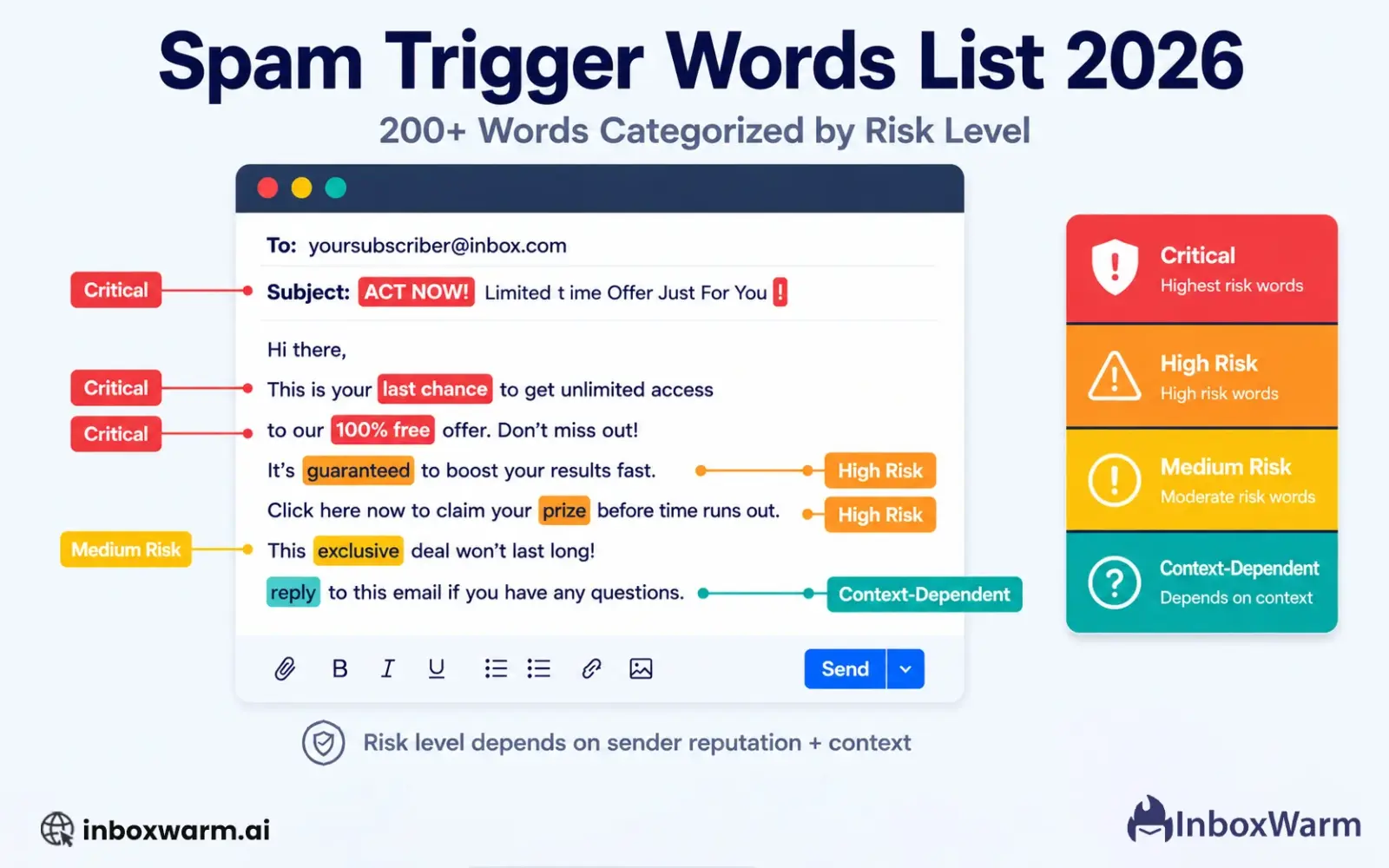

- Spam trigger words still affect email deliverability in 2026, especially in cold outreach, but they are not the biggest spam factor anymore.
- Modern spam filters evaluate sender reputation, domain warm-up, authentication, engagement signals, and content together.
- This guide ranks 200+ spam trigger words into four risk tiers, from Critical to Context-Dependent, and includes safer alternatives for each.
- The highest-risk categories include:
- Financial promises
- Fake urgency
- Phishing-style language
- Bulk cold-email patterns
- Crypto and AI-related phrases
- But remember: strong sender reputation matters more than perfect wording.
You removed “FREE” from the subject line. Changed “Act now.” Cleaned up the punctuation. And your emails still went to spam.
That happens because spam filters in 2026 are not simple keyword scanners anymore. Gmail, Outlook, Yahoo, and corporate email gateways evaluate hundreds of signals at once: sender reputation, authentication, domain history, engagement, sending patterns, and content.
Spam trigger words still matter, especially in cold email. But they work more like risk multipliers than automatic spam flags.
A trusted sender can often use words like “free” without issues. An unwarmed domain usually cannot.
This guide breaks down 200+ spam trigger words by risk level, explains which categories became more dangerous in 2025–2026, and shows the safer alternatives that reduce filtering risk without making your copy sound robotic.
- Read Section 1 first: it explains how modern spam filters actually work in 2026. This context changes how you interpret the word list.
- Use the four-tier risk system to prioritize: fix critical words first, then high-risk. Medium- and context-dependent words are lower priority.
- Each word has a safer alternative. The alternatives are not just synonym swaps, either. They are phrasings that communicate the same intent without the spam filter risk.
- Section 5 covers what matters more than word choice. If you have already cleaned up your word list and are still in spam, go there first.
Table of Contents
How Do Spam Filters Actually Evaluate Your Email in 2026?
Modern spam filters are machine learning systems, not keyword blocklists. Gmail, Outlook, Yahoo, and corporate email gateways like Mimecast and Proofpoint evaluate hundreds of signals simultaneously to determine whether an email belongs in the inbox or the spam folder.
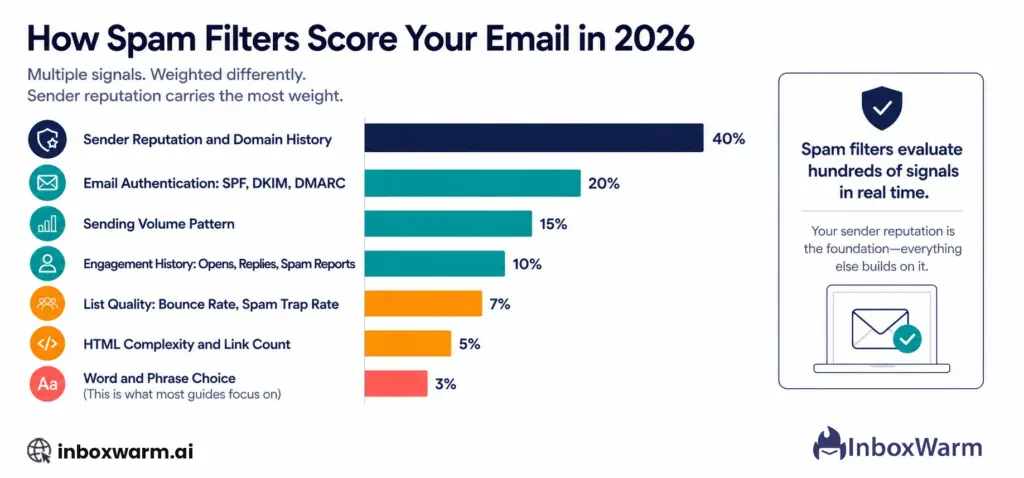
Here is why this matters for how you use the word list below. The risk level of any spam trigger word is not fixed. It is multiplied or reduced by the other signals the spam filter evaluates at the same time.
| Signal Context | Effect on Word Risk |
|---|---|
| Strong sender reputation + fully warmed domain | A single 'free' or 'act now' from a trusted sender with high inbox placement history is unlikely to cause filtering. The positive reputation signal outweighs the word-level flag. |
| New or unwarmed domain | The same word from a domain with zero sending history and no positive engagement signals faces maximum scrutiny. Every spam signal stacks up without a reputation counterbalance. |
| Authentication missing (no DMARC) | Spam filters increase scrutiny on emails that fail authentication checks. A word that would be fine from an authenticated sender becomes higher risk without SPF, DKIM, and DMARC in place. |
| High bounce rate on recent campaigns | If your domain recently sent to a low-quality list and generated hard bounces above 2 percent, your reputation is damaged. Spam words carry more weight when your reputation is already under pressure. |
| Multiple spam signals in one email | One spam word: low risk for a trusted sender. Three spam words plus a tracking pixel plus two links plus HTML formatting: high risk even from a sender with decent reputation. |
The practical implication
If your domain is unwarmed or has a poor reputation, avoiding spam trigger words will not save your deliverability. It is like checking your tire pressure while the engine is on fire.
Fix the foundation first: warm up your domain, configure SPF, DKIM, and DMARC, clean your list. Then use this word list as a content hygiene checklist on top of that foundation.
What Are the Four Risk Tiers in This Spam Trigger Words List?
Most spam-trigger word lists treat every entry as equally dangerous. They are not. A word that guarantees spam folder placement in one context may be completely harmless in another.
This list uses a four-tier system so you can prioritize correctly.
Avoid in all contexts. Near-guaranteed filter regardless of sender reputation.
Significantly increases spam score. Replace when possible.
Risky in combination with other signals. Fine from a trusted sender.
Only risky in specific contexts: cold outreach, promotional sends.
| Tier | What to Do | Examples |
|---|---|---|
| Critical | Remove or replace immediately. These words consistently trigger filters across Gmail, Outlook, Yahoo, and corporate gateways regardless of sender reputation. No context makes them safe in cold emails. | Guaranteed income, Act now, You won, Your account has been compromised, ALL CAPS subject lines |
| High Risk | Replace with a safer alternative where possible. These words significantly increase the spam score, especially for senders on new or warming domains. Context can occasionally justify their use for strong senders. | FREE, Limited-time offer, Discount, Unsubscribe, Click here |
| Medium Risk | Monitor and limit. These words raise flags when combined with other risk signals. A trusted sender using one or two of these in an otherwise clean email is usually fine. | Sale, Special offer, Savings, Exclusive, Deal |
| Context-Dependent | Use with judgment. Risk varies by email type. In cold outreach: higher risk. In an opted-in newsletter: lower risk. Understand which context you are sending in. | Click here, Learn more, Subscribe, Sign up free |
What Are All the Spam Trigger Words to Avoid in 2026?
The list below covers 200+ spam trigger words across nine categories. Each entry shows the risk tier and a safer alternative. Categories are ordered by average risk level, starting with the highest.
A note on safer alternatives: these are not just synonym swaps. They are phrasings that communicate the same intent in language that spam filters score as personal and non-promotional.
Before we get into the full list, remember this: spam filters evaluate patterns, not isolated words. The categories below are ranked by overall filtering risk based on current 2026 deliverability behavior across Gmail, Outlook, Yahoo, and major corporate gateways.
| Spam Trigger Word | Risk Level | Safer Alternative |
|---|---|---|
| Guaranteed income | Critical | additional revenue streams |
| Make money fast | Critical | accelerate your results |
| Get rich quick | Critical | build lasting wealth |
| Double your income | Critical | significantly increase your earnings |
| Earn extra cash | Critical | generate additional income |
| Financial freedom | High | financial independence |
| Million dollars | Critical | substantial revenue |
| Cash bonus | High | performance incentive |
| Get paid | High | receive compensation |
| Earn from home | Critical | remote income opportunity |
| No investment required | Critical | low barrier to entry |
| Profits guaranteed | Critical | projected returns |
| Residual income | High | ongoing revenue |
| Passive income | High | recurring revenue streams |
| Wealth building | High | long-term financial growth |
| Pay zero taxes | Critical | tax-efficient structure |
| Earn per week | Critical | weekly compensation |
| Work less earn more | Critical | improve your productivity and earnings |
| Extra income | High | supplemental revenue |
| Home business opportunity | Critical | flexible earning model |
Financial claims are one of the oldest spam patterns on the internet, which is why filters treat them aggressively. The next category is just as sensitive because it mirrors another classic spam tactic: manufactured urgency.
| Spam Trigger Word | Risk Level | Safer Alternative |
|---|---|---|
| Act now | Critical | respond by [specific date] |
| Limited time offer | Critical | available through [specific date] |
| Expires today | Critical | closes this Friday |
| Urgent | Critical | time-sensitive |
| Do not miss out | Critical | worth considering before [date] |
| Final notice | Critical | following up one last time |
| Last chance | Critical | a final note on this |
| Act immediately | Critical | respond before [date] |
| Order now | Critical | get started today |
| This week only | Critical | available through [day] |
| While supplies last | High | limited availability |
| Time is running out | Critical | deadline approaching |
| Do not delay | Critical | sooner is better here |
| Hurry | Critical | worth acting on soon |
| Now or never | Critical | the window is closing |
| Today only | Critical | this offer closes on [date] |
| Limited availability | High | a small number of spots remaining |
| Offer expires | High | available until [date] |
| Respond immediately | Critical | can you reply this week? |
| Don't wait | Critical | worth moving on soon |
Urgency language becomes even riskier when combined with exaggerated promises. That combination is one of the most common patterns behind deceptive promotional emails.
| Spam Trigger Word | Risk Level | Safer Alternative |
|---|---|---|
| 100% free | Critical | included at no additional cost |
| Risk-free | High | no commitment required |
| No obligation | High | cancel anytime |
| No strings attached | High | straightforward arrangement |
| Guaranteed | High | we stand behind our results |
| Promise | High | our commitment to you |
| Incredible deal | Critical | strong value for the price |
| Amazing offer | Critical | a good option worth considering |
| Once in a lifetime | Critical | a rare opportunity |
| Unbelievable | Critical | impressive results |
| You won | Critical | (remove entirely from cold email) |
| Winner | Critical | (remove entirely) |
| Congratulations | High | (use only when genuinely appropriate) |
| Selected for you | High | relevant to your situation |
| You have been chosen | Critical | (remove entirely) |
| One time offer | Critical | a specific option we have available |
| Exclusive access | High | early access |
| Best price guaranteed | Critical | competitive pricing |
| Satisfaction guaranteed | High | we work until it is right |
| Money back guarantee | High | refund policy in place |
The next category matters especially for cold email senders. These phrases do not always look spammy to humans, but spam filters associate them heavily with mass outreach tools and automated sequences.
| Spam Trigger Word | Risk Level | Safer Alternative |
|---|---|---|
| Dear [First Name] | High | Hi [actual first name] |
| {FirstName} (unfilled merge tag) | Critical | [actual name or remove placeholder] |
| {{Name}} (unfilled merge tag) | Critical | [fix before sending] |
| To whom it may concern | High | Hi [name] |
| Dear valued customer | High | Hi [name] |
| Dear friend | High | Hi [name] |
| Undisclosed recipients | Critical | [remove entirely] |
| This is not spam | Critical | [remove entirely, ironic trigger] |
| You are receiving this because | High | [personalise the reason instead.] |
| Click here to unsubscribe | High | [Use a one-click unsubscribe header instead.] |
| View in browser | High | [reduce footer link count] |
| Remove from list | High | [use proper list-unsubscribe header] |
| Manage preferences | Medium | [use proper list management] |
| I hope this email finds you well | High | [open with a specific, relevant observation] |
| As per my previous email | High | [reference the specific topic instead.] |
| Following up as promised | High | [be specific about what you are following up on] |
| Touching base | High | [be specific about the reason for the contact] |
| Just checking in | High | [add a specific reason or new information] |
| Per our conversation | Medium | [reference the specific thing discussed] |
| As discussed | Medium | [specify what was discussed.] |
This is where 2026 differs most from older spam-word lists. Several terms that were relatively harmless a few years ago now carry substantially higher risk because of crypto spam and AI-generated outreach volume.
| Spam Trigger Word | Risk Level | Safer Alternative |
|---|---|---|
| Bitcoin | High | digital currency |
| Cryptocurrency | High | digital assets |
| Crypto | High | [rephrase to describe the specific asset class.] |
| NFT | High | [describe the specific item or asset] |
| Web3 | High | [describe the specific technology] |
| DeFi | High | decentralized financial tools |
| Token sale | Critical | [avoid in cold email entirely] |
| Blockchain investment | Critical | distributed ledger technology |
| Trading signals | Critical | market analysis |
| Investment opportunity | High | business proposal |
| High-yield returns | Critical | strong projected returns |
| ROI of X percent | High | projected return on investment |
| Get in early | High | early access |
| Insider access | High | early access |
| AI can make you | Critical | [remove entirely] |
| AI-generated | Medium | [describe what the AI actually does] |
| I hope this finds you well | High | [open with something specific and relevant] |
| Hope all is well | High | [open with a specific observation] |
| As an AI language model | Critical | [remove entirely if AI-generated, rewrite to sound human] |
| Generated by AI | High | [Remove and rewrite content to sound human.] |
Unlike promotional language, the next category is not merely “risky.” These phrases are strongly associated with phishing attacks and business email compromise attempts, which means filters apply near-zero tolerance.
| Spam Trigger Word | Risk Level | Safer Alternative |
|---|---|---|
| Verify your account | Critical | [remove entirely] |
| Your account has been compromised | Critical | [remove entirely] |
| Click to confirm | Critical | [remove entirely] |
| Confirm your identity | Critical | [remove entirely] |
| Action required to avoid suspension | Critical | [remove entirely] |
| Your password will expire | Critical | [remove entirely] |
| Log in immediately | Critical | [remove entirely] |
| Suspicious activity detected | Critical | [remove entirely] |
| Process this payment | Critical | [remove entirely] |
| Wire transfer | Critical | [use 'payment' or 'transaction' in legitimate contexts only] |
| Bank account details | Critical | [remove entirely from cold email] |
| Social Security | Critical | [remove entirely from cold email] |
| Update your billing | Critical | [remove entirely from cold email] |
| Urgent security alert | Critical | [remove entirely] |
| Can you handle this urgently | Critical | [rephrase entirely without urgency pattern.] |
| Your account will be closed | Critical | [remove entirely] |
| Final warning | Critical | [remove entirely] |
| Your access will be revoked | Critical | [remove entirely] |
| Failure to respond | Critical | [remove entirely] |
| Immediate action required | Critical | [remove entirely] |
Healthcare and pharmaceutical terms occupy a unique position in spam filtering because of both regulatory scrutiny and the long history of illegal pharmacy spam campaigns.
| Spam Trigger Word | Risk Level | Safer Alternative |
|---|---|---|
| Lose weight fast | High | sustainable weight management |
| Weight loss guaranteed | Critical | science-backed weight management |
| Diet pill | High | nutritional supplement |
| Miracle cure | Critical | clinically studied treatment |
| FDA approved | High | regulatory compliant |
| No side effects | High | well-tolerated by most users |
| All natural | High | plant-based ingredients |
| Herbal remedy | High | botanical supplement |
| Anti-aging | High | healthy aging |
| Enhance performance | High | performance optimization |
| Prescription | High | physician-prescribed |
| Pharmacy | High | healthcare provider |
| Cure | Critical | evidence-based treatment |
| Heal | High | support recovery |
| 100% natural | High | naturally derived |
| Doctor approved | High | developed with medical professionals |
| Clinical breakthrough | High | clinical research findings |
| Obesity treatment | High | weight management program |
| Pain relief guaranteed | Critical | pain management support |
| Proven to work | High | evidence-based results |
Not every marketing phrase is inherently dangerous. Context matters. The following terms are usually safe for trusted senders but become riskier in cold outreach or from low-reputation domains.
| Spam Trigger Word | Risk Level | Safer Alternative |
|---|---|---|
| Free | Context-Dependent | complimentary / included / at no cost |
| Discount | Context-Dependent | reduced pricing / pricing adjustment |
| Sale | Context-Dependent | seasonal pricing / pricing event |
| Save | Context-Dependent | reduce your costs / trim your budget |
| Deal | Context-Dependent | arrangement / offer / proposal |
| Exclusive | Context-Dependent | early access / invite-only |
| Special offer | Context-Dependent | specific arrangement / tailored pricing |
| Buy now | Context-Dependent | get started / start today |
| Order today | Context-Dependent | begin today |
| Sign up free | Context-Dependent | start for free / create your account |
| Download now | Context-Dependent | access here / get access |
| Click here | Context-Dependent | [use descriptive anchor text instead] |
| Learn more | Context-Dependent | find out more about [specific thing] |
| Subscribe | Context-Dependent | join the [newsletter/community/list] |
| Get started | Context-Dependent | take the first step |
| Shop now | Context-Dependent | [describe what they can do specifically] |
| Percent off | Context-Dependent | [state the actual value instead of percentage] |
| New and improved | Context-Dependent | updated with [specific improvement] |
| Best value | Context-Dependent | strong return for the price |
| Top quality | Context-Dependent | [describe the specific quality signal] |
Individual words matter, but formatting patterns often matter even more. Subject-line structure can dramatically increase spam scores even when the wording itself looks harmless.
| Pattern | Risk Level | Safe Alternative |
|---|---|---|
| Subject line in ALL CAPS | Critical | Sentence case only. Never full caps. |
| Multiple exclamation marks (!! or !!!) | Critical | No exclamation marks in subject lines |
| Dollar signs ($$$) in subject | Critical | State value in words: 'save on your next purchase' |
| RE: on a cold first email (fake reply) | Critical | Genuine subject relevant to the content |
| FWD: on a cold first email (fake forward) | Critical | Genuine subject relevant to the content |
| [IMPORTANT] or [URGENT] prefix | Critical | State the actual importance in the subject itself |
| Multiple types of punctuation combined (!?? or !!!...) | Critical | One punctuation mark maximum |
| Exclamation mark at the end of subject | High | Remove the exclamation mark |
| Subject over 70 characters | Medium | Under 60 characters performs better on both spam and CTR |
| All-lowercase subject (e.g. 'just a quick note') | Medium | Sentence case is lower risk and more professional |
| Emoji overuse (3 or more emojis) | Medium | Zero or one emoji maximum |
Do Spam Trigger Words Carry More Risk in Subject Lines Than in the Email Body?
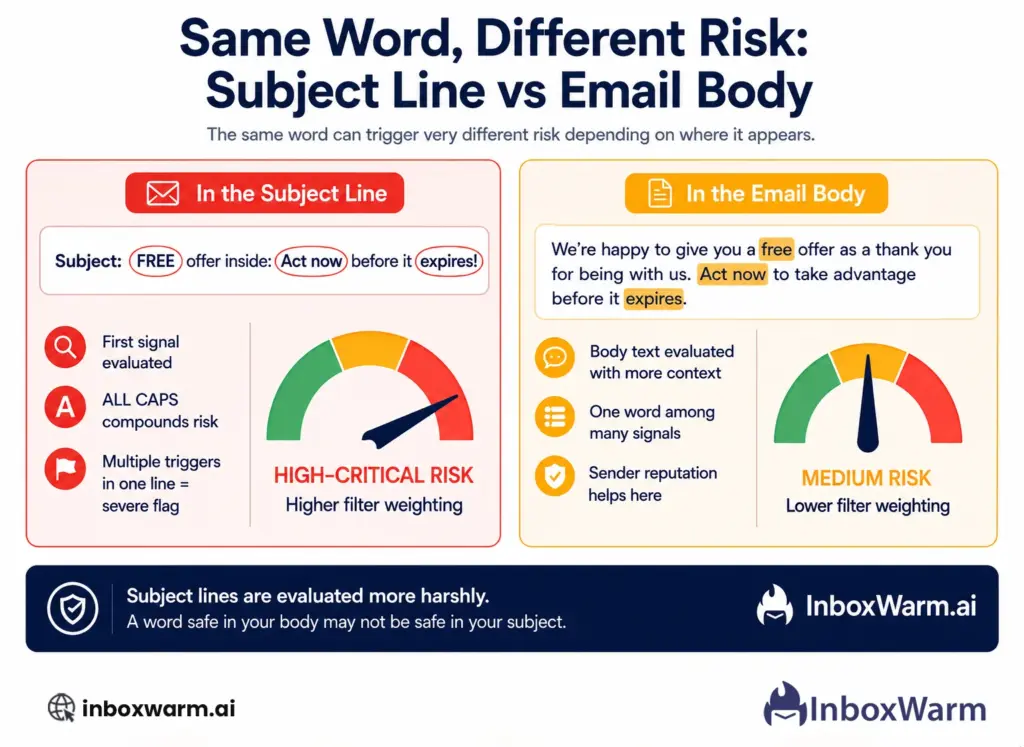
Yes, significantly. Spam filters evaluate subject line content more heavily than body content, for two reasons: the subject line is the first signal the filter processes, and it is the signal that is most often intentionally manipulated by spammers.
| Location | Risk Multiplier |
|---|---|
| Subject line | 1.5x to 2x the risk of the same word in the body |
| Body text paragraph | Base risk level |
| Body text near links | Base risk elevated |
| Signature / footer | Lower risk than body |
| P.S. line | Medium risk |
The practical takeaway: review your subject lines first. Every word in a subject line is evaluated against a higher standard than the same word in the body. A subject line that contains even one critical or high-risk word is a material deliverability risk regardless of how clean the body is.
What Spam Trigger Words Are New or Higher Risk Specifically in 2026?
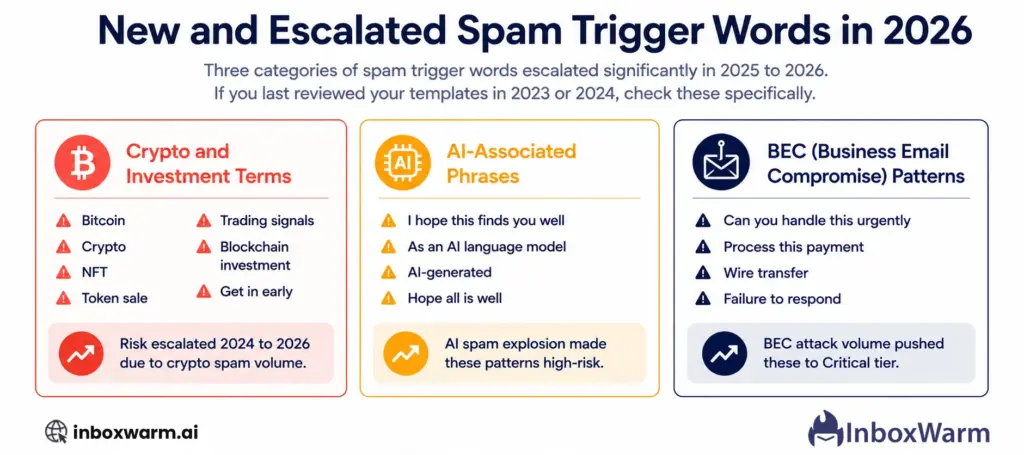
Spam filter training data is updated continuously. Words and phrases that were low risk in 2022 can become high risk in 2026 if they have been heavily abused by spammers in the intervening period.
Crypto and Investment Language (Escalated 2024 to 2026)
The volume of crypto-related spam and investment fraud email increased substantially through 2024 and 2025. As a result, spam filters trained on this data have significantly raised the risk score for crypto-related vocabulary.
Terms like ‘Bitcoin,’ ‘NFT,’ ‘token sale,’ ‘trading signals,’ and ‘get in early’ now carry High to Critical risk in cold email contexts, even from legitimate senders in the digital finance space.
AI-Associated Phrases (New Category in 2025 to 2026)
The explosion of AI-generated spam email created a new category of spam filter triggers in 2025. Phrases that became common in AI-generated content, particularly certain sentence openers and meta-references to AI, are now flagged as signals of bulk-generated, low-quality email. The most notable example: ‘I hope this email finds you well’ became one of the most overused phrases in AI-generated cold email and is now a documented spam filter risk at multiple corporate email gateways.
Other phrases that escalated in this category: ‘Hope all is well,’ ‘As per my previous email’, and any sentence that begins with a highly generic opener that no human would write in a genuinely personal email.
Business Email Compromise (BEC) Patterns (Critical, Consistently)
BEC attack volume increased through 2025 and into 2026. Phrases used in BEC attacks, including ‘can you handle this urgently’, ‘process this payment’, ‘wire transfer’, and ‘failure to respond’, are now at Critical risk across all major corporate email security platforms.
Even a single BEC-associated phrase in a cold email can trigger complete rejection by Mimecast, Proofpoint, and Barracuda, regardless of sender reputation.
What Actually Matters More Than Spam Trigger Words for Email Deliverability?
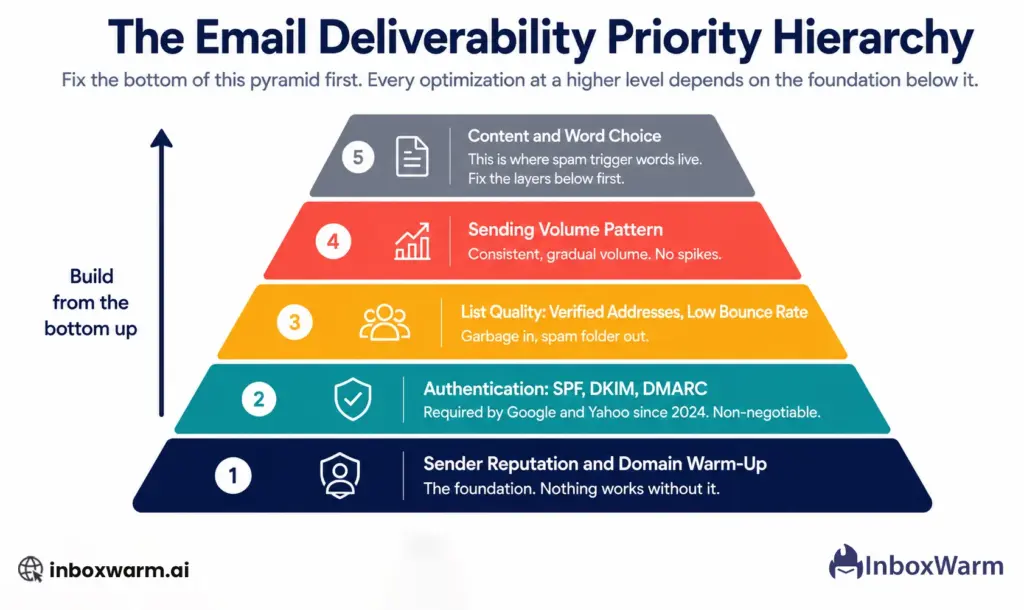
- Sender reputation and domain warm-up: A domain with a strong sender reputation can use words like ‘free’ and ‘exclusive’ without triggering filters. A domain with zero reputation history cannot. Warm-up builds the reputation that makes every other optimization work harder through a proper timeline of warm-up.
- Email authentication: SPF, DKIM, and DMARC are mandatory requirements since Google’s and Yahoo’s 2024 policy update. Missing authentication amplifies every other risk signal in your email, including spam trigger words.
- List quality: Sending to a verified list with a hard bounce rate below 2 percent signals that your email is expected and wanted. High bounce rates compound every other deliverability problem.
- Sending volume pattern: Consistent, gradually increasing volume looks organic. Sudden spikes from previously low-activity domains trigger rate-limiting and spam filtering at the infrastructure level before any content is evaluated.
- Content and word choice: This is where spam trigger words live. Once the four layers above are in good shape, content optimization meaningfully improves inbox placement. Before those layers are solid, word changes have minimal impact.
Fix the Foundation First
If you are still landing in spam after cleaning up your word list, the problem is almost certainly your sender reputation, not your copy. InboxWarm.ai builds the sender reputation that makes your emails deliverable before the first campaign sends.
How Do You Test Your Email for Spam Words Before Sending?
A word list review is one step. Before any major campaign send, run your email through a deliverability testing tool to get a full spam score, not just a content audit.
| Tool | What It Checks |
|---|---|
| Mail-Tester.com | Sends a test email to their address and returns a full spam score covering content, authentication, blacklists, and header structure. Free. |
| GlockApps | Tests inbox placement across Gmail, Outlook, Yahoo, and corporate filters. Shows whether your email reaches the inbox, spam, or promotions folder at each provider. |
| Sender Score (senderscore.org) | Checks the reputation score of your sending IP and domain against major blacklists and reputation databases. |
| Google Postmaster Tools | Google's own tool showing your domain reputation, spam rate, and authentication status as seen by Gmail. Free. |
| InboxWarm.ai Dashboard | Continuous inbox placement rate monitoring across providers, sender reputation tracking, and warm-up progress in real time. |
- Step 1: Review your template against the word list above. Replace “critical” and “high risk” words with safer alternatives.
- Step 2: Run the email through Mail-Tester. Target a score of 9 out of 10 or higher.
- Step 3: Check Sender Score to verify your sending IP has no blacklist issues.
- Step 4: Confirm Google Postmaster Tools shows your domain at ‘Medium’ or ‘High’ reputation.
- Step 5: Send. Keep InboxWarm.ai running in the background during the campaign to maintain your reputation.
Frequently Asked Questions
Does One Spam-Trigger Word Send My Email to Spam?
Not usually. A single word alone rarely causes filtering if your domain is trusted and properly authenticated. However, risk increases when spam words combine with weak reputation signals like an unwarmed domain, high bounce rates, or multiple links in the email.
What Is the Single Highest-Risk Spam Trigger Word?
There is no single “worst” word. Risk depends on context and combinations. That said, phishing-style phrases like “verify your account immediately,” all-caps “FREE,” fake reply subjects like “RE:”, and unfilled merge tags are among the most dangerous patterns in cold email.
Do Spam Trigger Words Matter More for Cold Email or Newsletters?
They matter more in cold email. Cold outreach typically comes from newer domains with lower reputation and no engagement history, which increases sensitivity to risky wording. Newsletter senders with engaged, opted-in audiences can often use more promotional language safely.
Is the Word “Free” Always a Spam Trigger?
No. “Free” is context-dependent. It becomes risky in subject lines, all caps, or when paired with other promotional language. In cold email, it’s safer to replace it with terms like “included” or “at no cost” to reduce risk.
How Do Modern Spam Filters Actually Work?
Spam filters use machine learning models that evaluate hundreds of signals at once. These include sender reputation, authentication (SPF, DKIM, DMARC), engagement rates, sending patterns, and content signals. Word choice is only one factor in a broader scoring system.
How Often Should I Check for Spam Trigger Words?
Review your templates at least every six months or after any deliverability drop. Spam filters evolve continuously, and terms that were safe earlier can become higher risk due to changing spam trends, especially in AI and crypto-related messaging.
What Are the Safest Subject Line Patterns?
The safest subject lines are short, specific, and non-promotional. Question-based formats perform well, avoid all caps, and stay under 60 characters. Personal relevance consistently reduces spam risk and improves engagement.
Can I Use Spam Trigger Words If My Domain Is Warmed?
Yes, but with caution. A strong sender reputation can tolerate some promotional language, but it does not override high-risk phishing or urgency patterns. Avoid Critical-tier words entirely and limit High-risk terms even with a warmed domain.
Why Am I Still Going to Spam After Removing Trigger Words?
Because content is rarely the main issue. Common causes include poor domain reputation, missing authentication (SPF/DKIM/DMARC), high bounce rates, inconsistent sending volume, or low-quality email lists. Word filtering is usually the final layer, not the root cause..
Conclusion
Spam trigger words still matter in 2026, but they are only one part of modern email deliverability.
Spam filters now evaluate trust signals first: sender reputation, domain warm-up, authentication, engagement, and sending behavior. Word choice mainly acts as an additional risk layer on top of those signals.
That is why a warmed, trusted domain can often use moderately promotional language without issues, while an unwarmed domain may still land in spam even with “clean” copy.
Use this list as a practical hygiene checklist:
- Remove Critical-risk phrases
- Replace High-risk wording where possible
- Use Medium and Context-Dependent terms carefully
Most importantly, fix the foundation first: warm your domain, configure SPF/DKIM/DMARC correctly, maintain list quality, and keep sending patterns consistent with a reliable email warmup tool.
Once those pieces are in place, content optimization becomes much more effective.