

TL;DR
- A case study sales cold email connects one relevant customer story to a prospect’s situation and asks whether they want to learn more.
- Choose a case study with a similar workflow, starting problem, or operating context. A recognizable logo alone is not enough.
- Share one verified result with its timeframe or scope when needed. Never turn one customer’s experience into a promise for the next.
- Keep the email focused on the recipient. Give the story’s useful takeaway before asking them to read the full case study.
- Use a permission-based ask such as “May I send the short example?” and add context in later follow-ups.
- Track positive replies and qualified conversations. Short copy, a customer result, or email warmup does not guarantee inbox placement or sales.
A customer story gives a prospect something your product description cannot: an example of how a real team handled a real problem. But sending a case study is useful only when the reader can see why that particular story belongs in their inbox.
This case study sales cold email template helps you introduce relevant customer evidence without turning the message into a long success story. Use the main template, five variations, and follow-ups below to connect a documented result to the work your prospect actually owns.
Table of Contents
The Case Study Sales Cold Email Template
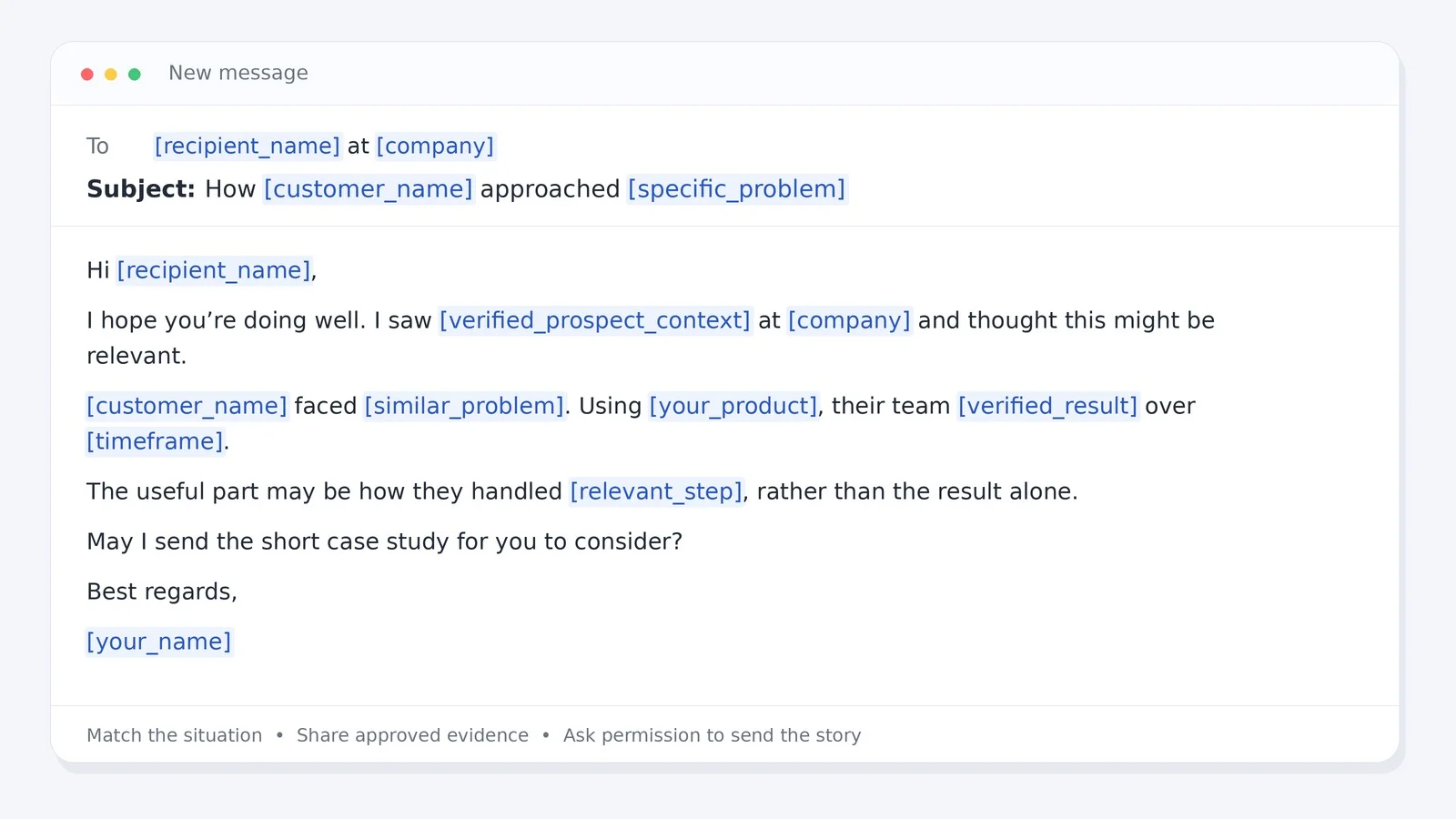
Use four beats: establish the connection, summarize the starting problem, share one documented outcome, and ask permission to send the details. Keep the full story for the next step.
The customer result earns attention; the connection to the prospect earns relevance. If you cannot explain that connection in one sentence, choose a different story. Replace the placeholders with approved, accurate details before sending.
How to Personalize a Case Study Email
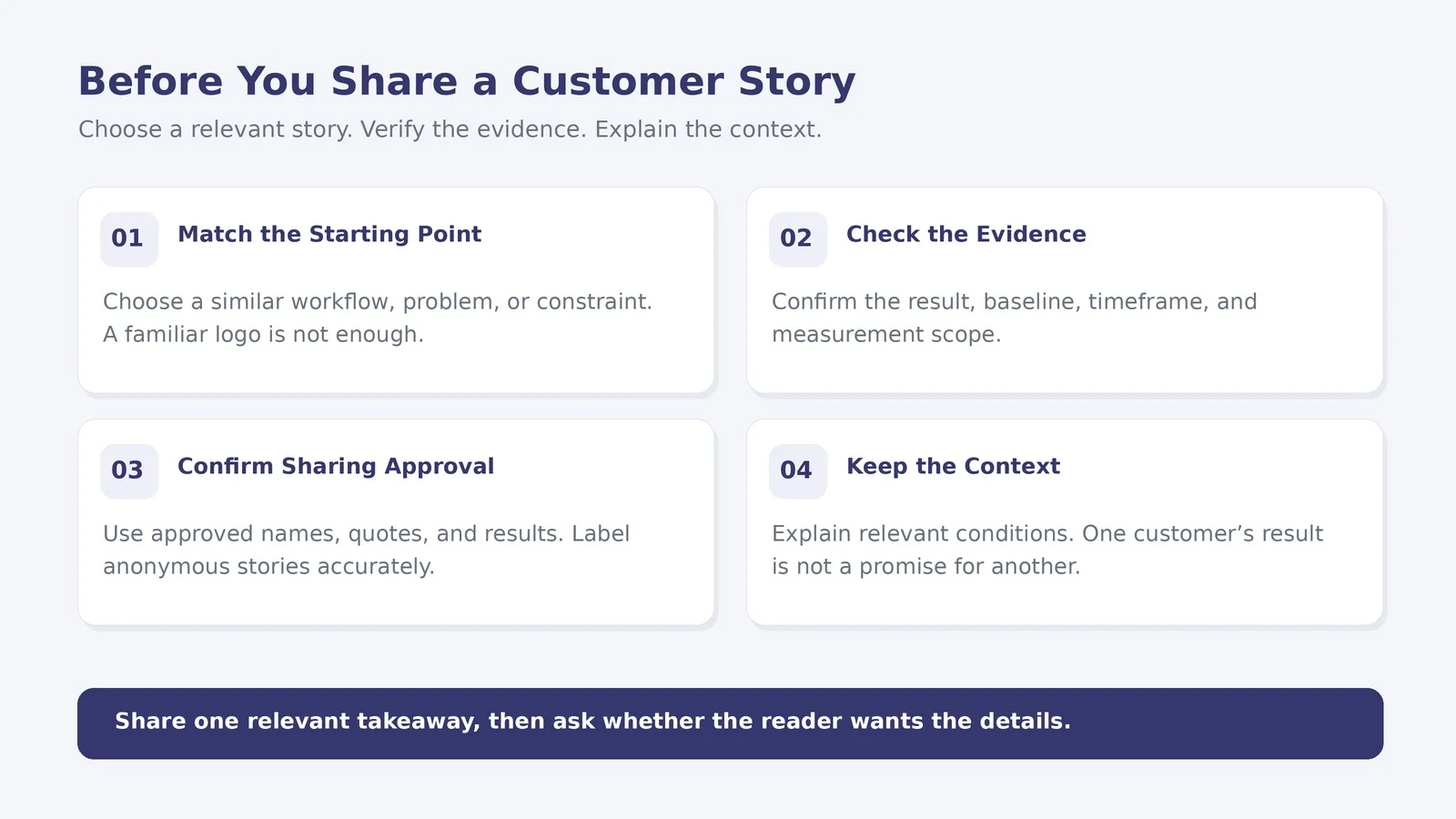
Start with one verified detail about the prospect, such as a workflow they mentioned in a public post or an initiative their company announced. Then choose a customer story that addresses a similar workflow or problem. In one sentence, explain what the prospect could learn from the customer’s approach.
If you have an approved metric, say what was measured and over what period. If you have a documented outcome without a number, describe what changed. For example, “The team moved approvals into one shared queue so each request had a visible owner.”
Subject Lines That Fit a Case Study Email
Describe the subject of the story or the problem it addresses. Avoid a misleading “Re:” on a new thread, a result without context, or a customer name the recipient has no reason to recognize.
| Subject Line | When to Use It |
|---|---|
| How [customer_name] approached [specific_problem] | The problem is relevant and the customer can be named. |
| A customer example for [specific_workflow] | The workflow matters more than the customer’s brand. |
| [specific_problem]: one team’s approach | You want to share a practical method rather than lead with a metric. |
| An example for [verified_initiative] | The prospect has publicly discussed the initiative. |
| Would a [use_case] example help? | You want a direct permission-based opening. |
When Should You Send This Template?
Send it when your evidence can answer a question the prospect could reasonably have. That might be whether a workflow can be simplified, how a team introduced a change, or what implementation looked like for a comparable organization.
- You have a meaningful match. The customer and prospect share a relevant workflow, constraint, team structure, or starting problem.
- The evidence is usable. The story is approved for external sharing, and you can trace the result to a documented source.
- You have a credible reason to contact this person. Their role or a first-party source connects them to the problem.
- You can explain the scope. You know what changed, over what period, and which conditions affect the comparison.
When Should You Not Use a Case Study Email?
Do not send a famous customer’s story simply because it is your strongest logo. An enterprise implementation may be a poor reference for a small team with different resources and requirements. Similar industry labels do not automatically make two operating situations comparable.
Avoid the format when you cannot substantiate the result, when the evidence is outdated, or when customer approval does not cover the intended use. An anonymous example can work if it is real, approved, and described accurately; a fictional example cannot serve as proof.
If you do not have relevant customer evidence, use a problem–solution email with an accurate product capability instead. If the recipient needs to understand a new kind of solution first, start with a product discovery email.
Case Study Sales Email Templates for Different Outreach Situations
Choose the version that fits what you actually know. These are five alternative first messages, not five emails to send in a row. Keep the greeting and closing natural, and make only one request per email.
1. Share a Story From a Similar Workflow
When to Use It: Use this when the customer and prospect perform a comparable job, even if their industries differ.
Personalization Tip: Explain the shared workflow. Do not imply that the prospect has the same pain unless you have evidence.
2. Lead With the Implementation, Not Just the Result
When to Use It: Use this when setup effort, adoption, or a process change is likely to matter to the recipient.
Personalization Tip: Use a story with documented implementation details. Do not promise the same rollout time for another team.
3. Share a Result Relevant to Their Role
When to Use It: Use this when the result connects directly to a responsibility the recipient owns.
Personalization Tip: State the metric, period, and baseline when they change the meaning. Do not assume every person with the same title has identical goals.
4. Share Evidence for a Publicly Announced Initiative
When to Use It: Use this when a company announcement gives you a clear reason to share a specific story now.
Personalization Tip: Reference the actual announcement. Avoid assuming its budget, timeline, or internal problems.
5. Share an Approved Anonymous Customer Example
When to Use It: Use this when the customer’s identity cannot be shared but the underlying story is real and approved for anonymous use.
Personalization Tip: Use only approved details. Describe the customer precisely enough to establish relevance without implying a named endorsement.
Case Study Email Examples With and Without a Metric
Fictional examples: The names and figures illustrate the email structure. Replace them with approved customer evidence and verified prospect details before sending.
Example 1: Share a Workflow Change
Example 2: Share a Measured Result
What to Personalize and Where to Find It
| Detail | What to Find | Source to Check |
|---|---|---|
| [verified_prospect_context] | A real initiative, workflow, or responsibility relevant to the story. | The company’s website, announcements, interviews, or the recipient’s own posts. |
| [similar_problem] | The specific connection between the customer’s starting point and the prospect’s situation. | The approved case study and first-party prospect research. |
| [verified_result] | The documented outcome and how it was measured. | The published case study or approved customer evidence record. |
| [timeframe] | The period over which the result was recorded. | The original measurement or case-study source. |
| [relevant_step] | An implementation detail the recipient can learn from. | Approved onboarding notes, an interview, or the full customer story. |
Keep a short evidence note with the source, date checked, approved wording, and any limitations. This makes the email easier to review and update. Spend your research effort on the customer–prospect connection before polishing the opening line.
How to Share Customer Results Accurately?
A useful result includes enough context to understand it. A reduction from ten hours to six hours per month is different from a reduction per employee or per project. Keep the denominator, time period, and baseline consistent with the approved source.
Do not present one customer’s outcome as the expected outcome for everyone. If the change also involved new processes, staffing, or other tools, avoid attributing the entire result to your product. Share what the evidence supports and explain relevant conditions in the case study.
If you have not measured a numeric improvement, a documented process change can still be valuable. Describe what changed and why that detail may help the reader. Evidence does not have to be a large percentage to be useful.
Should You Include the Case Study Link in the First Email?
The templates here ask permission to send the story. That keeps the first message short and gives the recipient an easy reply. It is a useful starting approach to test, not a rule that every first email must be link-free.
If you include a link, use one relevant destination that matches your description, and summarize why it matters in the email itself. Avoid multiple competing links, surprise downloads, or an unrequested attachment. A link’s presence alone does not determine whether a message reaches the inbox.
Will This Land in the Inbox?
A real customer result does not guarantee inbox placement. Authentication, sending reputation, list quality, recipient expectations, and sending behaviour all matter. Review your setup against Google’s email sender guidelines and your provider’s requirements before increasing volume.
Use InboxWarm’s spam word checker to review the wording and its subject line tester for subject feedback. These are review aids, not delivery certifications. If you use email warmup, keep it alongside authentication checks, relevant targeting, and ongoing monitoring.
How to Follow Up With a Case Study?
Make each follow-up useful without making the recipient reread the entire story. As an example cadence, you could send the first follow-up after several business days, leave a longer gap before the second, and close the loop later if there is still no reply. Adapt timing to the context; this is not a proven optimum.
Follow-Up 1: Highlight One Relevant Detail
Follow-Up 2: Explain the Starting Conditions
Follow-Up 3: Close the Loop Respectfully
Use “Re:” only within the original email thread. Stop after a refusal or opt-out, and make it easy for the recipient to decline more messages. If they ask for the story, send it rather than adding another meeting request first.
What Should You Measure?
Track positive replies, requests for the case study, useful objections, and qualified conversations. Also monitor bounces and opt-outs. A request for evidence is a meaningful next step even when it does not immediately turn into a meeting.
When comparing versions, keep the audiences similar and change one meaningful element, such as the relevance angle or the ask. If a campaign gets “not relevant” replies, revisit the story–prospect match. If people request the case study but do not continue, examine whether the full story answers the question the email raised.
Frequently Asked Questions
What Is a Case Study Sales Cold Email?
It is an outreach email that introduces a real customer example relevant to the prospect’s work. It briefly connects the situation, shares an approved result or process change, and asks whether the recipient wants the details.
How Do I Choose the Right Case Study for a Prospect?
Match the workflow, starting problem, operating context, or constraint before considering the customer’s brand. A smaller, more comparable customer can be a stronger reference than a famous company with very different needs.
Can I Use a Case Study Without Naming the Customer?
Yes, if the story is real and approved for anonymous external use. Use an accurate description, share only approved details, and do not imply a named endorsement.
What If I Do Not Have a Measured Customer Result?
You can share a documented process change or implementation lesson. Describe what changed without inventing numbers. If you have no approved customer evidence, choose another email structure.
Should I Attach the Full Case Study?
These templates start by asking permission to share it. If the recipient wants details, send a concise summary or a relevant link. Avoid an unexpected attachment when a simpler format would answer their question.
Can I Promise the Same Result to Another Company?
A customer case study demonstrates one experience under specific conditions. It does not establish that another company will achieve the same result. Keep the wording consistent with the evidence and explain meaningful limitations.
Check Your Sending Setup Before Sharing Your Next Customer Story
Pair relevant evidence with a sound sending setup. Review your domain’s email configuration alongside your targeting and message before increasing outreach.
