
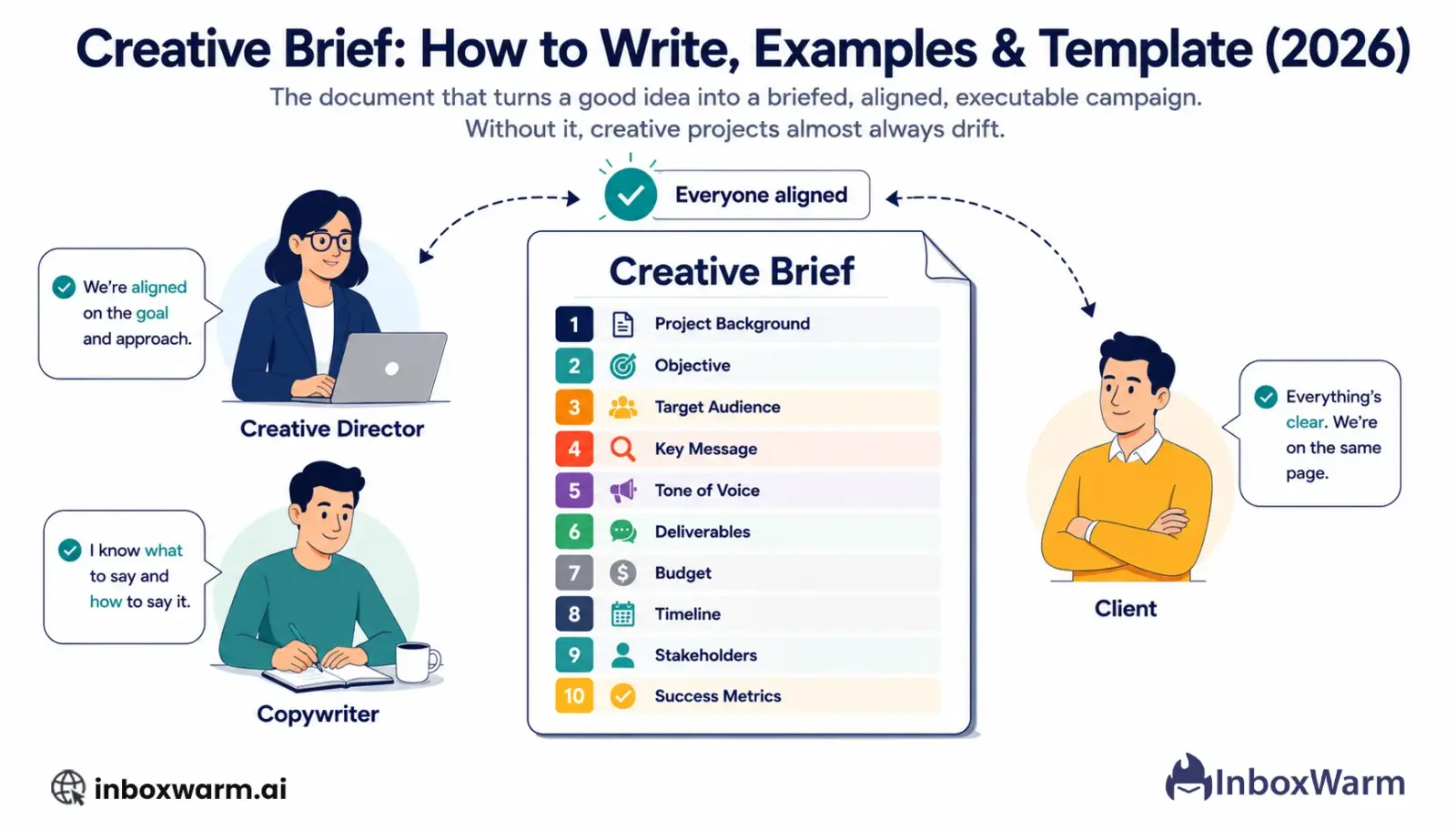

A creative brief is a 1–2 page document that aligns everyone before creative work begins.
It defines the objective, audience, key message, tone, deliverables, timeline, budget, and approvals so teams don’t rely on assumptions during execution.
A strong brief:
- Clarifies what success looks like (with measurable KPIs)
- Locks a single key message to avoid confusion
- Gives clear constraints that improve creative output
- Prevents scope creep before production starts
- Aligns stakeholders before any work begins
In short, it turns scattered expectations into one agreed direction.
Most creative work doesn’t fail because of weak ideas. It fails because teams start building before they agree on what they’re building.
Different stakeholders carry different assumptions about the goal, the audience, the message, and even the definition of “success.” Those assumptions only surface late, when work is already in motion and expensive to change.
A creative brief exists to eliminate that gap.
It turns scattered expectations into a single reference point that aligns everyone before production starts, strategy, messaging, tone, deliverables, and success metrics are all defined upfront. Done properly, it prevents revision cycles, scope confusion, and subjective feedback loops that derail creative timelines.
This guide breaks down exactly how to write a creative brief that actually works in real production environments, not just in theory. You’ll get the structure, real examples, and the practical mistakes that cause most briefs to fail in practice.
Table of Contents
What Is a Creative Brief?
A creative brief is a short, structured document that defines the scope, goals, audience, message, and constraints of a creative project before any creative work begins. It serves as the shared reference point for everyone involved: the client or stakeholder who owns the project, the account or project manager coordinating it, and the creative team executing it.
The word ‘brief’ is intentional. The document should be concise, ideally one to two pages, covering only the information that directly affects creative decisions. A creative brief is not a project plan, a brand guideline, or a campaign strategy document. It is the distillation of all of those into the specific directions a creative team needs to produce good work.
| What a Creative Brief Is | What a Creative Brief Is Not |
|---|---|
| A one to two page reference document for a specific project | A brand guidelines document (that covers general brand rules, not project-specific direction) |
| Written before creative work begins | A retrospective document written after the campaign launches |
| Focused on decisions that affect creative output | A project management plan with task assignments and budget breakdowns |
| Shared with everyone involved in the project | An internal strategy document kept from the creative team |
| Updated by consensus if the project scope changes | A living document that changes every time a stakeholder has a new idea mid-production |
Who Writes the Creative Brief?
In an agency context, the creative brief is typically written by the account manager or account director, in close collaboration with the client and strategy team. In an in-house marketing team, it is usually written by the marketing or campaign manager. In a small business or startup context, it is often written by whoever is commissioning the work, whether that is a founder, a marketing lead, or a project manager.
Regardless of who writes it, a good creative brief requires input from multiple stakeholders: the client or business owner who understands the commercial objective, the strategist or planner who understands the audience, and ideally a senior creative who can flag any constraints or gaps before work begins.
When Should a Creative Brief Be Written?
A creative brief should always be written before any creative work begins. This sounds obvious, but in practice many projects start without one because the timelines are tight, the project seems simple, or the team has worked together before and assumes they share a common understanding.
Those assumptions are where most creative projects go wrong. Shared history does not mean shared assumptions about a new project. The brief is the mechanism that replaces assumption with alignment.
Why Does a Creative Brief Actually Matter?
The business case for spending two hours writing a creative brief is straightforward: it prevents the much larger cost of producing work that misses the mark.
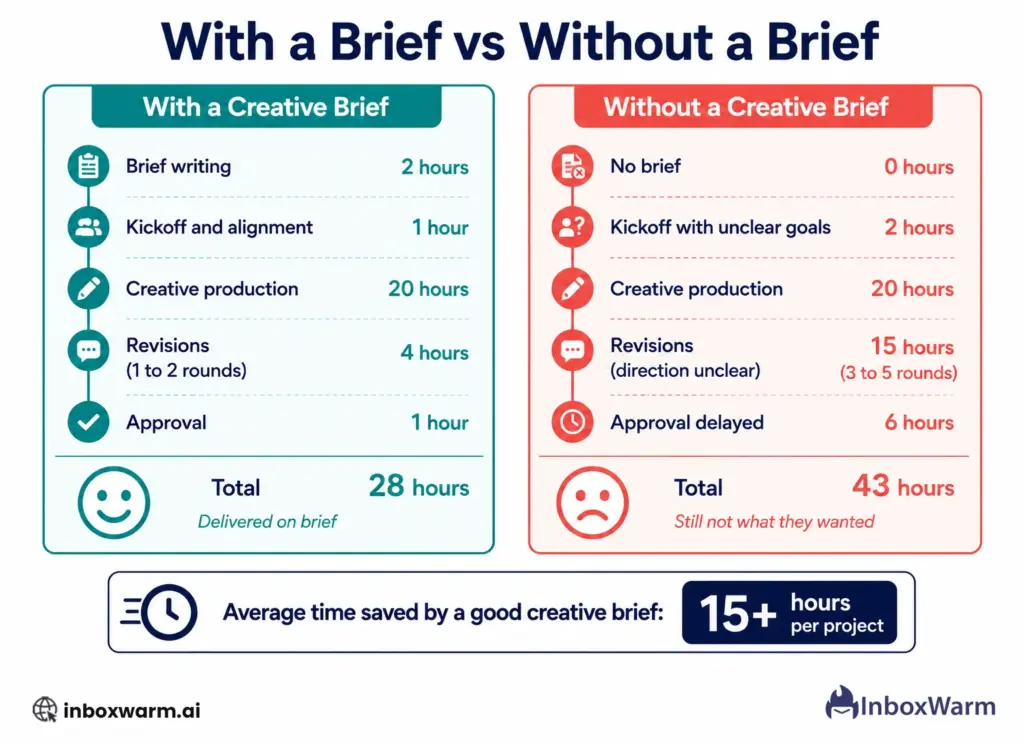
Beyond time savings, a creative brief delivers four specific outcomes that affect the quality of work produced.
1. Alignment before execution
A brief forces stakeholders to agree on the objective, audience, and message before production starts. Early disagreements are cheap to fix. Late-stage disagreements usually mean rework, delays, or scrapped work.
2. A shared definition of success
Without a brief, “good work” is subjective and often changes depending on who is reviewing it. With a brief, success is predefined and measurable: did it reach the right audience, communicate the right message, and follow the agreed-upon tone? This removes opinion-driven feedback loops.
3. Better creative output through constraints
Clear direction doesn’t limit creativity; it improves it. When objectives and audience are defined, creative teams can focus on execution quality instead of second-guessing intent or chasing approvals. Constraints create clarity, not restriction.
4. A reference point when scope shifts
In longer projects, priorities inevitably evolve. Without a brief, those shifts quietly change the entire direction of the work. With a brief, teams can evaluate new requests against the agreed scope and separate valid iteration from uncontrolled scope creep.
What Are the 10 Elements of a Strong Creative Brief?
A creative brief needs to answer ten specific questions. These are not arbitrary fields to fill in: each one addresses a category of decision that creative teams make during production. Missing any of them means creative teams will fill in the gap with their own assumptions, which may or may not match what the client or stakeholder expects.
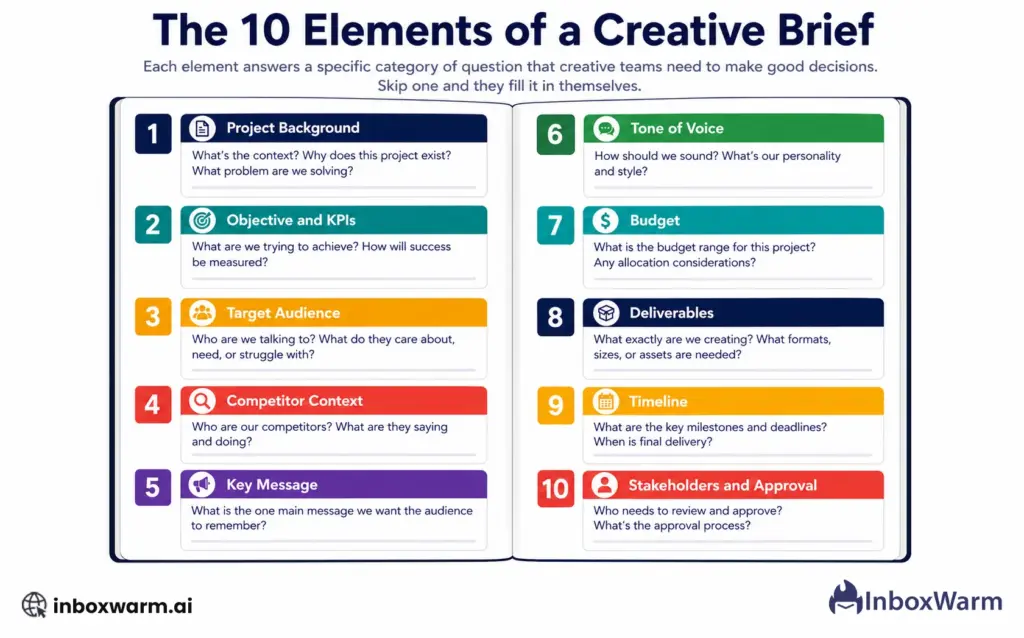
1. Project Background
The project background answers two questions: what are we making, and why are we making it now? This section gives the creative team the context they need to understand where this project fits in the broader business strategy.
A strong project background covers what the business or brand does, what the specific campaign or project is, what prompted it (a product launch, a market shift, a competitive response, a seasonal push), and what the desired outcome is at the business level. Keep it to three to five sentences. The creative team does not need the company’s full history. They need to understand what this specific project is for.
The mistake most people make here is being too vague. ‘We want to raise awareness of our brand’ is not a project background. ‘We are launching a new cold email outreach feature in Q3 and need a campaign that drives trial signups from heads of sales at Series A and B SaaS companies’ is.
2. Objective and KPIs
The objective defines what the project is supposed to achieve, and the KPIs define how you will measure whether it achieved it. These two things must be present together. An objective without KPIs is a wish. KPIs without a clear objective are metrics without meaning.
Use the framework: ‘The objective of this campaign is to [specific outcome] as measured by [specific metric] by [specific date].’ The more specific this is, the more useful it is. Objectives like ‘increase brand awareness’ or ‘drive engagement’ are not objectives: they are vague directional hopes that cannot be measured and, therefore, cannot be achieved.
| Weak Objective (Not Usable) | Strong Objective (Measurable and Specific) |
|---|---|
| Raise brand awareness among our target audience | Increase unaided brand recognition among B2B sales managers from 12% to 18% in the US market by Q4 2026, as measured by our next brand tracker survey |
| Drive more website traffic from this campaign | Generate 2,500 trial signups from the campaign landing page within 60 days of launch |
| Get people excited about the new product | Achieve a 15% email open rate and 4% click-through rate on the product launch email sequence |
| Improve engagement on social media | Grow LinkedIn page followers by 3,000 within the campaign period and achieve 5% average engagement rate on campaign posts |
3. Target Audience
The target audience section defines who the work is for. Not who might see it, but who the primary intended recipient is. This is the person whose attention the campaign is trying to capture, whose behavior it is trying to change, and whose language and references should shape the creative work.
A strong audience definition covers demographics (age, role, industry, company size if B2B), psychographics (what they care about, what problems they have, what motivates them), and current relationship with the brand (unaware, aware, considering, existing customer). For B2B campaigns, add the job title, seniority level, and the specific problem they face that this campaign addresses.
The mistake most briefs make here is defining the audience too broadly. ‘Small business owners’ is not an audience for a specific campaign. ‘Heads of sales at Series A and B SaaS companies who are struggling to hit outbound pipeline targets because their cold email deliverability is poor’ is an audience with enough specificity to make creative decisions from.
4. Competitor Context
The competitor context section answers, “What is everyone else in the category doing, and what space does that leave for us to occupy?”
This section exists not to copy competitors but to ensure the creative work does not accidentally look, sound, or position exactly like a competitor’s campaign.
Cover two to four primary competitors. For each, note: what they communicate (their key message), what channel they use most, and what tone or visual style defines their creative approach. Then note what the white space is: what are they not saying, not doing, not owning?
This section is often rushed or skipped in briefs for small or startup businesses on the grounds that they do not have direct competitors yet. This is almost never true. Every target audience already has a default solution they use before your product. Understanding that solution and what it fails to deliver is the competitive context that makes creative work sharper.
5. Key Message
The key message is the single most important thing the target audience should take away from the campaign. Not the list of features. Not the company positioning statement. The one thing that, if the audience remembers nothing else, you want them to remember.
Most creative briefs include a list of messages or a paragraph of talking points under this section. That is a mistake. Vague, overused language weakens your message and certain words actively trigger spam filters.
Force the discipline: write one sentence. If you find yourself writing two sentences, you have not made a decision yet. Go back to your stakeholders and reach agreement on which single message this campaign is built around. Everything else is supporting context.
Cover the brief. Ask someone who has not seen it: ‘If you saw this campaign and remembered one thing, what would it be?’
If everyone in the room gives the same answer, your key message is working.
If you get three different answers, the key message section needs more work.
The right one-sentence message is specific enough that a creative director can build a campaign concept from it and vague enough that a skilled creative can find an interesting execution.
6. Tone of Voice
Tone of voice defines how the campaign communicates, not what it says. It is the personality of the work: the adjectives that describe how the copy should read, how the visuals should feel, and what the overall register of the campaign should be.
A useful tone of voice section includes three to five descriptive adjectives (bold, warm, direct, playful, or authoritative); what the tone is NOT (to prevent a creative team from drifting into adjacent territory that does not fit the brand); and ideally one or two reference examples from other brands that demonstrate the target tone. The ‘is not’ column is often as valuable as the ‘is’ column.
| Tone Is | Tone Is Not |
|---|---|
| Direct and confident: we say what we mean without corporate hedging | Aggressive or arrogant: we are sure of ourselves but not dismissive of others |
| Warm but not casual: we sound like a trusted expert, not a sales pitch | Generic or safe: we have a point of view and we are not afraid to state it |
| Technically credible: we speak the language of our audience without talking down to them | Jargon-heavy: we never use a technical term when a plain one will do |
7. Budget
The budget section states the total available spend for the project and how it is allocated across production, media, and any other cost categories. This section exists because creative teams need to know what level of production is viable. A brief that asks for a video campaign without specifying budget might produce a concept that requires $200,000 of production from a team that has $20,000 to spend.
The budget does not need to be a detailed breakdown. A single total figure is often sufficient for small campaigns. For larger campaigns, note the split between production costs (creative asset creation) and media or distribution costs (paid placement, printing, events). If the budget is genuinely not yet determined, note that clearly and agree to set a ceiling before final brief sign-off.
Never leave the budget blank or write ‘TBD.’ A creative team that does not know the budget will either produce a concept that is too ambitious or constrain their thinking unnecessarily. Either way, you lose creative quality.
8. Deliverables
The deliverables section lists every specific asset the campaign will produce: the formats, sizes, quantities, and file specifications. This is the section that prevents the most common project management failure in creative work: scope creep.
Be exhaustive. If the campaign needs a hero image in three sizes plus a social cut-down plus a banner ad in four dimensions plus an email header, list all of them explicitly. If an additional deliverable is later requested that is not in this section, it should be treated as a scope change that requires a separate discussion about timeline and budget impact.
Common deliverables to consider: campaign hero assets (photography, illustration, video), copy elements (headlines, body copy, CTAs), digital ad formats (specific sizes for Google, Meta, LinkedIn), email assets, landing page copy and design, social media assets per platform, print materials if applicable, and any internal assets like sales decks or one-pagers.
If your deliverables include a cold email or follow-up sequence, having proven templates as a starting point saves significant production time.
9. Timeline
The timeline section states three specific dates: the brief sign-off date, the first creative review date, and the final delivery or go-live date. For longer projects, it also includes intermediate milestones: concept approval, copy approval, design approval, and final production.
The most common timeline mistake in creative briefs is working backward from the launch date without allowing enough time for each production stage. Creative teams need to know not just the final deadline but how many revision rounds are built into the schedule. A campaign with a six-week production timeline and a three-round approval process has a different actual timeline than the same calendar with one revision round.
State the timeline in real dates, not relative ones. ‘Concept review by June 14’ is a date. ‘Concept review in two weeks’ is an invitation for misalignment.
10. Stakeholders and Approval
The stakeholders section answers: who is involved in this project, what is their role, and who has final approval at each stage? This is the section that prevents the most expensive failure mode in creative production: delivering finished work to one stakeholder who approves it, only to have a more senior stakeholder see it for the first time at final delivery and request major changes.
List every person who will see, review, or approve work at any stage. For each, note their role (briefing party, creative reviewer, copy approver, legal reviewer, final sign-off) and their availability for review turnaround. Clarify who has decision-making authority at each approval stage. If multiple people are listed as approvers, clarify whose opinion takes precedence in case of disagreement.
What Are the Different Types of Creative Briefs?
Not all creative briefs are the same. The ten elements above apply to all of them, but different project types emphasize different sections and have different structural conventions. Here is how the brief changes by project type.
| Brief Type | Primary Emphasis |
|---|---|
| Marketing Campaign Brief | Objective, audience, key message, and competitor context are the dominant sections |
| Advertising Brief (Agency Brief) | Key message and tone of voice: the brief exists primarily to inspire a creative concept |
| Design Brief | Deliverables and technical specifications are the primary sections |
| Content Brief | Audience, key message, and SEO requirements define the brief |
| Product Launch Brief | Background and objective are the most critical sections |
| Cold Email Campaign Brief | Audience definition and key message are the dominant sections |
How Do You Write a Creative Brief Step by Step?
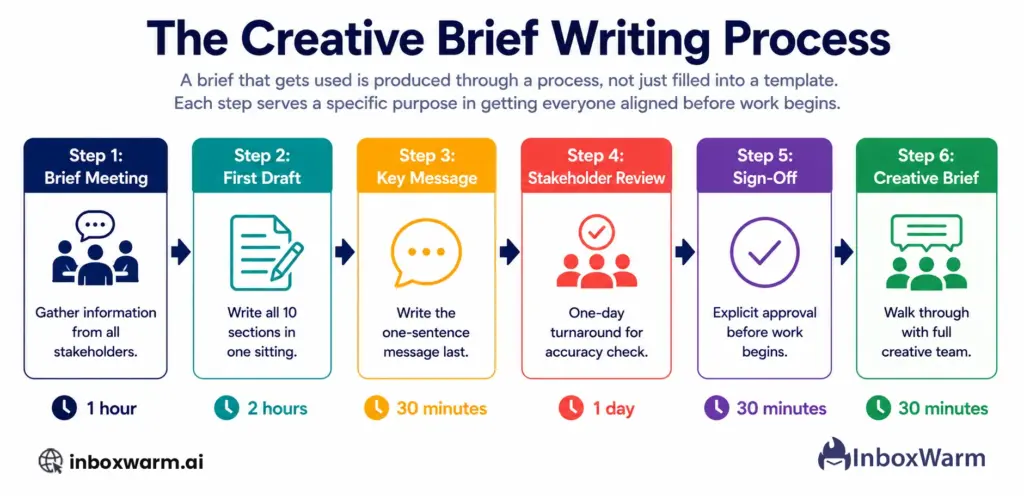
Knowing the ten elements is the prerequisite. Writing a brief that actually gets used requires a specific process. Here is the workflow that produces briefs that stick.
Step 1: Run the Brief Meeting Before You Write Anything
The biggest mistake in creative brief writing is trying to write the brief before getting the information you need from the people who have it. The brief is not a document you fill in from what you already know. It is a synthesis of a structured conversation with every key stakeholder.
Run a brief meeting with the client or project owner before writing a word. The meeting should cover: what the project is, why it exists now, who it is for, what success looks like, what the budget is, and when it needs to be done. Take detailed notes. If you are the client writing your own brief, write answers to these questions before opening a document.
The brief meeting is also where you surface and resolve ambiguities before they become expensive. A client who says ‘we want it to feel premium but accessible’ in the brief meeting can be pushed to clarify what that means before a designer spends a week on the wrong interpretation.
Step 2: Write a First Draft in One Sitting
Once you have the notes from the brief meeting, write the complete first draft in one sitting. Resist the temptation to leave sections blank with ‘TBD’ or ‘to be confirmed.’ If you do not have the information for a section, that is a gap you need to close before the brief is complete, not a placeholder to be filled in later.
The first draft should be your synthesis of everything you heard in the brief meeting. Where stakeholders gave you conflicting signals, make a judgment call and flag it clearly: ‘Based on our brief conversation, I have interpreted the primary objective as X. Please confirm this is correct.’ Forcing clarity on ambiguity is one of the most valuable things a brief writer does.
Step 3: Review the Key Message Section Last
After you have written every other section, go back and write the key message. By this point, you will have articulated the objective, the audience, the competition, and the tone. The key message should emerge from that context, not be invented in isolation.
If you are struggling to write one sentence for the key message, that is valuable diagnostic information: there is not yet a clear enough strategic focus for this campaign. Go back to your stakeholders before proceeding.
Step 4: Share for Review With a One-Day Turnaround
Share the draft brief with all key stakeholders for review. Set a specific one-day turnaround for feedback. Open-ended review timelines lead to brief documents sitting in email inboxes while creative work schedules slip.
Be specific about what kind of feedback you want: confirm accuracy, flag anything that is incorrect, and identify anything that is missing. Do not ask for general thoughts. The brief review is not a creative strategy workshop. It is a factual accuracy check.
Step 5: Sign Off the Brief Before Any Work Begins
Require explicit sign-off from the client or commissioning stakeholder before any creative work begins. Sign-off can be a simple email reply saying ‘I approve this brief.’ It does not require a formal signature. What it does require is a deliberate confirmation that every person with the authority to change the brief’s direction has reviewed and agreed to it.
This sign-off protects the creative team from scope creep and protects the client from the outcome of their own ambiguity. It is the moment that transforms the brief from a working document into the project contract.
Step 6: Brief the Creative Team in Person, Not Just by Email
When the brief is signed off, do not just send it by email. Hold a brief presentation with the full creative team where you walk through every section, answer questions, and surface any ambiguities that the written document did not resolve. A 30-minute brief presentation is one of the highest-return-on-time meetings in any creative project.
Encourage the creative team to challenge the brief. If they identify a contradiction between the objective and the budget, or between the target audience and the key message, those contradictions need to be resolved before work starts, not discovered in the first review.
What Does a Complete Creative Brief Look Like? A Worked Example
The most useful thing in any guide to creative briefs is a complete, filled-in example. What follows is a realistic creative brief for a SaaS product launch campaign: a cold email platform launching a new AI warm-up feature. Every section is written to illustrate what good looks like, not just what goes in each field.
Company: Company X (fictional SaaS email tool)
Project: Q3 product launch campaign for a new AI-powered email warm-up feature
Audience: Heads of Sales at B2B SaaS companies with active cold email programs
Channel: LinkedIn ads, cold email campaign, and landing page
Secondary objective: generate 400 qualified demo requests from heads of sales at Series A to C SaaS companies.
KPIs: trial signup conversion rate from landing page (target: 12%), demo request rate from email campaign (target: 6%), landing page sessions (target: 10,000 in first 30 days).
Warmbox: positioned around deliverability guarantee claims. Neither competitor focuses on AI-adaptive warm-up or makes the ‘warm-up adjusts to real-time engagement data’ claim.
White space: the AI optimization angle and the ‘smarter, not just faster’ positioning are unclaimed. Avoid positioning against specific competitors by name.
- The objective has a number: 1,200 trial signups in 60 days. Success is measurable.
- The audience has a pain: ‘experienced significant inbox placement drops in the past 12 months.’ The creative team can write a specific problem.
- The key message is one sentence. No list of talking points. The creative team knows exactly what to build around.
- The tone section includes the ‘is not’ column. ‘Quietly confident’ and ‘not hype-driven’ together is more directive than either alone.
- The competitor section identifies white space: ‘AI-optimization angle is unclaimed.’ This is a strategic direction, not just competitive awareness.
- The stakeholders section resolves the conflict question: ‘conflicts resolved by CMO decision.’ This prevents the most common project stall.
What Separates a Good Creative Brief From a Useless One?
The majority of creative briefs in circulation are technically complete but practically useless. They have all the right fields and none of the information that creative teams actually need to make decisions. Here is what separates a brief that produces good work from one that produces expensive revisions.
| Element | ✗ Useless Version | ✓ Useful Version |
|---|---|---|
| Objective | ✗ Increase brand awareness and drive engagement | ✓ Generate 800 trial signups within 45 days of launch, as tracked by the campaign landing page |
| Target Audience | ✗ Marketing professionals aged 25 to 45 | ✓ Heads of Content at B2B SaaS companies with 50 to 200 employees who are currently managing a freelance creative team and struggling with brief quality |
| Key Message | ✗ We help teams work better together with smarter tools | ✓ Stop losing creative hours to briefs that get ignored. WarmAI builds briefs that your team actually uses. |
| Tone | ✗ Professional but friendly | ✓ Direct and confident, like a senior strategist who has strong opinions and is happy to defend them. Not corporate. Not casual. Think HBR article, not LinkedIn post. |
| Competitor Context | ✗ Competitors include Notion, Asana, and Monday.com | ✓ Notion: strong on flexibility, weak on guidance. Asana: task management focus, no brief-specific features. White space: nobody owns the 'brief quality' angle or the 'briefing intelligence' positioning. |
| Timeline | ✗ ASAP | ✓ Brief sign-off: June 10. Concept review: June 19. Final assets: July 14. Launch: July 21. |
| Budget | ✗ TBD | ✓ Total: $48,000. Production: $18,000. Paid media: $22,000. Development: $5,000. Tooling: $3,000. |
What Are the Most Common Creative Brief Mistakes?
Even experienced marketers and project managers make the same creative brief mistakes repeatedly. Knowing them in advance is the fastest shortcut to writing better briefs.
Mistake 1: Writing the Brief in Isolation
A brief written by one person without input from key stakeholders reflects one person’s assumptions about the project, not the shared understanding of the team. The most dangerous version of this mistake is when the brief writer assumes they know what the client wants without asking. Get the brief meeting right, and the writing becomes straightforward.
Mistake 2: Multiple Key Messages
When a brief contains a list of five key messages, it has no key message. The discipline of forcing one sentence requires making a strategic decision about priority, and that is exactly the decision that the brief meeting is supposed to produce. Multiple messages signal that the strategic alignment conversation has not happened yet.
Mistake 3: Audience Described by Demographics Alone
‘Women aged 28 to 45’ is a demographic, not an audience. ‘Women aged 28 to 45 who have recently taken on a first management role and are struggling to establish authority with their team’ is an audience with a problem, a context, and an emotional state that a creative team can write to. Demographics tell you who to reach. Psychographics tell you what to say.
Mistake 4: Leaving Budget as TBD
No budget means no constraint, which means creative teams either self-constrain (limiting ambition unnecessarily) or produce concepts that are undoable at the actual spend level. A rough budget is better than no budget. ‘Around $30,000 to $50,000 is a useful creative constraint. ‘TBD’ is not.
Mistake 5: No Approval Process Defined
The most expensive failure mode in creative production is the stakeholder who appears at final review and requests significant changes having never been consulted during the process. List every person who will see the work at any stage. Clarify whose feedback is mandatory and whose is advisory. Specify who breaks ties when approvers disagree.
Mistake 6: Treating the Brief as a Living Document
A brief that is updated mid-production every time a stakeholder changes their mind is not a brief: it is a moving target. Once signed off, a brief should only change if there is a material change to the project’s commercial context (budget cut, launch date moved, product feature changed). Stylistic preference changes mid-production are scope changes that should be treated as such.
Mistake 7: Making It Too Long
A ten-page creative brief is not more useful than a two-page one. It is less useful. A long brief signals that the strategic thinking has not been distilled into clear decisions yet. If your brief is longer than two pages, the first edit should cut everything that does not directly affect a creative decision. Background context that does not change the brief goes in the appendix. Information that changes the brief goes in the brief.
How Do Creative Briefs Change When AI Tools Are Part of the Production Process?
AI tools have changed what creative teams can produce and how quickly they can produce it. They have not changed what a good creative brief needs to do: align stakeholders on direction before work begins. In some ways, AI tools make the brief more important, not less.
When AI tools are used in creative production, three additional considerations should be added to a standard brief.
| AI Production Consideration | What to Add to the Brief |
|---|---|
| AI-generated copy and content | Specify tone of voice with more precision than you would for human writers. AI tools interpret tone instructions literally. Vague tone guidance ('friendly and professional') produces generic output. Specific guidance ('write as if explaining to a smart colleague who is mildly skeptical but open to being convinced') produces more usable drafts. |
| AI-generated visuals | Include a reference image section in the deliverables. AI image tools require prompt direction, and brief writers who specify reference images alongside style descriptors produce significantly better first outputs. Specify any mandatory visual brand elements (color, logo safe zone, imagery style) explicitly. |
| AI-assisted research and strategy | Note in the background section which research inputs were AI-generated and which were primary source data. AI-generated competitive analysis, persona development, and market sizing should be flagged for human verification before briefing a creative team on their accuracy. |
| Brand voice preservation | If the brand has an established voice that AI tools will be used to produce content in, include brand voice examples in the brief. Three to five sentences of 'this is how we write' is more effective than a style description when prompting AI tools. |
What Does a Complete Creative Brief Template Look Like?
Use this template as your starting point for any creative project. Every field is filled in from the brief meeting. Every section has a maximum length guideline to keep the document to two pages or under.
Copy the template. Fill in each section with real information from your brief meeting.
If you cannot fill in a section, that is a gap to close before the brief is signed off. Do not leave any section blank.
Maximum length for the full brief: two pages. If you exceed this, cut the background context first.
If your brief includes a cold email campaign
The creative work is only half of it. Before your first email goes out, your sending domain needs to be warmed up; otherwise, even a well-written sequence lands in spam.
InboxWarm.ai handles that automatically, so your campaign reaches the inbox from day one.
Frequently Asked Questions
How Long Should a Creative Brief Be?
A creative brief should be one to two pages. If it is longer than two pages, it has not been sufficiently distilled. The discipline of keeping a brief short forces the strategic decisions that longer documents allow you to defer. Background context that does not change a creative decision should be cut or moved to an appendix. The brief itself should contain only information that directly affects how the creative team does its work.
What Is the Difference Between a Creative Brief and a Project Brief?
A creative brief is specifically for creative output: it defines the strategic direction, messaging, tone, and audience for creative assets. A project brief is a broader document covering scope, deliverables, timelines, budget, and resource allocation across all workstreams of a project, not just the creative component. Most well-run projects have both: a project brief for project management purposes and a creative brief for the creative team. In small organizations these are often combined into one document, but the creative brief section should always cover the ten elements described in this guide.
Who Should Write the Creative Brief?
A creative brief is usually written by a marketing manager, project manager, or account manager responsible for the project. However, it should be created using input from key stakeholders, including the client or business owner, the strategist, and a creative lead. The writer’s role is to combine these inputs into a single, clear, and actionable direction for the team.
Can You Write a Creative Brief With AI Tools?
Yes, AI tools can support the creation of a creative brief, especially in drafting audience insights, competitor context, or tone-of-voice suggestions. However, AI should not replace strategic thinking or stakeholder alignment. The best approach is to use AI for drafting support while relying on human input for goals, messaging, and final approval.
What Happens When a Creative Team Disagrees With the Brief?
Disagreements should be addressed during the brief review stage before any work begins. At this point, changes are simple and inexpensive to make. Once production starts, disagreements can lead to rework, delays, or reduced creative quality. Early alignment ensures smoother execution and fewer revisions later.
How Do You Handle Scope Creep in a Creative Brief?
The approved creative brief acts as the reference point for managing scope. Any new request should be evaluated against what was agreed in the brief. If additional work is needed, the timeline, budget, or scope must be adjusted accordingly.
A clear way to communicate this is:
“If we include this, we’ll need to adjust the timeline, budget, or scope. Which should we change?”
Conclusion
A creative brief is two pages that save twenty hours of revision. The discipline of writing one well, covering all ten elements with specific, decision-making information rather than vague placeholders, is the single most impactful thing a project manager or account manager can do to improve the quality of creative work produced on their projects.
The most important section is the key message: the one sentence that tells the creative team what the campaign must communicate above everything else. The most common failure point is leaving that sentence vague, which means the creative team’s interpretation of the brief becomes the campaign, not the strategic intent behind it.
Use the ten-element framework in this guide. Use the filled-in example to see what good looks like. Use the good-versus-useless comparison table to audit your next draft. Use the template as your starting point for every project.
And if your brief includes a cold email campaign, don’t stop at the creative. Make sure your sending domain is warmed up using an email warm-up tool before the first email goes out, because a well-written sequence that lands in spam is still a sequence that doesn’t get read.