
TL;DR
- A market expansion cold email connects a verified move into a geography or customer segment to a specific, useful offer.
- Confirm the named market, relevant product or team, source date, and whether the company is planning, piloting, or already operating there.
- Use five first-email templates for entry planning, localization, partner onboarding, customer onboarding, or an ownership question.
- Match the resource and recipient to the work. A new office, translated page, or regional job listing does not establish every part of a launch.
- The worked example shows how a confirmed pilot changes the wording and the next step.
- Follow up with a useful detail, update your notes when plans change, and stop after a refusal or opt-out.
A cold email to a company expanding into new markets should explain how your offer relates to the market-entry work the company has actually announced. Name the destination or customer segment, describe the stage accurately, and offer something the relevant team can assess.
“Congratulations on the expansion” can acknowledge the news, but it does not explain your value. The useful part is the connection: which task can you support, why is it relevant now, and what can the recipient review before deciding whether to talk? These five templates help you make that connection without assuming the company needs a new vendor.
Table of Contents
The Cold Email Template for a Company Entering a New Market
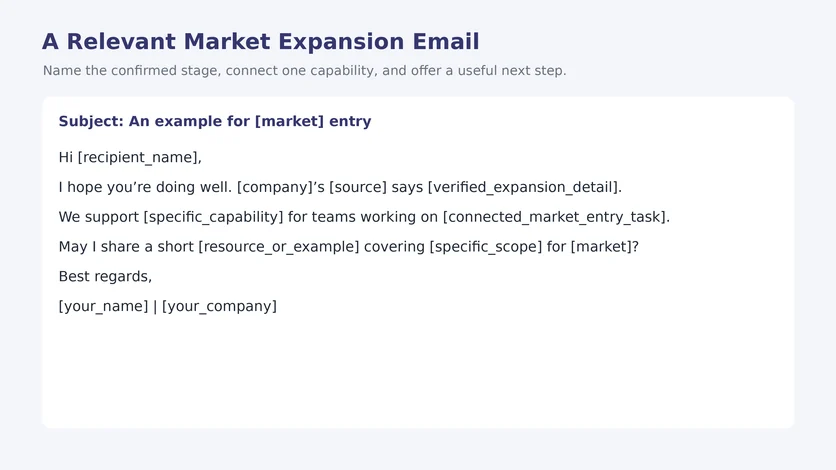
Use this version when a current company source identifies the market and your capability fits a specific part of the entry plan. Keep the request focused on a prepared example rather than a broad promise to “help you scale.”
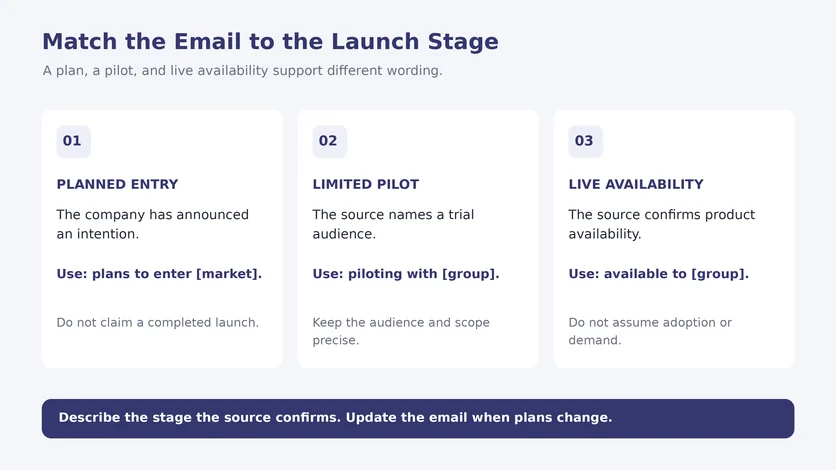
Write the expansion detail as a complete, supported statement: “the team plans to introduce [product] in [market]” or “[product] is now available to [named_customer_group].” Do not use the second version when the source only supports the first.
Confirm What Kind of Expansion Is Happening
New-market outreach can concern a country, region, industry, or customer segment. It can also concern one product rather than the entire company. Make that scope clear before choosing an email angle.
| Public Update | What It Supports | What It Does Not Establish |
|---|---|---|
| A plan to enter a named country or region | An announced geographic objective. | A completed launch, local customers, or a fixed deadline. |
| A product pilot or limited beta | Access for the stated pilot group under the described conditions. | General availability to every buyer in the market. |
| A general availability announcement | Availability for the product and audience named in the announcement. | Adoption, demand, or the need to replace an internal process. |
| A new office or regional job listing | The office purpose or responsibility explicitly described. | A new customer market, a local sales team, or an approved vendor budget. |
| A move into a named industry or customer segment | The segment and use case the company has identified. | A geographic launch or a need shared by every buyer in that segment. |
For a concrete historical example, Stripe’s October 2022 Thailand announcement distinguished general availability from the preceding beta phase. That distinction changes whether an email should say “testing with a limited group” or “available in the market.” The example illustrates source interpretation, not a current prospecting opportunity.
Preserve those differences in your notes. A localized page can support an observation about published content; it does not independently prove a launch date or a broader operating change.
Match Your Offer to the Company’s Market-Entry Stage
Choose the resource around what the team can use at its current stage. A market-entry checklist and a live customer onboarding example answer different questions, even when both relate to the same expansion.
| Confirmed Stage | Potentially Relevant Resource | Check Before Offering It |
|---|---|---|
| Announced or planning | A scoped planning worksheet or market-specific research sample. | Whether the company has named a concrete task your capability supports. |
| Preparing content or customer-facing materials | A localization review sample or terminology workflow. | The actual language, audience, assets, and reviewer qualifications. |
| Building a partner channel | A partner onboarding example or shared information checklist. | Whether the company has announced that channel and what your service covers. |
| Running a pilot | A pilot feedback or onboarding example. | The pilot audience and limits; avoid describing it as a full launch. |
| Live in the named market | A customer onboarding or operational handoff example. | The product’s availability and the function responsible for the workflow. |
These are possible connections to investigate, not a diagnosis of what the company lacks. Do not promise local expertise, distribution relationships, or language coverage you cannot provide.
Who Should Receive a Market Expansion Email?
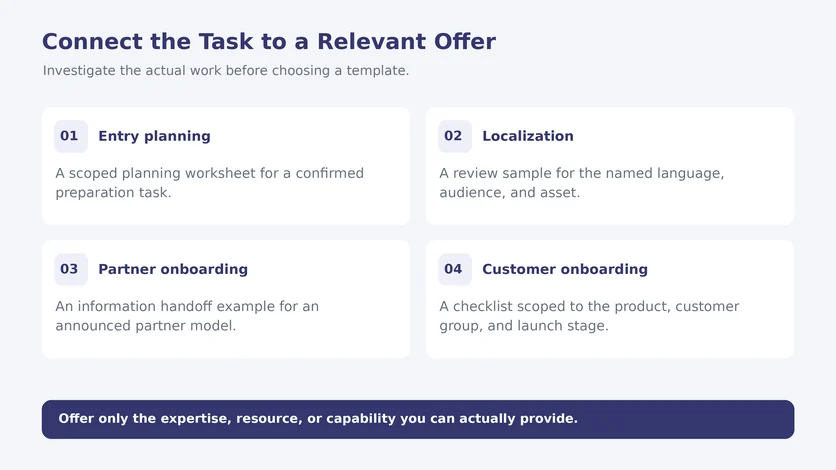
In B2B lead generation, the right starting contact is the person or function connected to the proposed work. Match the recipient to the task instead of emailing the founder simply because they announced the expansion.
- Market planning: A regional, strategy, or commercial role whose published responsibility connects to the entry plan.
- Localization: A localization, product marketing, or content function responsible for the specific assets.
- Partner onboarding: A partnerships, channel, or operations function connected to the announced partner model.
- Customer onboarding: An implementation, customer success, or operations role relevant to the product and audience.
Company structures vary. Verify current role information and use the ownership-check template when responsibility is unclear. Avoid sending identical messages to several people at the company just to discover who replies.
What Should You Say When a Company Enters a New Market?
These are alternative first emails. Choose one based on a supported task and the recipient’s role; do not send all five versions as a sequence.
1. When the Team Is Preparing Localized Materials
When to use it: A company source identifies a language rollout or work on specific customer-facing materials. Your team can support the language, audience, and content involved.
Adaptation note: Replace the review step with work you can demonstrate, such as terminology consistency. Do not claim the current copy is inaccurate or assume a recipient’s preferred language from their location.
2. When the Company Announces a Partner Channel
When to use it: The company has named a reseller, distributor, or other partner approach. Your offer supports a defined part of partner onboarding rather than implying access to a network you do not have.
Adaptation note: A direct-sales launch does not prove the company plans a distributor channel. Use this variation only when the channel is supported by the source.
3. When the Product Is Available to a New Customer Group
When to use it: A current availability announcement supports the product, market, and customer group. Your capability connects to a customer onboarding task rather than an assumed service problem.
Adaptation note: If the source describes a pilot, name the pilot audience instead. Do not claim that new customers are struggling, support demand has increased, or the company has no local experience.
4. When You Need to Confirm the Expansion Owner
When to use it: The expansion and offer fit, but the owner of the relevant task is not confirmed. Start with a plausible function and ask one clear routing question.
Adaptation note: A suggested contact is a possible route, not a confirmed introduction or evidence of buying interest. Describe any referral accurately if you contact someone else.
Subject Lines for Market Entry and Expansion Outreach
Make the subject describe the actual offer or question. A destination name can provide context, but it should not imply that the recipient requested your help.
| Subject Line | Appropriate Context |
|---|---|
| An example for [market] entry | A prepared example connected to an announced entry task. |
| [language] review for [specific_asset] | A supported localization plan and a genuine review capability. |
| Partner onboarding for [market] | An announced partner channel and a relevant onboarding example. |
| [product] onboarding in [market] | Confirmed product availability or a clearly named pilot. |
| Who handles [market_entry_task]? | A genuine ownership question for a plausible starting contact. |
Avoid unsupported urgency such as “before your launch next month” unless the company has published that deadline and it remains current. Do not use an invented local partnership or referral to make the subject appear familiar.
A Worked Example: Writing for a Pilot Instead of a Full Launch
Fictional illustration: AtlasFlow, ClearStart, the recipient Maya, and the sender Noor are invented. The example demonstrates an editorial decision; it is not a client story or a performance claim.
Assume AtlasFlow’s announcement describes a UK pilot of its scheduling product for independent clinics. Its current team page identifies Maya as leading customer onboarding. ClearStart supports reusable onboarding checklists, and Noor can supply a sample checklist for that workflow.
| Evidence | What Changes in the Email |
|---|---|
| The announcement names a UK pilot. | Say “UK pilot,” rather than “your UK-wide rollout.” |
| The audience is independent clinics. | Offer an example scoped to that audience. |
| Maya leads onboarding. | Use a relevant starting contact without claiming procurement authority. |
| The sender can provide a sample checklist. | Offer the checklist, without claiming it reflects AtlasFlow’s internal process. |
| Customer adoption and onboarding problems are unknown. | Remove claims about rapid growth, delays, or overwhelmed staff. |
The email names the confirmed stage and offers a defined resource. It does not imply that every UK clinic can already buy the product or that AtlasFlow needs to replace its existing onboarding process.
When Should You Send a Market Expansion Cold Email?
Send when the company’s current work gives your offer a clear purpose. There is no universal number of days after an expansion announcement that makes an email relevant.
- Before launch: Use wording about plans and offer something useful for a confirmed preparation task.
- During a pilot: Keep the offer within the pilot’s audience and scope.
- After launch: Check current availability and connect the offer to work the relevant team handles.
- After a change or delay: Update the research before continuing. Do not reuse a launch deadline that has passed or been withdrawn.
A current job listing can add context, but it does not independently establish a purchase timeline. If the offer only makes sense at another stage, wait for relevant evidence or choose another angle.
Two Follow-Ups That Keep the Market Context Useful
Follow up with a useful detail about the resource, rather than repeating the expansion announcement. Choose a reasonable gap for the audience and situation, and stop after a refusal or opt-out.
Follow-Up 1: Clarify the Resource
Follow-Up 2: Close the Sequence
Use “Re:” only in the actual thread. If the recipient corrects the market, launch stage, or ownership, respond to that information and update your notes before sending anything else.
Is Your Market Expansion Email Ready to Send?
Use this checklist to confirm that the opening, offer, and timing fit the same verified expansion. Resolve any missing detail before adding the message to a campaign.
- Market: Have you named the correct geography or customer segment?
- Stage: Does the wording distinguish a plan, pilot, and live availability?
- Scope: Are the product, audience, and relevant task supported by the source?
- Contact: Is the recipient connected to the work, or is the email clearly asking about ownership?
- Offer: Can you supply the exact resource, language coverage, or capability described?
- Campaign: Have you reviewed sender details, refusals, opt-outs, applicable campaign requirements, and your provider’s policies?
Record whether a response confirms the market, task, owner, or a useful next step. A routing reply or polite acknowledgment is different from a purchasing conversation. Check sending configuration separately from message relevance; no template guarantees replies or inbox placement.
Frequently Asked Questions
What Is a Market Expansion Cold Email?
It is an outreach email that connects a company’s verified entry into a new geography or customer segment to a relevant offer. A useful opening identifies the market and the actual stage of expansion, then explains a specific connection to the work involved.
How Do I Find Companies Expanding Into New Markets?
Start with company newsrooms, product availability announcements, regional updates, partner pages, and relevant job listings. Use third-party reports for discovery, then check the original source and its date before describing the expansion in an email.
Does a New Office Mean a Company Is Entering a New Customer Market?
Not necessarily. An office may support existing customers, internal operations, or hiring. Check what the company says the office will do before treating it as evidence of a new sales market or a need for your service.
When Should I Send an Email About Market Expansion?
Send when you have a relevant offer for the company’s current stage and a suitable contact. A planning resource may fit before launch, while an onboarding example may fit after availability is confirmed. There is no universal timing interval established by these templates.
Should I Write the Email in the Market’s Local Language?
Use the language appropriate to the recipient and their work, based on reliable context. A country name alone does not establish a person’s preferred language. Have market-specific copy reviewed by someone qualified for that language and audience.
Can I Use the Same Template for a New Industry Segment?
Yes, if you adapt the source detail, use case, and offered resource to the industry segment. Entering a new vertical is different from opening a country market. Do not import geographic assumptions, regulatory claims, or buyer expectations without evidence.
What If the Expansion Has Only Been Announced?
Describe it as a plan. Do not claim the product is already available, the company has local customers, or a launch deadline is fixed. If the planned initiative is too broad to support your offer, research further or choose another angle.
What Should I Do If the Recipient Says the Expansion Is Delayed?
Update the account record and stop the active sequence. Respond to the information they share rather than repeating the old pitch. If they invite a later follow-up, record that context; do not treat a delay as permission to keep contacting them.
Check Your Sending Setup Before Outreach
Build the email around a verified market-entry task, then review your domain’s email configuration alongside contact fit, message quality, and sending practices.