
TL;DR
- A cold email to a newly funded company should connect a verified announced priority to a specific, supported offer.
- Check the announcement date, transaction context, stated plans, and relevant contact before drafting.
- Use five first-email templates for an announced initiative, hiring, market expansion, product development, or uncertain ownership.
- A funding stage or amount does not establish a vendor budget, a broken process, or a buying deadline.
- Choose timing from current evidence rather than a universal post-funding sending window.
- Follow up with useful context, respect refusals and opt-outs, and review delivery separately from interest.
Cold email templates for newly funded companies help you turn a public investment announcement into a relevant introduction. A useful message names a specific plan the company has shared, explains how your offer connects, and asks whether a small next step would help.
The announcement gives you something to investigate. It does not tell you that the company needs your product. This guide includes five templates, a worked example, subject lines, and follow-ups to help you write without making that assumption.
Table of Contents
The Cold Email Template for Newly Funded Companies
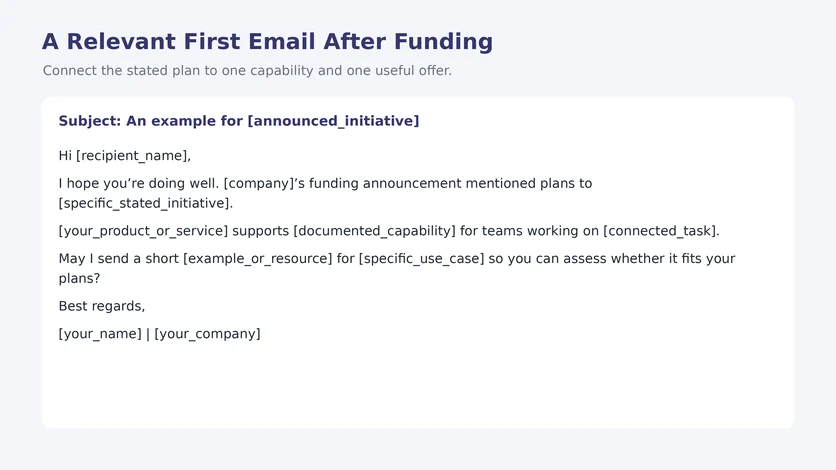
Use this version when the company’s announcement names an initiative your product or service can support. Keep the initiative more prominent than the amount raised.
Replace every placeholder with verified information. Prepare the resource before offering it. If the announcement only says “accelerate growth,” find a more specific source before turning that phrase into a pitch.
What Does a Funding Announcement Actually Tell You?
A funding announcement can establish that a company has publicly described an investment event and, sometimes, an intended use of proceeds. It does not establish your category’s budget, purchasing authority, or a problem your product can solve.
Read the transaction context as well as the headline. For example, Stripe’s March 2023 funding announcement specified employee liquidity and equity-related withholding tax obligations. This historical example shows why a large funding headline should not be treated as evidence of a general software purchasing plan.
| Public Detail | What It Can Support | What You Still Need to Check |
|---|---|---|
| The company names a market it plans to enter. | A question or resource tied to that stated market. | Whether the relevant activity is underway and which function owns it. |
| The announcement mentions hiring in a named function. | Research into the announced hiring plan. | Current vacancies, responsibilities, and whether your offer supports that work. |
| The company identifies a product initiative. | A connection to the specific development work described. | Technical fit, scope, ownership, and whether outside support is relevant. |
| The headline gives a round amount or stage. | Accurate background context if needed. | Spending allocation, current priorities, procurement process, and timing. |
| An investor or database lists a transaction. | A starting point for source verification. | The company identity, original announcement, dates, and transaction context. |
Do not confuse round size, cumulative funding, and valuation. If an amount is unnecessary to explain your offer, leave it out rather than add a detail that creates another verification task.
What Should You Verify Before Contacting a Funded Company?
Keep a short evidence note for each account. It should make the proposed email easy for another person to review without repeating the whole research process.
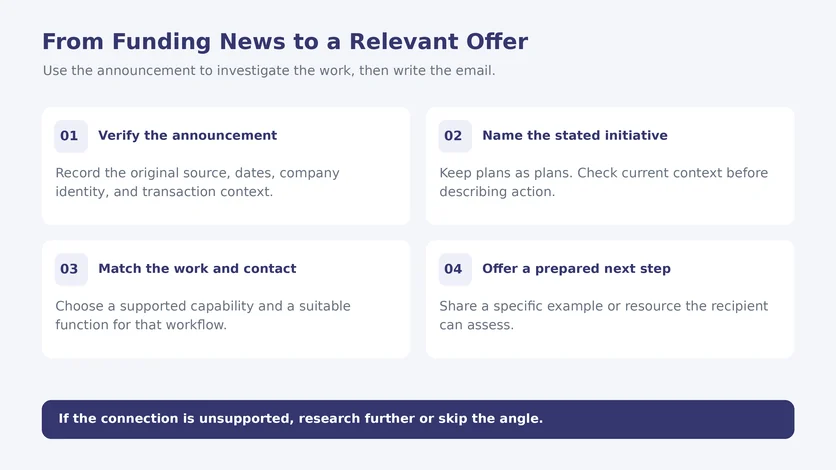
- Confirm the company. Match the business name, website, and announcement so that similarly named businesses are not mixed together.
- Record the source and dates. Save the original URL, publication date, and date checked. Treat the announcement date and transaction closing date separately when the source does.
- Extract one stated initiative. Record the actual plan, preserving uncertainty such as “plans to” or “intends to.”
- Look for current context. Check a relevant product page, careers listing, or operational update where it helps establish the connection. Do not turn a plan into a completed action.
- Identify a suitable contact. Use current role information connected to the work. A job title alone does not confirm final buying authority.
- Check your offer. Name a capability you can support and a resource you can actually provide. Do not add invented customer outcomes or partnerships.
If the sources conflict, hold the message for review. If the funding event is the only connection between the company and your product, choose another angle or skip the account.
When Should You Email a Newly Funded Company?
Use current evidence of a relevant initiative to choose timing. There is no single post-funding interval established here as best for every audience or offer. Sending quickly does not fix a weak connection, and waiting a set number of weeks does not prove purchasing readiness.
| Situation | Recommended Editorial Decision |
|---|---|
| A current announcement names a relevant initiative and you can identify a suitable contact. | Prepare a specific offer and complete the normal campaign review. |
| The announcement is public, but the only detail is a broad ambition to grow. | Research further before drafting a funding-specific pitch. |
| An older announcement is followed by a current, relevant operational update. | Lead with the current update; do not describe the old funding as recent. |
| You cannot verify the event, initiative, or company identity. | Hold the draft until the evidence is resolved. |
| The recipient has declined or opted out. | Stop the sequence and follow your suppression process. |
If you test different intervals, treat them as campaign hypotheses. Compare similar audiences and offers, and record meaningful replies rather than treating any response as buying interest.
Who Should Receive Your Funding-Based Cold Email?
Relevant B2B lead generation starts with the function connected to the announced work. A funding announcement may quote the founder, but the quoted person is not automatically the right contact for every vendor.
| Announced Work | Possible Starting Function | Avoid Assuming |
|---|---|---|
| Hiring and employee onboarding | People, recruiting, or operations, depending on the workflow. | A recruiting contact also owns employee onboarding software. |
| Entering a named market | The relevant regional, commercial, or operational team. | The company has committed to your proposed entry method. |
| A product development initiative | A product or engineering role connected to that initiative. | The team wants outsourced development or replacement tools. |
| A named commercial initiative | Sales, marketing, or revenue operations, as supported by role information. | New funding means the team has approved more outbound volume. |
Use the ownership-check template below when there is a plausible business connection but responsibility remains unclear. Do not send the same pitch to multiple people at the account simply because you cannot identify the owner.
Four More Cold Email Templates for Post-Funding Outreach
Choose the version supported by the company’s stated plans and current evidence. These are alternative first messages, not five touches to send to the same recipient.
1. When the Company Announces Hiring Plans
When to use it: The announcement names the relevant function, and a current company source supports the hiring context. The example below offers a useful onboarding resource rather than claiming the team is overwhelmed.
Research check: Verify that the roles are current. If onboarding is outside the recipient’s remit, find the appropriate function instead of treating recruitment and onboarding as the same responsibility.
2. When the Company Names a New Market
When to use it: The company explicitly identifies a geography or customer market, and your offer has a concrete connection to the work involved.
Research check: An intention to expand does not establish a launch date, local office, hiring plan, or internal difficulty. Reference only what the company has stated.
3. When Funding Supports a Product Initiative
When to use it: A company source identifies a specific product development priority, and you can explain a relevant capability without inventing its technical requirements.
Research check: Do not infer the technology stack, a delayed roadmap, or a need for outside developers from a funding announcement.
4. When the Relevant Owner Is Unclear
When to use it: The initiative is relevant and verified, but you have not confirmed who owns the connected workflow. Choose a plausible starting contact rather than claiming responsibility as a fact.
Research check: A referral identifies a possible route. It does not establish interest, permission to claim an introduction, or confirmation that a purchase is planned.
Subject Lines That Focus on the Announced Work
Use the subject to describe the email’s actual topic. The funding round can stay in the opening when the initiative gives the recipient a more useful subject.
| Subject Line | Use It When |
|---|---|
| An example for [announced_initiative] | You offer a prepared example connected to an explicit plan. |
| [team_name] onboarding example | Current hiring context supports an onboarding resource. |
| A resource for [named_market] | Your resource has a clear, accurate market-specific scope. |
| [specific_workflow] at [company] | The email concerns that workflow, rather than funding in general. |
| Who handles [specific_workflow]? | The first question genuinely concerns ownership. |
Avoid subjects that imply an existing relationship, investor recommendation, or requested meeting unless that context is true. Do not manufacture urgency around the announcement.
A Worked Example: From a Funding Announcement to an Email
Fictional illustration: HarborDesk, the recipient Aisha, and the sender’s product StartPath are invented for this example. This is not a customer story or evidence of campaign results.
Assume HarborDesk’s public announcement says it plans to build its customer success team. Its current careers page lists two customer success roles. StartPath supports reusable employee onboarding checklists. A current role page identifies Aisha as leading people operations.
| Evidence Note | Drafting Decision |
|---|---|
| The announcement describes a plan to grow customer success. | Keep “plans to grow” rather than claiming the team has already doubled. |
| Two relevant roles appear on the current careers page. | Mention the listed roles without predicting when they will be filled. |
| Aisha leads people operations. | Treat this as a plausible starting point, not confirmed budget ownership. |
| The sender can supply a sample onboarding checklist. | Offer that specific resource rather than an undefined growth audit. |
| The company’s current onboarding process is unknown. | Remove “your onboarding must be struggling to keep up.” |
The offer is specific to the announced work. It leaves current software, hiring dates, purchasing plans, and internal problems unresolved.
Two Follow-Ups After a Funding-Based Introduction
Follow up only while the original context remains relevant and the recipient has not declined or opted out. Choose a reasonable gap for the audience and situation; this example does not prescribe a universal schedule.
Follow-Up 1: Explain What the Resource Covers
Follow-Up 2: Close the Sequence Respectfully
Use “Re:” only when replying within the actual thread. Do not write as though the recipient saw the earlier email or owes a response. If they explain that the initiative has changed, update your account notes rather than continuing with the old assumption.
Is Your Funding-Based Cold Email Ready to Send?
Use this checklist to confirm that your message connects verified company plans to a relevant offer and a clear next step. If an answer is unclear, resolve it before adding the email to your campaign.
- Evidence: Can you point to the source for each company-specific statement?
- Relevance: Does the stated initiative explain this particular offer?
- Identity: Are the sender and company clearly and accurately identified?
- Scope: Can you supply exactly the resource or example you offered?
- Respect: Have you checked refusals, opt-outs, campaign requirements, and your sending provider’s policies?
- Delivery: Has the sending setup been reviewed separately from the copy?
When evaluating the campaign, distinguish a request for the resource, a relevant discussion, a routing reply, and an explicit purchasing conversation. A funding announcement is context; the recipient’s response provides evidence about fit and interest. No template guarantees replies or inbox placement.
Frequently Asked Questions
What Is a Funding Announcement Cold Email?
It is a first outreach message that uses a public funding announcement as context for a relevant business offer. The connection should come from a stated initiative or verified activity, rather than an assumption that the recipient now has money to spend.
How Do I Find Newly Funded Companies to Contact?
Use company newsrooms, company or investor announcements, and reputable funding databases to discover accounts. Verify important details against the original source, then check company fit, the relevant initiative, and the appropriate contact before adding an account to a campaign.
When Should I Email a Company After It Raises Funding?
Choose timing based on a current, supported business reason and an appropriate contact. An announcement date alone does not establish purchasing readiness. A relevant operational update can support outreach later; an unrelated offer does not become useful because you send it immediately.
Should I Mention the Funding Amount in the Email?
Only if it adds necessary context and you have verified what the number describes. Round size, total funding, and valuation are different figures. Usually the announced initiative provides a clearer opening than repeating the amount.
Should I Congratulate the Founder on Funding?
A brief, sincere congratulation is optional. It should not replace a relevant reason for writing. If the offer concerns a specific function, contact a suitable person in that function instead of assuming the founder is the right buyer.
Do Seed and Series A Companies Need Different Emails?
Adapt the email to the company’s verified plans and the recipient’s responsibilities. Funding stage can be background context, but it does not reliably establish team size, tooling, budget ownership, or a purchasing deadline.
What If the Funding Announcement Does Not Explain How the Money Will Be Used?
Look for a separate, current source describing a relevant initiative. If you cannot establish a connection, use another supported outreach angle or skip the funding-based message. Do not invent spending plans to complete a template.
Can These Templates Guarantee Replies From Funded Startups?
No. These are editable examples, not tested performance claims. Relevance, contact suitability, the offer, sending practices, and recipient preferences all influence what happens. Treat a refusal or opt-out as a reason to stop.
Check Your Sending Setup Before Outreach
Give your email a clear reason to exist, then review your domain’s email configuration alongside contact fit, message quality, and sending practices.